
No products in the cart.

Jinlong
DTF Printer A3 vs A4 vs A2 Guide for Best Business Size
Choosing the right DTF printer size can make or break your custom apparel business. Whether you’re debating between A3 vs. A4 vs. A2, this decision directly impacts your production speed, print quality, and overall profitability. If you’re a startup, hobbyist, or scaling print shop owner, you already know that the wrong machine wastes time and budget. This guide cuts through the hype and technical specs to help you pick the DTF printer size that fits your workflow, space, and ROI goals—brought to you by the experts at Jinlong DTF. Let’s get straight to what matters.
The Contenders: Defining the Sizes
A4 DTF Printers (The Entry Level) – Dimensions, Format, Best For, The Reality Check
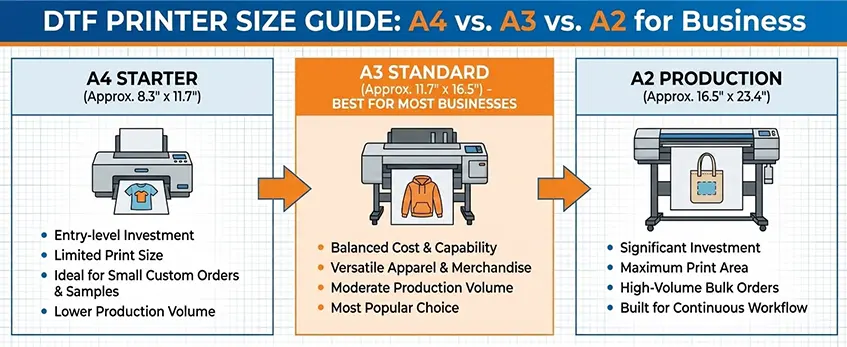
A4 DTF printers are often the starting point for many businesses and hobbyists entering the direct to film (DTF) printing market. Measuring roughly 8.3 x 11.7 inches, these desktop DTF printers fit easily on standard workstations, making them ideal for limited spaces. They handle sheet-fed printing formats, usually suited for small prints like custom patches, logos, or single small garments.
Best for:
- Hobbyists or testers experimenting with DTF technology.
- Small business owners focusing on low-volume custom apparel printing.
- Users with limited workspace and tighter budgets looking for entry-level commercial heat transfer printer options.
However, the reality check is crucial: A4 DTF printers are limited in print size and output speed. They struggle with large-format prints or batch jobs, which affects turnaround times and overall ROI. The smaller format means more frequent loading and manual intervention, making these printers less efficient for scaling businesses.
Key specs at a glance:
- Print area: 8.3\” x 11.7\”
- Format: Sheet-fed only
- Ideal for: Sample prints, prototype runs, small accessories
Choosing an A4 DTF printer means balancing affordability with limited production capacity. If you’re testing the waters in direct to film printing or working on custom apparel business equipment for niche products, this size can deliver quality output without overwhelming your setup or budget. But if growth and speed are priorities, other sizes might be more suitable.
The Contenders: Defining the Sizes – A3 & A3+ DTF Printers (The \”Sweet Spot\”)
A3 and A3+ DTF printers hit that perfect middle ground for many businesses. A3 printers typically handle print sizes around 11.7 x 16.5 inches, while A3+ models stretch a bit wider, giving you extra space for bigger designs or multiple small prints on one sheet. This size is ideal for printing full-front t-shirt designs, small gang sheets, and custom artwork that doesn’t require the bulk of larger formats.
Why are A3 and A3+ considered the \”sweet spot\”? They strike a balance between print area and cost efficiency, making them popular among startups and growing boutiques. Compared to A4 printers, they increase your print size capability without jumping into the higher investment and space demands of A2 setups. Plus, when paired with a DTF roll feeder, these printers help boost production speed and reduce waste by allowing roll-to-roll printing, which saves time on loading individual sheets.
If you’re looking for a versatile printer that can handle a variety of print jobs—from direct to film custom apparel business equipment to smaller batch jobs—A3 and A3+ models offer the flexibility and performance most users need. They often come equipped with advanced features like white ink circulation systems to ensure crisp whites, and work seamlessly with RIP software for DTF to optimize print quality and ink usage.
For anyone scaling beyond entry-level but not ready for industrial scale, the A3 range is a smart choice, perfectly bridging hobbyist use and full production. To learn more about how different ink types perform here, check out this detailed guide on DTF printer ink vs DTG ink.
The Contenders: Defining the Sizes – A2 / 45cm DTF Printers (The Industrial Step-Up)
A2 or 45cm DTF printers represent a clear step up for those ready to move beyond entry-level or mid-size printing. With a print width of roughly 17.7 inches (450mm), these printers can handle larger designs and gang sheet printing more efficiently. This makes them ideal for print shops scaling up their production or businesses that need higher daily volumes without switching to full industrial setups.
Dimensions & Format:
A2 DTF printers typically handle media sizes around 23\” by 17\” or larger, supporting roll-fed printing that boosts workflow speed. Many come with dual-head configurations, meaning faster output and more consistent print quality for bulk jobs.
Best For:
- Scaling print shops doing high daily volume printing
- Businesses focusing on gang sheet printing for multiple prints in one run
- Print services requiring more workspace but still a manageable footprint
- Companies using commercial heat transfer printers to fulfill larger orders quickly
They are less portable and need more space than A3 or A4 machines but strike a good balance between speed, print area, and overall investment. If your goal is to grow fast while maintaining quality and efficiency, the A2 size is an excellent industrial step-up choice.
For many, the choice of an A2 printer also comes with advanced features like a white ink circulation system and integrated powder shaker ovens, which improve white ink reliability and streamline post-print processing.
If you’re interested in how these printers compare to smaller formats or want a deeper dive into the technology behind DTF printing, consider exploring detailed insights on DTF printer meaning and how it works.
Head-to-Head Comparison: Production Speed & Efficiency
When choosing between A4, A3, and A2 DTF printers, production speed and workflow efficiency are big factors that affect your ROI.
| Printer Size | Printhead Type | Printing Speed | Key Efficiency Perk |
|---|---|---|---|
| A4 | Single-head | Slower (entry-level) | Best for low volume runs |
| A3 / A3+ | Single or dual-head | Medium to fast | Balanced for batch jobs |
| A2 / 45cm | Dual-head or multi-head | Fastest (industrial) | Roll-fed with powder shaker |
Single-Head vs Dual-Head Speeds
A4 printers mostly come with single printheads, making them ideal for hobbyists or test prints but slow for production. A3 and A3+ models often offer dual-head options that double the print speed without compromising print quality — a sweet spot for small businesses and boutiques.
Industrial-level A2 printers typically feature dual or multi-head setups, providing much faster throughput. This speed leap suits high-volume print shops where time is money.
Roll-fed Advantage
Roll-fed printers, common in A2 machines, are a game changer. Unlike sheet-fed A4 or A3 printers, roll-fed setups allow continuous printing without constant media loading. This increases productivity, especially when paired with systems like a DTF powder shaker oven, cutting down manual labor and downtime.
In contrast, sheet-fed printers are more hands-on, which works well for custom or one-off jobs but limits batch efficiency.
Optimizing your setup for production speed depends on your volume and project type. For more on maximizing print quality and materials, check out the DTF transfer film 60cm Double Pro Series for roll-fed applications.
Head-to-Head Comparison: Cost Analysis – Investment and Consumables
When choosing between A4, A3, and A2 DTF printers, upfront investment and ongoing consumables costs are major factors that shape your return on investment (ROI).
| Printer Size | Approx. Upfront Cost | Consumables Cost | Notes |
|---|---|---|---|
| A4 | $1,200 – $2,000 | Lower | Entry-level, best for low volume and testing. Ink and PET transfer film usage are minimal. |
| A3 / A3+ | $3,500 – $5,000 | Moderate | Balanced for frequent prints with reasonable consumable costs. Compatible with popular textile pigment ink and PET film. |
| A2 (45cm) | $7,000 – $10,000+ | Higher | Industrial-level spend, but lower cost per print when doing gang sheet printing or roll-fed runs. |
Key Takeaways:
Upfront Investment: A4 DTF printers are the most budget-friendly to start, great for hobbyists or small businesses testing the market. A3 models represent the sweet spot balancing cost and capacity. A2 printers require a significant initial outlay but pay off for high-volume commercial heat transfer printing.
Consumables Costs: Larger printers use more printable area and consumables like PET transfer film, DTF powder, and white ink. Roll-fed A2 printers improve efficiency by reducing waste compared to sheet-fed setups common with A4 and A3.
Investing in a quality white ink circulation system minimizes ink waste, a key cost factor across all sizes. Check the hidden expenses of DTF printing to avoid surprises.
Overall, balance your budget with expected print volume and workflow needs. A3 printers often deliver the best cost-performance ratio for startups and growing shops, while A2 suits scaling businesses ready for gang sheet printing.
Maintenance & Durability: Modified Printer vs Purpose-Built, White Ink Circulation
When comparing DTF printer A3 vs A4 vs A2 in terms of maintenance and durability, the design matters a lot. Many entry-level or small-format printers are modified models originally built for other printing types. These often require extra tweaks for DTF, which can lead to more frequent maintenance.
Key Differences:
| Aspect | Modified Printers (Often A4, entry-level) | Purpose-Built Printers (A3, A2, industrial) |
|---|---|---|
| Build Quality | Basic frame, parts repurposed | Robust design meant for DTF workflows |
| White Ink System | Basic or aftermarket white ink circulation | Advanced white ink circulation prevents clogging |
| Maintenance Needs | More frequent cleaning and manual intervention | Automated cleaning cycles, less manual upkeep |
| Durability | Shorter lifespan under heavy use | Built for continuous production, ideal for high volume |
| Downtime | Higher risk due to clogging and wear | Lower downtime, optimized for reliability |
Why White Ink Circulation Matters
White ink is notorious for clogging printheads and causing downtime. Purpose-built DTF printers come with dedicated white ink circulation systems that keep the ink moving constantly to prevent sediment buildup. Modified printers usually lack this feature or rely on manual flushing, which increases maintenance time and cost.
For serious print shops, investing in printers with proper white ink management is key to maximizing ROI and maintaining consistent quality. This is especially true in higher-end models like A3+ and A2 that handle bigger print jobs and more frequent runs.
If you want to dive deeper into white ink circulation and how it affects performance, exploring options like Jinlong\’s built-for-purpose printers and their white ink circulation system can make a big difference.
Choosing a printer with a solid maintenance profile means less downtime, smoother production, and better long-term returns—key factors whether you pick A4, A3, or A2 DTF printers.
Head-to-Head Comparison: Space Requirements – Desktop Footprint vs Stand-Alone Unit with Powder Shaker
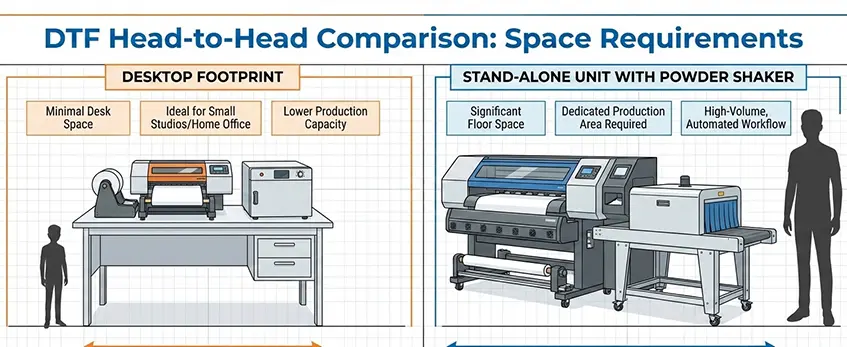
When it comes to space, size matters—especially in small businesses or tight studio setups. Here’s how A4, A3, and A2 DTF printers stack up:
| Printer Size | Space Needed | Typical Setup | Notes |
|---|---|---|---|
| A4 | Small desktop footprint | Compact, fits easily on desks | Ideal for hobbyists or small workstations |
| A3 / A3+ | Medium desktop or small stand | Slightly bigger, still manageable in limited space | Balances size with higher production needs |
| A2 / 45cm | Large standalone unit | Often requires dedicated space with powder shaker oven | Industrial setup demands room, more investment |
Desktop DTF printers like A4 and A3 models are perfect when you need a compact setup that fits your workspace without hassle. They’re plug-and-play and usually don’t require extra devices beyond your printer and a small curing station.
A2 printers, however, generally come as stand-alone units combined with a powder shaker and sometimes an oven. These are bulkier and designed for higher volume shops that have the floor space and budget to support a dedicated production area.
If space is tight, A4 or A3 printers offer great options without compromising quality or efficiency. For bigger operations ready to step up production, the trade-off is having more room for workflow improvements and faster output.
Explore our DTF powder safety guide for tips on setting up your powder shaker area safely, no matter the size.
Choosing the right printer size will save you time, money, and headaches — especially for your workspace layout.
Decision Framework: Which One Fits You? Scenario A: The Hobbyist / Tester
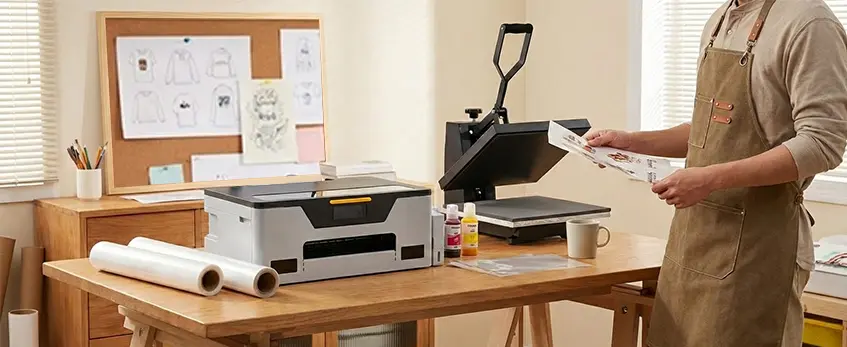
If you’re just starting out or testing the waters with direct-to-film printing, an A4 DTF printer is often the best fit. It’s compact, affordable, and perfect for lower print volumes, making it ideal for hobbyists or those who want to experiment without a big upfront investment.
Why Choose A4 for Hobbyists?
- Print Volume: Great for small batches, prototypes, and sample prints.
- Space: Fits easily on a desktop or small workbench, no need for a dedicated room.
- Budget: Lower initial cost and cheaper consumables compared to larger models.
While it’s tempting to jump to bigger sizes, an A4 printer lets you learn the ropes without overwhelming your workspace or budget. If you’re focused on smaller items like custom patches, small apparel pieces, or novelty items, this size maximizes your cost efficiency.
For those just getting into custom apparel business equipment, starting with an A4 desktop DTF printer means fewer complications, and you can scale up once you understand the process and demand. Make sure you also consider the compatibility of accessories like PET transfer film and the right RIP software for DTF to streamline your workflow from day one.
For a detailed guide on workflow, including how to manage your prints efficiently, check out Jinlong’s DTF printer with powder shaker workflow from printing to curing.
Starting small doesn’t mean you sacrifice quality—A4 printers can deliver excellent print resolution DPI, especially with reliable printheads like the XP600, which is common in entry-level machines. This balance of size, quality, and cost makes the A4 DTF printer a solid starter choice before investing in larger, more industrial units.
Decision Framework: Which One Fits You?..Scenario B: The Startup / Boutique
For startups and boutique businesses, finding the right DTF printer means balancing quality, speed, and budget. These businesses usually want full-front prints and consistent automation to keep up with growing orders without overspending.
Why Choose A3 or A3+ DTF Printers?
- Full-front prints fit perfectly on A3 sizes, offering enough space for detailed designs.
- The automation features in many A3+ models speed up production, making them ideal for small batch runs or limited editions.
- A3+ DTF printers, like those from Jinlong, deliver a sweet spot of quality print resolution and efficiency, supporting the demands of a design-focused boutique.
Speed vs Budget
- Dual-head A3+ printers boost throughput, helping boutiques minimize turnaround times while staying within a practical investment range.
- Compared to A2 units, A3 systems require less upfront capital without sacrificing much on print quality or durability.
Why Jinlong DTF?
- Jinlong\’s startup-friendly machines combine reliable white ink circulation systems with advanced RIP software for DTF, ensuring smooth prints and less maintenance downtime.
- Their printers also support both roll-fed and sheet-fed options, giving you flexibility depending on your workflow.
Considering these points helps boutiques scale carefully, securing quality without the risks of overspending. If you\’re launching a custom apparel business, starting with a Jinlong A3 or A3+ system sets a solid foundation for growth.
For details on managing white ink issues or optimizing your prints, you can explore Jinlong’s guide on white ink circulation systems in 2026 DTF printers.
Decision Framework: Which One Fits You? Scenario C: The Scaling Print Shop – Gang Sheets, High Daily Volume Printing
If your print shop is scaling up and handling high daily volumes, an A2 or 45cm DTF printer is often the best fit. These larger-format machines excel at gang sheet printing, allowing you to print multiple designs or several copies in one go. This boosts throughput and cuts down turnaround times—a must for busy shops fulfilling bulk orders.
Key benefits for scaling businesses include:
- Larger print area: Accommodate bigger designs and multiple prints on the same sheet or roll.
- Roll-fed advantage: Supports continuous printing, reducing setup time and material waste.
- Dual-head speeds: Many industrial models come with dual printheads, doubling output compared to entry-level printers.
- Durability: Purpose-built for long runs with features like white ink circulation systems, minimizing maintenance hassles.
While the upfront investment is higher than A3 or A4 printers, the return-on-investment comes fast when you factor in production speed and efficiency gains. Plus, you’ll save on consumables with more efficient printing layouts and lower per-print costs.
For a print shop ready to upgrade to serious volume, the industrial step-up of an A2 DTF printer offers the right blend of power, space, and performance.
Consider pairing your printer with quality DTF transfer films like the 50cm Double Pro Series to maximize output and maintain consistent print quality.
This setup lets you meet client deadlines while scaling profitably with every print run.
Why Choose Jinlong DTF? Beyond the Size – Hardware Quality Importance
When it comes to DTF printers, size isn’t everything. The hardware quality behind the machine plays a major role in print results, uptime, and overall satisfaction. Jinlong understands that no matter if you choose an A3, A4, or A2 printer, robust hardware makes the real difference.
Key Hardware Benefits with Jinlong DTF:
| Feature | Why It Matters |
|---|---|
| Durable Printheads | Uses proven XP600 & i3200 printheads for high-resolution DPI and reliable output. |
| Solid Build Quality | Sturdy frames reduce vibration for consistent print precision and longer machine life. |
| White Ink Circulation | Prevents clogging and ensures smooth white ink flow, crucial for bright, clean transfers. |
| Reliable Roll Feed System | Supports continuous production with less manual intervention—a must for commercial heat transfer printers. |
Good hardware means fewer headaches—less downtime, clearer prints, and better ROI. It also reduces the risk of print defects like fading and cracking, which are common issues in lower-quality DTF setups. For detailed advice on avoiding these issues, check out our guide on preventing cracking and fading in DTF transfers.
Investing in Jinlong isn’t just about picking a size—it’s about getting a machine built to withstand real-world printing demands with high-quality components designed from the ground up for DTF printing efficiency. That means the best results, day after day, regardless of your print volume or business size.
Why Choose Jinlong DTF?..Our Technology – Printheads, White Ink Management, RIP Software
Jinlong DTF printers combine top-tier technology designed to boost your printing quality and efficiency. Here’s why our technology stands out:
| Feature | Jinlong Advantage | Benefit for You |
|---|---|---|
| Printheads | Uses high-precision XP600 & i3200 printheads | Sharp, consistent print resolution (DPI) and reliable output |
| White Ink Management | Advanced white ink circulation system | Prevents clogging, maintains smooth white layers on PET transfer film, and reduces downtime |
| RIP Software | Dedicated RIP software for DTF | Streamlined color management, layout control, and better use of DTF powder for clean prints |
Our printheads ensure detailed images, especially for small text and complex designs, common in custom apparel business equipment. The white ink circulation system keeps white layers consistent and vibrant—a must for commercial heat transfer printing where durability and brightness matter.
Jinlong’s RIP software is tailored for DTF workflows, simplifying gang sheet printing and helping you manage print jobs efficiently whether you’re running single sheet or roll-fed printing setups.
For more insight on cost and production efficiency, check out our detailed breakdown of cheap DTF printer cost. This helps understand how our technology aligns with minimizing your operating expenses.
With Jinlong’s technology, you get reliable print quality, reduced maintenance hassles, and software that fits your workflow—perfect for anyone serious about scaling DTF printing.
Why Choose Jinlong DTF?..Support – After-sales and workflow help
Choosing the right DTF printer is only half the battle. Jinlong stands out with solid after-sales support and workflow assistance that help you get the most from your investment. Whether you\’re just starting or scaling up, having expert help on call can save you time and reduce costly downtime.
Key Support Benefits:
| Support Feature | What You Get |
|---|---|
| Technical Assistance | Quick troubleshooting for printer or RIP software issues, including printhead and white ink circulation fixes. |
| Workflow Optimization | Guidance on using Jinlong’s RIP software for DTF, film and ink setup, plus advice on powder shaker oven use. |
| Consumables Advice | Recommendations for the best PET transfer film and DTF powder to maximize print quality and reduce costs. |
| Training & Resources | Access to tutorials, materials, and direct support to streamline your production process. |
This comprehensive support ensures your Jinlong DTF printer performs at its best, boosting efficiency and ROI. For apparel businesses relying on smooth operations, this level of care is a game changer—especially when using advanced tech like dual-head printers or managing garment heat-transfer workflows.
If you want to learn about proper settings and maintenance to keep your printer running smoothly, check out our detailed printing guide with film and ink tips. This helps you avoid common issues and get consistent results.
In short, Jinlong’s after-sales service is designed to keep your DTF setup—and business—running without a hitch.


 English
 Español
 Deutsch
 Français