



Hot Peel DTF Film Roll Settings Temperature Pressure and Timing Guide
Understanding Hot Peel DTF Films
Are you wondering what hot peel DTF films are and how they differ from other types? Let’s break it down.
Qu'est-ce que le film DTF Hot Peel ?
Hot peel DTF (Direct-to-Film) film rolls are designed to release the transfer immediately or quickly while still hot or warm after pressing. This means you peel the film off right after heat pressing without waiting for it to cool completely.
Hot Peel vs Cold Peel and Instant Peel
| Fonctionnalité | Peeling à chaud | Peeling à froid | Peeling instantané |
|---|---|---|---|
| Temps de peeling | Immediately after heat press | After cooling | Immediately, often with a timer |
| Vitesse | Fast, great for production lines | Slower, suited for detailed work | Fast, with pressure-sensitive adhesives |
| Compatibilité des tissus | Most fabrics, especially cotton | Delicate or heat-sensitive fabrics | Varies depending on adhesive type |
When to Choose Hot Peel Film Rolls
Hot peel DTF is perfect if you:
- Exécuter speed-focused shops needing fast turnaround.
- Work with cotton, cotton blends, and many common fabrics.
- Want a consistent, smooth peel without waiting time.
Jinlong DTF Hot Peel Film Roll Features
Jinlong’s hot peel DTF film rolls stand out with:
- A durable PET base layer for clean, wrinkle-free prints.
- Compatibility with premium adhesive powders that ensure excellent adhesion and vibrant colors.
- Reliable peel performance for fast, high-quality transfers.
Using Jinlong DTF hot peel film can streamline your workflow without sacrificing quality, especially if you focus on quick production runs and a variety of fabric types.
This overview sets you up to get the best hot peel DTF transfer settings for your heat press, ensuring consistent, quality prints. Next, we’ll cover how to set up your heat press properly before you start.
Essential Heat Press Setup Before Starting

Getting your heat press ready is key for perfect hot peel DTF film roll transfers. First, calibrate your heat press to ensure temperature accuracy—uneven heat can ruin the transfer. Check for consistent platen heat and confirm the pressure consistency across the whole surface. This avoids any weak spots in your print.
Before pressing, always pre-press garments for 3–5 seconds to remove moisture and wrinkles. A smooth, dry surface helps the adhesive powder bond better and prevents bubbling or fading.
Make sure you have these tools on hand:
- Teflon sheet to protect both your press and the print
- Heat-resistant tape to keep transfers perfectly aligned
- A reliable timer to track pressing and peeling times precisely
Safety matters, too. Work in a well-ventilated area, keep your workspace clear of clutter, and use heat-resistant gloves if needed to avoid burns or accidents.
Proper setup saves time and ensures strong transfers with your Jinlong hot peel DTF film rolls. For more on choosing the right film type, check out the detailed guide on hot peel vs cold peel DTF film rolls.
Recommended Hot Peel DTF Heat Press Settings
For the best results with Jinlong DTF hot peel film rolls, using the right heat press settings is crucial. Here’s a straightforward guide to the standard universal settings that work well across most projects.
Temperature Range:
Réglez votre presse à chaud entre 320°F and 330°F (160°C – 165°C). This range ensures the adhesive activates properly without scorching the film or garment.
Le temps :
Appuyer sur 12 à 15 secondes on the first pass. This timing gives a solid transfer while preserving color vibrancy and details.
Pression :
Utilisation pression moyennement ferme, roughly 40 to 50 PSI (about 3 to 4 bar). This amount helps the film bond securely with the fabric without damaging delicate fibers.
Step-by-Step Pressing Process
Alignment:
Carefully position the DTF print on your garment, using heat-resistant tape if needed to avoid shifting.
First Press:
Place a Teflon sheet over the film to protect both the heat platen and transfer. Apply the pressure, temperature, and time settings above.
Peel Technique:
Effectuer un pelure chaude, removing the film while it’s still warm. This immediate release prevents residue and ensures crisp edges.
Post-Press (Optional):
For extra durability, cover the print with the Teflon sheet and press again for 5 to 7 seconds at the same temperature and a little less pressure.
Second Press Recommendations
A quick second press immediately after peeling or even after the print has cooled down can greatly improve wash fastness and prevent cracking. It’s especially recommended for heavy-use garments or vibrant designs that demand long-lasting quality.
Using these hot peel DTF transfer settings guarantees you get vibrant, durable prints every time. For more detailed tips on using Jinlong films, check out the hot peel DTF transfers guide.
Fabric-Specific Hot Peel DTF Settings Adjustments
Getting your hot peel DTF film roll print settings right means adjusting temperature, pressure, and timing based on the fabric type. Here’s how to optimize your transfers for different materials:
Cotton and Cotton Blends
- Use a higher temperature, around 320°F to 330°F (160°C to 165°C), for strong adhesion.
- Medium-firm pressure works best to ensure the print bonds deeply without damaging fibers.
- Press time should be about 15-18 secondes to get a durable finish.
Polyester and Synthetics
- Lower the temperature to 300°F to 310°F (149°C to 155°C) to prevent scorching or melting.
- Keep pressure medium to avoid imprint distortion.
- Shorter press times, around 12–15 seconds, usually give the best results.
Nylon, Stretch, and Performance Fabrics
- Use lower heat settings, close to 295°F (146°C), to protect fabric stretch and texture.
- Apply light to medium pressure, monitoring peel quality closely.
- Peeling hot is especially important here to avoid cracking.
Dark vs. Light Garments
- Dark fabrics may require slightly higher heat and pressure for vibrant opacity.
- Light colors respond well to standard settings but watch for any scorching signs on sensitive textiles.
Special Materials: Hats, Hoodies, Tote Bags
- Adjust pressure carefully since materials can vary in thickness; hats and tote bags often need lower pressure and longer press time.
- Hoodies may need pre-pressing to remove moisture and wrinkles before applying heat peel DTF transfers.
Quick Reference Chart
| Type de tissu | Temp (°F) | Time (sec) | Pression | Méthode d'épluchage |
|---|---|---|---|---|
| Cotton / Blends | 320-330 | 15-18 | Medium-Firm | Peeling à chaud |
| Polyester / Synthetics | 300-310 | 12-15 | Moyen | Peeling à chaud |
| Nylon / Stretch | 295 | 12-15 | Léger-Moyen | Peeling à chaud |
| Vêtements sombres | 320-330 | 15-18 | Medium-Firm | Peeling à chaud |
| Hats, Hoodies, Totes | 300-320 | 15-20 | Varies (Lower for Hats/Totes) | Peeling à chaud |
Tailoring your universal hot peel DTF transfer settings to fabric types helps avoid common issues like scorching or poor adhesion. If you’re using Jinlong’s DTF hot peel film roll, matching these adjustments with the right temperature and pressure ensures you get crisp, durable prints every time. For deeper insights on powder adhesive use with these films, check out our detailed guide on DTF powder toxic concerns and adhesive best practices.
Common Issues and Troubleshooting for Hot Peel Transfers
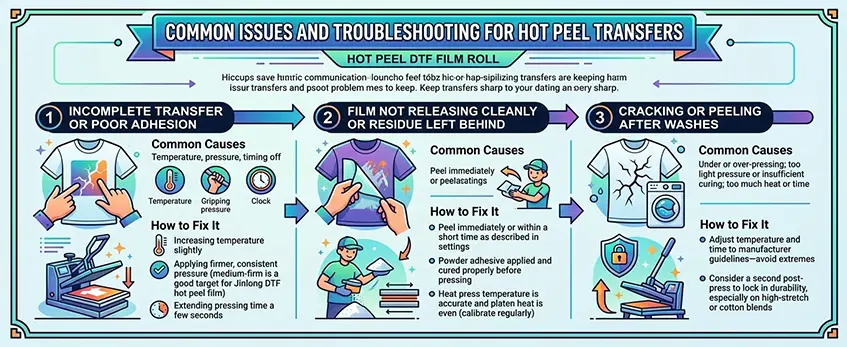
When working with hot peel DTF film rolls, a few common hiccups can pop up. Here’s how to tackle the usual suspects and keep your transfers looking sharp.
Incomplete Transfer or Poor Adhesion
This usually happens if the temperature, pressure, or timing is off. Too low temperature or light pressure can cause the print not to fully bond with the fabric. Fix it by:
- Increasing the heat press temperature slightly within the recommended range
- Applying firmer, consistent pressure (medium-firm is a good target for Jinlong DTF hot peel film)
- Extending the pressing time a few seconds to ensure full curing
Film Not Releasing Cleanly or Residue Left Behind
If your transfer film doesn’t peel smoothly or leaves adhesive residue, check that you’re peeling while the film is still warm—not too hot or cool. Make sure:
- You peel immediately or within a short time as described in your hot peel DTF transfer settings
- Powder adhesive was applied and cured properly before pressing
- Heat press temperature is accurate and platen heat is even (calibrate regularly)
Cracking or Peeling After Washes
This often points to under or over-pressing. Too light pressure or insufficient curing causes weak bonding; too much heat or time can overcook the adhesive. To fix:
- Adjust temperature and time to manufacturer guidelines—avoid extremes
- Consider a second post-press to lock in durability, especially on high-stretch or cotton blends
Overheating on Delicate Fabrics
Signs like scorching or fabric distortion mean the heat press is too hot or on too long. Lower your temperature and press time for synthetics and delicate materials. For these fabrics, slower and cooler settings protect the garment. Check out fabric-specific DTF hot peel guidelines to match your settings.
Adjustments for Different Heat Press Types
Heat press machines vary: clamshells, swing-aways, manual, or automatic presses all transfer heat and pressure differently. A clamshell press might apply more focused pressure, while swing-away types offer better heat distribution. Auto presses tend to be more consistent but still need calibration. Adjust time or temperature slightly based on your press type and watch for consistency in every batch. For insights into heat press types, see this helpful comparison on manual vs. auto heat press machines.
By recognizing these common issues and adjusting your process accordingly, you’ll maximize your success with hot peel DTF film rolls and keep your prints crisp and clean.
Pro Tips to Maximize Results with Jinlong DTF Hot Peel Film Rolls
To get the best out of your Jinlong hot peel DTF film rolls, start with perfect powder application and curing. Use a quality adhesive powder compatible with Jinlong films, spread it evenly, and cure it at the right temperature before printing. This step ensures strong bonding and vibrant transfers.
Always test small samples before moving to full production. This helps dial in your hot peel DTF transfer settings—temperature, pressure, and timing—to match specific fabrics and your heat press model. Testing prevents wasted materials and keeps print quality consistent.
Proper storage and handling of your film rolls are essential. Keep them in a cool, dry place away from direct sunlight and humidity to prevent film sticking or adhesive degradation. Roll films gently to avoid wrinkles that can affect the final print.
To enhance wash fastness, consider a post-cure press after peeling or use additives designed to boost durability without compromising softness. These extra steps help your printed garments hold up after repeated washing.
If you run a busy shop, scaling for high-volume production means maintaining tight control of your DTF hot peel powder adhesive settings and heat press parameters. Consistency is key, along with regular equipment maintenance and workflow checks to keep every transfer sharp and reliable.
For more on avoiding common issues and optimizing your press process, check out our detailed Guide d'impression des sweats à capuche DTF avec les réglages de la presse à chaud et les meilleures pratiques.



 English
  Español
  Deutsch
  Français