


Best DTF Transfer Printer vs DTG Which Offers Better Value 2026
If you’re diving into custom apparel printing, deciding between the best DTF transfer printer vs. DTG can feel like a tough call. Both promise vibrant, high-quality results, but which one actually delivers better value for your money in 2026? Whether you’re a small business owner, a startup printer, or scaling your print-on-demand operation, this choice impacts your upfront costs, ongoing expenses, print quality, and long-term profitability. In this post, we cut through the noise with a clear, practical comparison of Impression par transfert DTF et DTG, so you can confidently pick the solution that fits your fabrics, volumes, and budget. Let’s get straight to what matters most: value.
What Is DTF Printing and How Does a DTF Transfer Printer Work?
DTF printing, or Direct to Film printing, is a versatile custom t-shirt printing technology that’s gaining traction in 2026 for its efficiency and broad fabric compatibility. Here’s how the process works in simple terms:
- Printing onto Specialized Film: A DTF transfer printer first prints your design directly onto a clear, specialized PET film. This includes a key layer of vibrant white ink beneath the colored inks, which provides excellent opacity and sharpness on all garment colors.
- Applying Hot-Melt Powder: Immediately after printing, the film passes through a powder application stage where a hot-melt adhesive powder is evenly spread over the wet ink layer.
- Le séchage : The powder-coated film is then cured or dried in a heat tunnel to solidify the adhesive.
- Heat-Pressing onto Garments: Finally, the dried film transfer is placed onto the fabric and heat-pressed, bonding the design firmly to the garment with strong durability.
Advantages of Transfer-Style DTF
- Pre-Print and Store Transfers: Unlike DTG, DTF lets you pre-print transfers in bulk, giving you the freedom to maintain inventory or press on demand, which supports flexible production workflows.
- Wide Fabric Compatibility: This method works well on cotton, polyester, blends, and more—making it a go-to for a diverse product range.
- Durability and Vibrancy: Thanks to the white ink base and hot-melt powder, DTF prints maintain color vibrancy and wash resistance over time.
Typical DTF Transfer Printer Setups for Small to Mid-Scale Operations
Small to mid-sized businesses often opt for compact yet reliable DTF transfer printers. These setups typically include:
- A desktop or semi-professional DTF transfer printer capable of printing up to 16\” wide.
- A powder shaker machine to apply and remove excess adhesive powder.
- A curing oven or heat tunnel for the powder curing step.
- A heat press for applying finished transfers to apparel.
Such a setup strikes a balance between cost-effectiveness and production capacity, making DTF transfer printing an excellent choice for startups and growing custom apparel businesses looking for a versatile, reliable printing method with a controlled investment.
What Is DTG Printing and How Does It Work?
DTG (Direct-to-Garment) printing involves spraying ink directly onto pretreated garments using an inkjet technology. This process starts with pretreating the fabric—usually cotton or high-cotton blends—to help the water-based inks bond well and produce vibrant colors. After printing, the garment goes through a curing step, typically with a heat press or conveyor dryer, to set the ink and ensure durability.
DTG printing shines when it comes to cotton-focused workflows because it integrates smoothly with light-colored fabrics, producing fine details, smooth gradients, and photorealistic designs. This makes it a favorite for businesses that prioritize softness and high print quality on 100% cotton tees and hoodies. However, the need for pretreatment adds a step and some cost but is crucial for getting optimal results with DTG technology.
Head-to-Head Comparison: DTF Transfer Printer vs. DTG
Initial Investment and Startup Costs
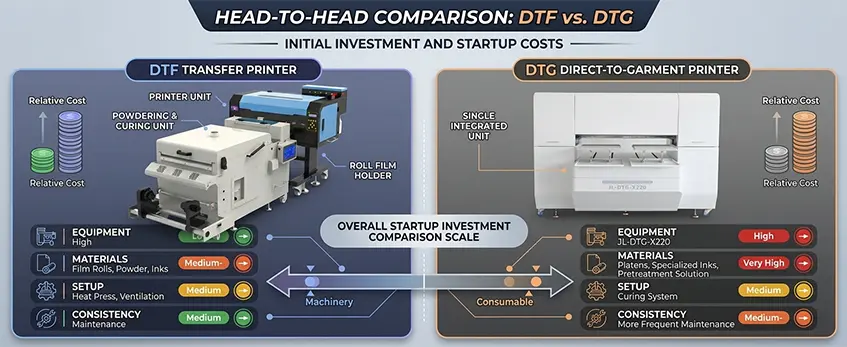
When starting out, the investissement initial is a big factor in choosing between a DTF transfer printer and a DTG machine. Here\’s a simple breakdown of typical costs and equipment needs:
| Cost Aspect | DTF Transfer Printer | Imprimante DTG |
|---|---|---|
| Printer Price Range | $5,000 – $15,000 (small to mid-scale) | $15,000 – $40,000+ (quality models) |
| Essential Extra Equipment | Powder shaker & heat-curing oven | Pretreatment machine for garments |
| Complexité de l'installation | Moderate (film, powder, curing steps) | Higher (pretreatment step, garment prep) |
| Barrier to Entry | Lower due to cheaper printers and simpler essentials | Higher due to costs and pretreatment process |
Imprimantes DTF generally have a lower startup cost. They require a printer, hot-melt powder shaker, and curing oven, which cost less than a full DTG setup. In contrast, DTG machines need high-end printers plus pretreatment machines to prepare garments, increasing both cost and workspace needs.
For beginners, DTF offers a lower barrier to entry, especially for those looking to keep initial expenses down and avoid complicated garment prep.
If you\’re interested in a practical DTF setup and workflow, check out this detailed guide de flux de travail DTF numérique couvrant l'impression, le poudrage, le durcissement et le pressage, which breaks down the extra gear and processes needed.
Dans , DTF transfer printers are usually more budget-friendly for startups and small businesses, while Impression DTG requires a bigger upfront investment better suited for higher-volume or cotton-focused operations.
Head-to-Head Comparison: DTF Transfer Printer vs. DTG
Ongoing Costs and Cost Per Print
Lorsque l'on compare les DTF vs DTG for ongoing expenses, DTF inks and consumables tend to be much more affordable. DTF uses specially formulated inks and powder that are generally cheaper than DTG’s high-quality textile inks. Plus, you don’t need pretreatments with every garment for DTF, cutting down on extra supply costs.
| Facteur de coût | DTF Transfer Printer | Imprimante DTG |
|---|---|---|
| Ink Cost | Lower; bulk DTF ink is cost-effective | Higher; premium DTG inks |
| Consommables | Transfer films and hot-melt powder; moderate cost |
Head-to-Head Comparison: DTF Transfer Printer vs. DTG
Print Quality and Design Capabilities
Lorsqu'il s'agit de qualité d'impression, DTG generally leads in producing ultra-fine details and smooth gradients, especially for photorealistic images. Thanks to direct inkjet technology laying ink straight onto pretreated fabric, DTG offers vibrant colors with a soft finish that blends well on light-colored 100% cotton garments.
D'autre part, DTF transfer printers shine with bold, solid graphics. Their strong white ink base creates high opacity, making colors pop on dark or mixed fabric types like blends and polyester. While DTF might not capture ultra-fine detail as sharply as DTG, it excels in designs needing crisp edges and strong contrast.
| Fonctionnalité | DTF Transfer Printer | Imprimante DTG |
|---|---|---|
| Detail & Fine Gradients | Good, best with solid graphics | Excellent, superb photorealism |
| Vibration des couleurs | Very vibrant, strong white base | Vibrant but softer on darks |
| Opacité sur les vêtements sombres | High due to white ink base | Moderate, may need pretreatment |
| Compatibilité des tissus | Large (coton, polyester, mélanges) | Primarily cotton & light colors |
For users balancing versatility and bold designs, DTF transfers offer an edge in print appearance across dark and synthetic fabrics. DTG remains top choice for photo prints on natural fibers. This difference plays a big role when choosing the best DTF transfer printer or DTG setup for your brand’s style.
Hand Feel and Aesthetic: DTF Transfer Printer vs. DTG
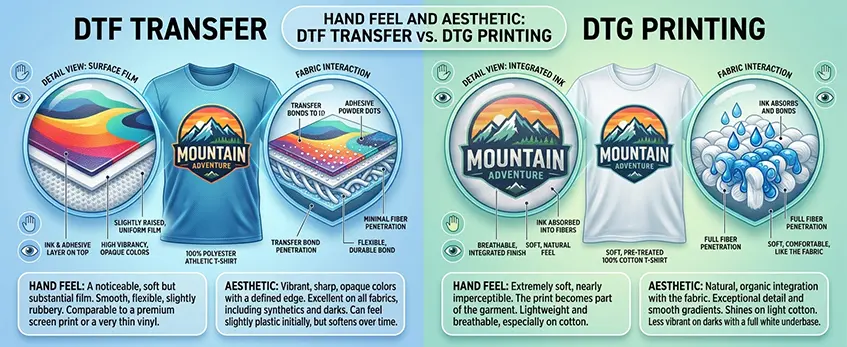
When it comes to hand feel and overall look, both DTF transfer printer and DTG printing bring different strengths to the table:
| Fonctionnalité | Impression DTG | DTF Transfer Printing |
|---|---|---|
| Sensation sur le vêtement | Soft, breathable, and “embedded” into fabric | Slightly thicker print layer, but flexible and elastic |
| Comfort | Feels close to screen printing; very natural | Improves softness after multiple washes |
| Print Texture | Smooth, minimal raise | Noticeable texture but not bulky |
| Customer Perception | Seen as premium and comfortable | Viewed as durable and vibrant |
| Cas d'utilisation idéaux | Light-colored cotton shirts where softness is key | Bold designs on diverse fabrics needing durability |
DTG prints offer a soft, breathable finish that feels like part of the garment, often preferred for comfort, especially on cotton tees. On the other hand, DTF prints have a slightly thicker layer but remain flexible and elastic, with hand feel that typically softens after a few washes.
Understanding these differences helps businesses decide based on customer preferences for comfort versus vibrancy and durability, making the DTF transfer vs direct to garment hand feel a crucial factor in choosing printing methods.
Head-to-Head Comparison: DTF Transfer Printer vs. DTG
Durabilité et performances de lavage
When it comes to durability and wash performance, both DTF transfer printers and DTG have their strengths, but there are clear differences worth noting.
| Fonctionnalité | DTF Transfer Printing | Impression DTG |
|---|---|---|
| Cycles de lavage | Handles 30+ wash cycles well | Usually lasts 20-30 wash cycles |
| Craquage | Minimal cracking due to flexible film | Can crack over time, especially on thicker inks |
| Décoloration | Maintains vibrant colors longer | Colors may fade after repeated washing |
| Care Instructions | Wash inside out, cold water recommended | Pretreated garments need gentle care |
| Longevity on Fabrics | Works well on cotton, polyester, blends; retains durability across fabric types | Best on 100% cotton, fades more on blends/polyester |
DTF prints feature a strong white ink base sealed under hot-melt powder, which adds to its durability and resistance to fading and cracking. The slightly thicker but elastic film layer holds up well through repeated wash cycles without significant wear. This makes DTF a great choice for garments expected to endure frequent washing.
DTG offers a softer, more \”embedded\” print feel and decent durability on cotton fabrics but can lose vibrancy faster over time, especially on darker or blended fabrics where pretreatment is required. The print tends to be more susceptible to cracking if not cared for properly.
Overall, if wash performance and lasting durability are priorities, DTF transfer printing frequently delivers better real-world longevity across a wider range of garment types. For more details on maintaining DTF print durability, check out this guide on making DTF stickers that last after washing.
Head-to-Head Comparison: DTF Transfer Printer vs. DTG
Fabric and Substrate Versatility
When it comes to fabric and substrate options, DTG vs DTF comparison shows clear differences in what each method handles best.
| Fonctionnalité | DTF Transfer Printing | Impression DTG |
|---|---|---|
| Les meilleurs types de tissus | Cotton, polyester, blends, nylon, canvas, hats, bags, and more | Primarily cotton and cotton blends, best on light colors |
| Substrate Versatility | Highly versatile: works on many synthetic and natural fabrics, plus accessories like hats and bags | Limited to garments that can be pretreated and absorb ink well |
| Color Performance | Strong on both light and dark fabrics due to white ink base | Vibrant on light fabrics, less effective on dark or polyester fabrics without special pretreatment |
| Usability in Mixed Runs | Ideal for mixed fabric orders, more flexibility | Best suited for consistent cotton batches |
DTF transfer printers stand out with their ability to print on a wider range of materials, making them ideal for businesses that want flexibility beyond just cotton tees. For example, printing on nylon tote bags or polyester athletic wear is straightforward with DTF.
D'autre part, Impression DTG excels with soft, breathable cotton garments but struggles on polyester or darker colors unless costly pretreatment is applied. Its scope is narrower but perfect for high-quality cotton-focused lines.
For shops targeting diverse fabrics and customized items like hats or blends, DTF offers better substrate versatility and broader product offerings, a huge plus for expanding product lines without extra equipment.
For those wanting to dive deeper into cost-saving materials used in transfer printing, exploring tips on DTF roll film cost efficiency can be useful to optimize product variety and pricing.
Head-to-Head Comparison: DTF Transfer Printer vs. DTG
Production Speed and Scalability
When it comes to production speed and scaling your printing business, DTF transfer printers and DTG machines each have their own strengths.
| Aspect | DTF Transfer Printer | Imprimante DTG |
|---|---|---|
| Time per shirt (small runs) | Moderate—prints transfers, then heat-press | Typically faster direct printing |
| Time per shirt (bulk runs) | Very fast—transfers can be pre-made and pressed as needed | Can slow down due to garment-by-garment printing |
| Pre-production of designs | Yes—transfers can be printed ahead and stored, ideal for on-demand workflows | No—prints directly onto each garment upon order |
| Évolutivité | High—batch printing transfers allows easier scale-up | Limited by printing and curing speed per shirt |
DTF transfer printing shines in its ability to print transfers in batches ahead of time. This means you can build an inventory of popular designs and quickly heat-press them onto garments as orders come in. This flexibility is a huge advantage for print-on-demand or seasonal spikes.
DTG printing generally excels with small, immediate runs, offering direct-to-garment printing without the need for extra prep steps. However, it can become a bottleneck for larger orders since each shirt must be printed and cured individually.
For businesses eyeing growth and efficiency, the ability to scale through pre-made DTF transfers often delivers better value in production speed and operational flexibility.
For more details on how DTF transfer printing works and its workflow benefits, check out this guide on comment fonctionne l'impression DTF, de la conception à la presse à chaud.
Head-to-Head Comparison: DTF Transfer Printer vs. DTG
Maintenance and Ease of Use
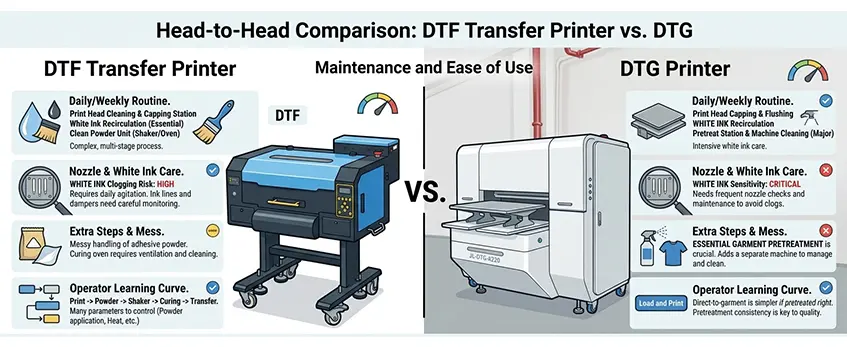
When it comes to maintenance and ease of use, both DTF transfer printers et DTG machines come with their own challenges and advantages that impact daily operation and reliability.
| Facteur | DTF Transfer Printer | Imprimante DTG |
|---|---|---|
| Clogging Risks | Lower risk; ink flows through film, but regular cleaning of print heads and shaker is needed to avoid powder buildup | Higher risk of clogging due to direct inkjet on fabric; frequent cleaning and maintenance required |
| Cleaning Routine | Moderate: clean print heads, shaker maintenance, powder residue removal | Intensive: print head cleaning, pretreatment equipment upkeep, frequent maintenance cycles |
| Courbe d'apprentissage | Easier for beginners; steps clear with film and powder process | Steeper learning curve; mastering pretreatment and proper curing takes time |
| Fiabilité | More reliable in daily runs; less sensitive to downtime | Sensitive to downtime; print head problems cause longer interruptions |
| User Friendliness | Simplified setup with fewer liquid inks at risk; shaker adds some complexity | Requires skill in pretreat application and more care handling inks |
| Coûts de maintenance | Generally lower due to fewer consumables and less downtime | Higher, especially with expensive print heads and pretreatment equipment |
DTF transfer printing\’s workflow often means less frequent printer downtime, which suits small to mid-scale shops aiming for consistent output. Meanwhile, DTG\’s direct-to-garment nature means higher upkeep but offers seamless integration for cotton-centric production.
For those starting out or running high-volume daily jobs, keeping maintenance light and simple gives DTF transfer printers an edge in operational reliability—and total cost of ownership. Learn more about the powder and film process involved in DTF printing to optimize upkeep in your setup ici.
Head-to-Head Comparison: DTF Transfer Printer vs. DTG
Environmental and Operational Factors
Lors de l'examen des DTF vs DTG from an environmental and operational standpoint, there are clear differences in waste, water usage, and workspace needs that impact value and ease of use.
| Facteur | DTF Transfer Printer | Imprimante DTG |
|---|---|---|
| Déchets | Uses hot-melt powder and transfer film; minimal fabric waste but some powder residue. Powder handling requires care but low liquid waste overall. | Generates pretreatment waste and rinse water; regular cleaning produces wastewater needing proper disposal. |
| Utilisation de l'eau | Virtually no water needed during printing and curing. Powder curing is dry process. | High water usage due to pretreatment and frequent nozzle cleaning cycles. |
| Workspace Needs | Requires space for printer, powder shaker, heat press; powder needs ventilated area or good airflow. | Needs prep area for pretreatment, drying, and curing space; humid environment control for ink stability. |
| Impact sur l'environnement | Lower water waste, less chemical runoff; powder handling key for safe operation. | Higher water and chemical consumption with waste handling requirements. |
DTF printing typically offers a cleaner, drier process with fewer environmental concerns related to water and runoff. However, powder storage and handling require attention to maintain safety and performance—best practices can be found in trusted guides on hot-melt glue powder handling for optimal care.
Meanwhile, DTG’s need for pretreatment and water-heavy maintenance makes it less eco-friendly, with stricter workspace setups to manage humidity and waste.
This makes DTF transfers better suited for smaller or more environmentally conscious operations requiring less water and chemical waste, while DTG may demand more infrastructure to run efficiently and responsibly.
Which Delivers Better Value? Scenario-Based Recommendations
When deciding between the best DTF transfer printer vs. DTG, it really comes down to your specific needs and business goals.
Best for Small Startups or Low-Volume Custom Work
DTF transfer printers usually win here. They offer lower startup costs and the ability to produce transfers ahead of time, making inventory management and on-demand pressing easy and affordable. This setup is ideal if you\’re just starting out or handling smaller orders with quick turnaround.
Best for High-Volume or Diverse Fabric Orders
DTF printing shines with its compatibility across a wide range of fabrics—cotton, polyester, blends, nylon, hats, bags—you name it. If you’re dealing with a large variety of products or production scales, DTF’s versatility and durability provide better value than DTG, which works best mainly on cotton and light colors.
Best for Print-On-Demand Models
Both technologies can work, but DTF’s ability to pre-print transfers and store them makes it ideal for efficient batch production and scaling your POD business. DTG offers less flexibility here due to slower print speeds and pretreatment steps required before each print.
Hybrid Approaches
Some businesses combine methods—using DTF transfers alongside DTG or screen printing—to leverage strengths from each technology. This can be smart if you want to offer diverse product lines or balance cost with quality in specific use cases.
Clear Verdict on Value
Overall, DTF transfer printing frequently provides superior value for most new and growing businesses in the U.S. Its lower equipment and consumable costs, broader fabric compatibility, and proven wash durability make it an excellent choice for reliable, cost-effective custom printing.
For those looking into reliable DTF supplies, exploring options like the DTF Transfer Film 45cm Single Basic Series can help optimize your investment with proven-quality materials.
Best DTF Transfer Printers for Value in 2026
When shopping for the best DTF transfer printer in 2026, several key factors come into play: print quality, speed, reliability, customer support, and total ownership cost. For value-conscious buyers—especially small to mid-size businesses—finding a machine that balances performance with affordable ongoing expenses is crucial.
Criteria for Evaluation
- Qualité d'impression : Sharp, vibrant colors with strong white ink opacity are vital for standout designs.
- Vitesse : Fast print times help meet deadlines, especially for on-demand or bulk orders.
- Fiabilité : Minimal downtime and consistent output saves money and frustration.
- Support: Responsive technical assistance and easily available consumables simplify operations.
- Total Ownership Cost: Includes initial purchase price, ink, film, powder, maintenance, and repairs.
Top Recommendations in 2026
One standout in the value-driven market is Imprimantes Jinlong DTF. They offer reliable performance tailored specifically for small to medium operations at an affordable price point, making them an excellent choice for new entrants and growing businesses alike.
Pour :
- Strong, crisp prints with vivid colors and excellent white ink layering thanks to advanced ink technology like the jinlong DTF ink white.
- Compatibility with a range of transfer films including their durable Film de transfert DTF designed for various apparel types.
- Cost-effective consumables and low maintenance requirements reduce ongoing expenses.
- Good support network and straightforward setup optimize workflow quickly.
Cons :
- While excellent for small and mid-scale volumes, very high-volume production may require larger industrial models.
- Initial setup requires learning the powder application process, but resources like le fonctionnement d'un agitateur de poudre DTF help smooth the learning curve.
Cas d'utilisation idéaux
- Startups and small shops needing versatile, durable printing on multiple fabric types.
- Businesses that want to pre-produce transfers for on-demand or inventory stock.
- Operators focused on balancing quality and overall cost-per-print efficiency.
For anyone looking to dive into the profitable custom printing setup market, Jinlong DTF printers deliver excellent value without compromising on print quality or durability. Their machines and consumables make it easier to get started and scale up with confidence in 2026.
Check out their full range and accessory options at jinlongprints.com to find a system tailored to your business needs.
Common Mistakes to Avoid When Choosing Between DTF and DTG
When deciding between a DTF transfer printer and DTG, many businesses slip up on a few key points that affect long-term success:
Overlooking total cost of ownership: Don’t just focus on the initial DTF transfer printer cost or DTG machine price. Factor in inks, powders, pretreatment, maintenance, and power usage. These ongoing costs can quickly add up and impact your profit margins.
Ignoring fabric needs or volume projections: DTG is great for cotton and light colors, but if you plan to print on polyester, blends, or specialty fabrics, DTF’s versatility wins out. Also, consider your typical order size—DTF’s transfer-style setup shines in pre-production and quick on-demand runs, while DTG is better for directly printing high volumes on specific garment types.
Underestimating maintenance or training time: Both DTF and DTG require regular upkeep, but DTG printers often need more pretreatment and cleaning, which can slow down production if not managed well. Newcomers should realistically assess the learning curve and daily maintenance involved to avoid costly downtime and print failures.
Choosing the right printing technology means balancing these factors, so be sure to carefully evaluate your business needs and realistic workflows before investing. For a deeper dive into setup and maintenance, check out our detailed digital DTF equipment guide covering printers, shakers, ovens, and software.
How to Get Started with DTF Transfer Printing
Getting started with DTF transfer printing is easier than many think, especially with the right setup and workflow. Here’s a straightforward step-by-step guide to help you launch your custom printing business with confidence:
Step 1: Choose the Right Equipment
Begin with selecting a reliable DTF transfer printer suited for your business size and budget. For small- to mid-scale operations, models like the Jinlong JL DTF604P offer great print quality and cost-effectiveness. Don’t forget essential accessories: powder shaker, curing oven, and heat press.
Step 2: Prepare Your Design Files
Create or import your artwork in high-resolution with transparent backgrounds. Keep in mind DTF excels with bold, vibrant graphics but also works well with detailed designs when properly managed.
Step 3: Print on Specialized Films
Load your design onto the DTF film using your printer, making sure to print the white ink layer beneath the colors for opacity and vibrancy. This printing on specialized film is the core of the DTF transfer process.
Step 4: Apply Hot-Melt Powder
Immediately apply a hot-melt adhesive powder to the wet ink on the film. This step ensures your design will successfully bond with the garment. For best results, check out powder options like the soft-hand feel TPU powder known to improve print comfort.
Step 5: Cure the Powder
Use a curing oven or heat source to melt and fix the powder onto the film. This creates a stable transfer that’s ready for pressing.
Step 6: Heat-Press onto Garments
Place the transfer on the garment and apply heat and pressure using a heat press. This final step ensures your design bonds firmly and lasts through washes.
Tips for Workflow Optimization & Quality Control
- Batch Transfers: Print multiple transfers ahead and cure them in batches to speed up production — a major advantage for on-demand models.
- Impressions de test : Always run test prints to fine-tune colors and ink levels for consistent results.
- Maintain Equipment: Regular cleaning and calibration of your DTF printer avoid clogging and prolong machine life.
- Quality Checks: Inspect transfers for full powder coverage and proper curing before pressing to avoid poor adhesion or fading.
Marketing Your DTF Prints
- Highlight durability and versatility — DTF prints work on a variety of fabrics, which appeals to customers seeking options beyond cotton.
- Emphasize vibrant colors and strong whites, perfect for bold custom designs.
- Offer customization and quick turnarounds, leveraging the print-on-demand strength of DTF.
- Build your brand with samples showing off DTF’s hand feel and durability advantages versus DTG.
With these steps and tips, you can confidently get started with DTF transfer printing, positioning your business for quality output and sustained growth in the competitive custom apparel market.


 English
  Español
  Deutsch
  Français