
Aucun produit dans le panier.

Jinlong
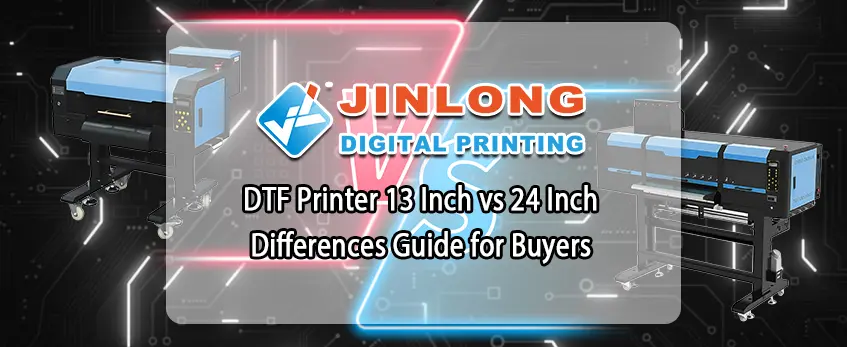
DTF Printer 13 Inch vs 24 Inch Differences Guide for Buyers (en anglais)
Si vous plongez dans le monde de la Impression du DTF, L'une des premières grandes décisions à prendre est de choisir entre un Imprimante DTF 13 pouces et un Imprimante DTF 24 pouces. Ce choix n'est pas seulement une question de taille : il conditionne votre flux de travail, votre budget et le potentiel de votre entreprise. Alors que les modèles compacts de 13 pouces s'intègrent parfaitement dans les petits espaces et sont parfaits pour les débutants ou les petits volumes, les imprimantes de 24 pouces offrent des vitesses de production plus élevées et des zones d'impression plus grandes pour une mise à l'échelle sérieuse. Dans ce guide, nous analysons les principales différences afin que vous puissiez adapter la taille de votre imprimante à vos objectifs de croissance en toute confiance. jinlong DTF des options qui servent les deux extrémités du spectre.
Comprendre les tailles d'imprimantes DTF : Ce que signifient réellement 13 pouces et 24 pouces
Lorsque vous comparez une imprimante DTF 13 pouces à une imprimante DTF 24 pouces, la différence essentielle réside dans les éléments suivants largeur d'impression. L'imprimante 13 pouces offre généralement une zone d'impression utilisable de 12 à 13 pouces de large, soit un peu moins que la taille nominale en raison des marges d'impression. En revanche, une imprimante DTF de 24 pouces offre une largeur effective de 23 à 24 pouces, ce qui double pratiquement l'espace imprimable.
L'imprimante 13” DTF est souvent conçue comme un appareil de format A3+, parfait pour les installations de bureau ou les petits ateliers qui souhaitent une capacité de rouleau à rouleau d'entrée de gamme sans encombrement important. Elle excelle dans le traitement des impressions de vêtements de taille standard, comme les dessins sur une seule poitrine ou les graphiques plus petits. Quant à l'imprimante DTF 24 DTF se situe dans la fourchette de production moyenne, souvent alignée sur les formats de rouleaux A1 ou plus larges. Ce format convient mieux à l'impression par lots, aux graphiques plus grands ou à l'impression en bande de plusieurs articles à la fois.
Quel est l'impact de la largeur d'impression sur votre entreprise ? Voici ce qu'il faut prendre en compte :
- Placement des dessins et modèles: Les machines plus larges vous permettent d'imprimer des dessins plus grands ou multiples en un seul passage.
- Impression Gang: Le format 24 pouces est idéal pour imprimer plusieurs pièces ensemble, ce qui permet de réduire le temps de traitement et d'optimiser l'utilisation de l'encre.
- Réduction des déchets: L'utilisation intelligente d'imprimantes plus larges permet de réduire les pertes de substrat en réalisant plus d'impressions par feuille ou par rouleau.
Pour choisir entre une imprimante DTF 13 pouces et une imprimante DTF 24 pouces, il faut évaluer ces différences de taille en fonction de vos besoins de production. Si votre volume et votre champ d'application sont modestes, l'imprimante 13 pouces peut s'avérer une solution solide et peu encombrante. Pour les commandes plus importantes ou les impressions plus larges, l'option 24 pouces offre plus de flexibilité et d'efficacité.
Principales différences côte à côte : Imprimante DTF 13 pouces ou 24 pouces

| Fonctionnalité | Imprimante DTF 13 pouces | Imprimante DTF 24 pouces |
|---|---|---|
| Largeur d'impression et conception | Jusqu'à 13 pouces, idéal pour les impressions uniques sur toute la poitrine | Jusqu'à 24 pouces, idéal pour les feuilles à bandes multiples ou les graphiques de grande taille |
| Vitesse et volume de production | Faible rendement ; convient aux petits lots et aux échantillons | Rendement plus élevé ; couvre plus de surface par heure, idéal pour les commandes en gros (par exemple, plus de T-shirts pour adultes par jour). |
| Têtes d'impression et configuration de l'encre | Généralement à une ou deux têtes ; vitesse plus lente pour le blanc/CMYK | Têtes doubles ou quadruples ; impression plus rapide des blancs et des CMJN pour plus d'efficacité |
| Taille du bâtiment et espace | Compact, adapté aux ordinateurs de bureau ; convient aux magasins à domicile | Encombrement plus important ; nécessité d'un espace dédié dans un environnement commercial |
| Ventilation des coûts | Coût initial plus faible, consommation d'encre réduite, maintenance moins coûteuse | Investissement initial plus élevé mais meilleur retour sur investissement (ROI) à des volumes plus élevés |
| Polyvalence et applications | Idéal pour les petites séries, les échantillons et les substrats variés | Idéal pour les commandes de gros volumes, les tirages surdimensionnés et l'impression en bande efficace |
Si vous comparez une imprimante 13’ à une imprimante 24” DTF le modèle le plus petit est parfait pour les débutants ou les personnes disposant d'un espace limité et souhaitant réaliser des impressions de qualité sur des vêtements personnalisés. En revanche, une imprimante DTF grand format de 24 pouces convient aux ateliers en pleine croissance qui ont besoin d'une production plus rapide et de zones d'impression plus grandes pour les articles en vrac ou surdimensionnés.
Pour en savoir plus sur l'impact de la largeur d'impression sur la production et le flux de travail, consultez les informations suivantes Impression DTF sur chemises, avantages, inconvénients et qualité d'impression. Il s'agit d'une ressource précieuse si vous souhaitez mettre en balance l'efficacité, le coût et la flexibilité de la conception.
Avantages et inconvénients : imprimantes DTF 13 pouces
Avantages :
- Coût de démarrage abordable, ce qui facilite l'investissement sans se ruiner.
- Compact et peu encombrant, il est parfait pour les installations domestiques ou les petits magasins.
- Convivialité pour les débutants, idéal pour les amateurs ou les novices en matière d'impression directe sur film
- Idéal pour la plupart des vêtements standard avec des largeurs d'impression d'environ 12-13 pouces, couvrant les motifs typiques des T-shirts.
Inconvénients :
- Limité à des dessins plus petits en raison de la largeur d'impression plus étroite
- Vitesse de production plus lente que celle des modèles plus larges, ce qui peut constituer un goulot d'étranglement pour les commandes en grande quantité
- L'impression en bandes est moins efficace, ce qui signifie qu'il n'est pas possible d'imprimer de nombreuses petites pièces à la fois, ce qui entraîne des pertes de temps et d'argent.
Idéal pour :
- Les vendeurs à domicile et les propriétaires de boutiques Etsy qui se concentrent sur les commandes personnalisées ou les tirages limités.
- Les entreprises dont le volume de commandes est faible ou moyen et qui privilégient la qualité à l'échelle.
Si vous commencez petit et que vous souhaitez une imprimante DTF fiable à un prix modeste, l'imprimante DTF 13 pouces vous offre de la flexibilité sans encombrer votre espace de travail. Pour vous aider à choisir la bonne imprimante DTF 13 pouces et les fournitures compatibles, consultez nos recommandations détaillées sur les meilleurs films et rouleaux pour ces modèles dans notre guide de Options de film de transfert DTF.
Avantages et inconvénients : imprimantes DTF 24 pouces
Avantages
- Débit plus élevé : Les imprimantes DTF 24 pouces gèrent des largeurs d'impression plus importantes, ce qui permet une production plus rapide et une plus grande surface par heure. Elles sont donc parfaites pour les travaux à haut volume.
- Optimisation de la feuille de gang : Vous pouvez imprimer plusieurs motifs à la fois sur une seule grande feuille, ce qui permet de réduire la gâche et d'améliorer l'efficacité.
- Prise en charge des dessins et modèles de plus grande taille : Idéale pour les impressions surdimensionnées, telles que les graphiques à dos plein ou extra-larges, que les imprimantes plus petites ne peuvent pas prendre en charge.
- Une mise à l'échelle plus rapide : Avec des têtes d'impression doubles ou quadruples et des configurations d'encre avancées, ces imprimantes DTF grand format accélèrent la production pour répondre aux demandes croissantes.
Inconvénients
- Investissement initial plus élevé : Le coût initial d'une imprimante DTF de 24 pouces est nettement plus élevé que celui d'une imprimante de 13 pouces, y compris les frais d'encre et de maintenance.
- Plus d'espace nécessaire : Il ne s'agit pas de modèles de bureau : ils nécessitent un espace de travail dédié avec suffisamment de place pour l'impression rouleau à rouleau et l'équipement de finition.
- Augmentation de la consommation d'encre : Des impressions plus importantes et des vitesses plus élevées impliquent une plus grande consommation d'encre, en particulier d'encre blanche, ce qui nécessite des systèmes fiables tels que ceux utilisés dans les modèles de tête de qualité basés sur Epson.
- Courbe d'apprentissage plus prononcée : La configuration et l'optimisation d'une imprimante DTF 24 pouces peuvent être complexes et nécessitent une certaine expérience de la gestion des couleurs et des routines de maintenance.
Idéal pour
- Les imprimeries en croissance : Les entreprises qui augmentent leur production tout en maintenant la qualité bénéficieront des gains d'efficacité.
- Les entreprises POD (Print-on-Demand) : Un débit élevé permet des délais d'exécution rapides et des commandes de tailles diverses.
- Production à l'échelle commerciale : L'imprimante DTF 24 pouces est un investissement judicieux pour toutes les entreprises qui ont besoin d'une impression en masse cohérente avec des options de conception polyvalentes.
Pour les entreprises qui envisagent une solution solide et évolutive, ces imprimantes DTF grand format offrent des performances à la hauteur de leurs objectifs de production. Pour en savoir plus sur la gestion de l'encre blanche et la fiabilité du système d'encrage, clés de l'efficacité des imprimantes 24 pouces, consultez ce document détaillé. Encre blanche DTF pour une qualité d'impression jet d'encre, une opacité et une durabilité expliquées.
Lequel choisir ? Cadre de décision

Le choix entre une imprimante DTF 13 pouces et une imprimante DTF 24 pouces se résume à vos besoins actuels et à vos objectifs futurs. Voici une méthode simple pour faire votre choix :
Évaluez vos besoins
- Commandes mensuelles :
- Volume faible à moyen ? Le 13 pouces convient parfaitement.
- Des commandes importantes et régulières ? 24 pouces permet d'économiser du temps et de l'argent à long terme.
- Taille et variété de la conception :
- Principalement des modèles standard ou plus petits ? 13 pouces, c'est tout ce qu'il faut.
- Des impressions plus grandes ou plusieurs dessins sur une même feuille ? Le 24 pouces excelle.
- Espace de travail :
- Espace limité ou bureau à domicile ? Un modèle de bureau compact de 13 pouces est idéal.
- Vous disposez d'une salle d'impression dédiée ? Le format 24 pouces est plus adapté.
- Budget :
- Budget serré ou test du marché ? Le 13 pouces offre des coûts initiaux moins élevés.
- Prêt à investir dans l'évolutivité ? Le 24 pouces offre un retour sur investissement plus rapide au fil du temps.
Scénarios courants
- Tester les eaux : Commencez petit avec une imprimante DTF 13 pouces. Elle est économique et adaptée aux débutants.
- Une entreprise en pleine croissance : Passez à un modèle supérieur ou commencez directement avec un modèle de 24 pouces pour traiter des travaux plus importants et améliorer la vitesse de production.
Les modèles Jinlong DTF à l'épreuve du temps
Jinlong propose des imprimantes fiables de toutes tailles, conçues pour évoluer avec votre entreprise. Leurs modèles permettent des mises à niveau faciles et offrent des performances constantes, que vous soyez en phase de démarrage ou d'expansion.
| Facteur | Imprimante DTF 13 pouces | Imprimante DTF 24 pouces |
|---|---|---|
| Largeur d'impression | ~12-13 pouces | ~23-24 pouces |
| Volume idéal | Faible à moyen | Moyenne à élevée |
| Espace nécessaire | Compact, facile à utiliser | Encombrement plus important, espace de travail nécessaire |
| Coût (initial) | Plus bas | Plus élevé |
| Vitesse de production | Modéré | Plus rapide |
| Flexibilité de la mise à niveau | Bon pour les débutants | Idéal pour les entreprises en expansion |
Avant de prendre une décision, réfléchissez à l'évolution de votre volume de commandes et de vos besoins en matière de conception. Pour en savoir plus sur la gestion efficace de votre production d'imprimés, voyez comment une imprimante graphique moderne pour t-shirts peut accroître les bénéfices et l'efficacité.
Choisir la bonne taille d'imprimante DTF dès le départ permet d'éviter des changements coûteux par la suite et de s'assurer que vous êtes optimisé pour votre marché actuel et vos plans de croissance.
Autres facteurs importants au-delà de la largeur
Lorsqu'il s'agit de choisir entre une imprimante DTF de 13 pouces et une imprimante DTF de 24 pouces, la largeur d'impression est cruciale, mais elle n'explique pas tout. La qualité de l'impression têtes d'impression joue un rôle important : de nombreux modèles fiables utilisent des têtes d'impression Epson, réputées pour leur précision et leur durabilité. Cela permet d'obtenir des impressions nettes et de réduire les problèmes liés aux têtes d'impression, que vous pouvez découvrir dans ce document détaillé sur les têtes d'impression. Guide de dépannage de la tête d'impression DTF de Jinlong.
Le système d'encre est également important, en particulier la façon dont l'imprimante gère la circulation de l'encre blanche. Une bonne circulation de l'encre blanche permet d'éviter les bouchons et de conserver des blancs éclatants, ce qui est essentiel pour des vêtements personnalisés de qualité. De plus, l'intégration d'un secoueur de poudre est indispensable pour une application efficace de la poudre, réduisant la gâche et améliorant la qualité du transfert.
Ne négligez pas maintenance, garantie et assistance-Ce sont des domaines dans lesquels les imprimantes Jinlong DTF se distinguent. Leurs machines sont conçues pour être faciles à entretenir et leur service clientèle est à votre disposition pour assurer le bon déroulement de vos opérations.
Enfin, assurez-vous d'avoir le bon accessoires pour une installation complète : les fours de séchage, les secoueurs de poudre, les presses à chaud et la ventilation sont autant d'éléments importants. Le choix d'un système avec des accessoires compatibles dès le départ vous permet d'économiser du temps et de l'argent.
En prêtant attention à ces facteurs, au-delà de la largeur d'impression, vous ferez un choix plus judicieux et plus rentable, qu'il s'agisse d'une imprimante DTF de bureau de 13 pouces ou d'une imprimante DTF grand format de 24 pouces.



 English
 Español
 Deutsch
 Français