
Aucun produit dans le panier.

Jinlong
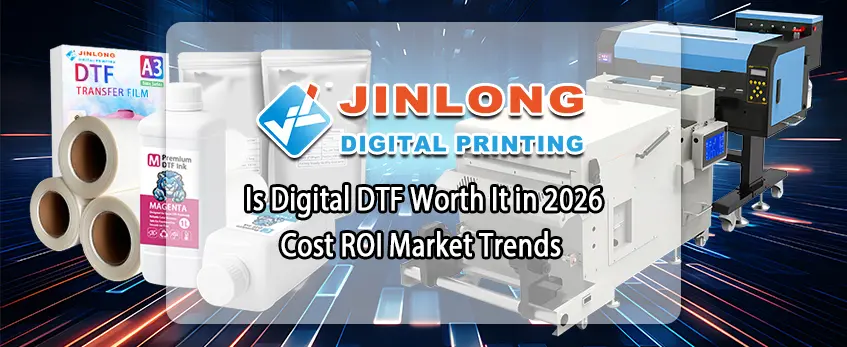
Le DTF numérique en vaut-il la peine en 2026 Coût ROI Tendances du marché
L'impression numérique DTF en 2026 (mise à jour rapide)
L'impression numérique DTF en 2026 a considérablement évolué depuis ses débuts. À la base, l'impression directe sur film (DTF) consiste à créer des motifs éclatants sur un film spécial à l'aide de la technologie numérique à jet d'encre, puis à transférer l'œuvre d'art sur des tissus ou d'autres surfaces à l'aide de la chaleur et de la pression. Ce procédé permet d'obtenir des impressions détaillées et durables, ce qui en fait un choix populaire pour les vêtements personnalisés et autres.
Les principales avancées qui façonneront le DTF en 2026 sont les suivantes :
- Des flux de travail plus rapides: La nouvelle génération d'imprimantes DTF rationalise la production grâce à des vitesses d'impression plus rapides et à l'application automatisée de poudre, réduisant ainsi les temps d'arrêt et augmentant le rendement.
- Options de neuf couleurs: Au-delà des configurations CMJN+blanc traditionnelles, les presses DTF modernes offrent désormais des systèmes à neuf couleurs, améliorant la précision des couleurs, les dégradés et l'éclat de l'impression pour des résultats de qualité supérieure.
- Encres écologiques: Les innovations dans le domaine des encres DTF à base d'eau et à faible teneur en COV ont rendu le processus plus écologique, s'alignant ainsi sur les préoccupations et les réglementations environnementales croissantes.
- Applications au-delà de l'habillement: Si les t-shirts personnalisés restent un produit de base, DTF s'est étendu aux textiles d'intérieur, aux accessoires et même aux produits promotionnels, élargissant ainsi le potentiel du marché.
Cette combinaison d'améliorations technologiques et de diversité des applications positionne l'impression numérique DTF comme une solution polyvalente, durable et rentable pour les entreprises qui cherchent à capitaliser sur le marché en plein essor de l'impression personnalisée en 2026. Avec des acteurs clés comme jinlong DTF leader dans les consommables et l'équipement, l'industrie est plus accessible et rentable que jamais.
Tendances actuelles du marché qui façonnent le DTF en 2026
En 2026, les tendances du marché de l'impression directe sur film montrent une forte croissance mondiale, tirée par la demande croissante de personnalisation et de délais d'exécution rapides dans les secteurs de l'habillement et des marchandises. La concurrence sur les prix s'est intensifiée, faisant baisser les coûts des imprimantes DTF et les prix des consommables, ce qui facilite l'entrée sur le marché des start-ups et des petites entreprises.
L'un des principaux moteurs est l'innovation - l'automatisation rationalise les flux de travail, réduit le travail manuel et renforce l'homogénéité de l'impression. Parallèlement, les innovations DTF respectueuses de l'environnement, telles que les encres à base d'eau et les films recyclables, deviennent la norme, répondant ainsi aux préoccupations des entreprises et des consommateurs en matière de développement durable.
En conséquence, la rentabilité de l'impression DTF en 2026 s'améliore, en particulier pour ceux qui investissent dans les équipements automatisés les plus récents et les matériaux écologiques. Cette évolution élargit l'attrait du DTF au-delà de l'habillement, sur des marchés plus variés tels que la décoration d'intérieur et les produits promotionnels, ce qui permet à la technologie de rester pertinente et compétitive.
Décomposer les coûts : Ce que vous paierez en 2026
Lorsque l'on envisage d'utiliser le DTF numérique en 2026, il est essentiel de comprendre l'ensemble des coûts. Les prix des équipements varient considérablement en fonction de vos besoins - les imprimantes DTF d'entrée de gamme peuvent commencer aux alentours de $3 000 à $7 000, tandis que les modèles industriels atteignent $50 000 ou plus pour les ateliers à gros volumes. Ces machines offrent désormais des configurations à neuf couleurs et des flux de travail plus rapides, mais leur prix est à l'avenant.
Les consommables tels que le film DTF, la poudre et l'encre constituent les dépenses courantes. Comptez environ $0,40 à $0,70 par impression si vous incluez le coût de la qualité. Film de transfert DTF, L'encre DTF est une poudre qui garantit une bonne adhérence et une encre respectueuse de l'environnement. Les coûts opérationnels tels que l'électricité, l'entretien et le remplacement occasionnel des têtes d'impression s'additionnent également. Les frais cachés, tels que les abonnements aux logiciels ou les presses chauffantes spécialisées, peuvent augmenter les coûts de démarrage.
N'oubliez pas que le choix de fournitures fiables n'influe pas seulement sur la qualité d'impression, mais réduit également les temps d'arrêt et les dépenses imprévues. Par exemple, investir dans des DTF ink CMYK Pro series peut réduire les problèmes de colmatage et les coûts d'entretien au fil du temps.
Dans :
- Imprimante DTF d'entrée de gamme : $3,000–$7,000
- Imprimante DTF industrielle : $20,000–$50,000+
- Consommables par impression (film, poudre, encre) : $0.40-$0.70
- Coûts supplémentaires : Entretien, électricité, logiciel, chauffage presse
La connaissance de ces facteurs vous aidera à établir un budget précis et à éviter les surprises en ce qui concerne l'investissement dans l'équipement DTF et les coûts d'exploitation en 2026.
RCI réaliste et répartition de la rentabilité de l'impression numérique DTF 2026

Lors de l'examen de la Potentiel commercial de l'imprimerie DTF en 2026, il est essentiel de comprendre les délais réalistes de retour sur investissement. La plupart des petites et moyennes entreprises obtiennent un retour sur investissement dans les délais suivants 6 à 12 mois, en fonction de leur volume et de leur stratégie de tarification. Par exemple, une installation typique peut générer des bénéfices d'environ $30-$60 par heure après avoir couvert les coûts matériels et opérationnels.
Les facteurs clés qui ont stimulé ces rendements sont les suivants :
- Utilisation efficace des Consommables DTF, en particulier en choisissant des produits de haute qualité et d'un bon rapport coût/efficacité Film, poudre et encre DTF.
- Automatisation du flux de travail qui accélère la production et réduit les coûts de main-d'œuvre.
- Cibler des marchés de niche tels que les vêtements sur mesure, dont les prix sont plus élevés.
- Tirer parti des innovations respectueuses de l'environnement pour attirer les clients soucieux de la durabilité.
Toutefois, il convient de se méfier des risques tels que la fluctuation des prix des consommables, les temps d'arrêt des machines dus à un mauvais entretien et la surestimation de la demande. Une planification minutieuse et l'utilisation d'approvisionnements fiables, tels que ceux de Jinlong, permettent d'éviter ces risques. Poudre et encres DTF-peut vous aider à maintenir une rentabilité stable et à réduire votre seuil de rentabilité. L'utilisation d'outils tels qu'un Calculateur de retour sur investissement du DTF peut également aider à modéliser les bénéfices sur la base de vos coûts et de vos prix spécifiques.
En , avec une bonne configuration et une gestion attentive des coûts, le DTF numérique peut devenir une entreprise très rentable d'ici à la mi-2026.
DTF vs. alternatives : Où il gagne (et perd) en 2026

En 2026, le choix entre le DTF et d'autres méthodes d'impression comme le DTG, la sérigraphie, le vinyle ou la sublimation dépendra des besoins de votre entreprise. Voici une brève analyse des points forts et des points faibles du DTF numérique sur le marché actuel.
| Méthode d'impression | Points forts | Faiblesses | Les meilleurs cas d'utilisation |
|---|---|---|---|
| Impression DTF | - Mise en place et exécution rapides | - Légèrement moins durable que la sérigraphie | Petites et moyennes séries, vêtements sur mesure |
| - Fonctionne sur la plupart des tissus (coton, polyester, mélanges) | - Le coût des consommables peut s'avérer élevé | Motifs multicolores, toucher doux | |
| - Encres écologiques et flux de travail automatisés | - Moins éclatant sur les impressions blanches ou claires | Des produits polyvalents au-delà de l'habillement | |
| DTG (Direct to Garment) | - Excellents détails d'impression et éclat des couleurs | - Compatibilité limitée avec les tissus | Impressions très détaillées sur coton |
| - Sensation de douceur sur les impressions | - Plus lent pour les commandes groupées | Petites commandes personnalisées | |
| Sérigraphie | - Meilleure durabilité et faible coût par impression en masse | - Temps de préparation long, peu rentable pour les petites séries | Commandes de gros volumes, conceptions simples |
| - Couleurs vives | - Moins de souplesse dans les mélanges de couleurs | Vêtements personnalisés en vrac | |
| Impression sur vinyle | - Idéal pour les dessins simples et les textes de petite taille | - Non respirant, peut se fissurer avec le temps | Numéros, logos, noms sur les uniformes |
| - Durable et vibrant | - Prend du temps pour les dessins multicolores | Faible quantité de production | |
| Sublimation | - Pleine couleur, vibrante sur polyester | - Ne fonctionne que sur le polyester ou les matériaux enduits | Vêtements de sport, tasses et articles de sport |
| - Très durable, pas de contact avec le tissu | - Ne peut être imprimé sur du coton | T-shirts en polyester et articles personnalisés |
Verdict en situation réelle
L'impression DTF en 2026 est particulièrement intéressante pour les petites et moyennes entreprises qui cherchent à concilier qualité, flexibilité et rapidité. La possibilité d'imprimer sur une large gamme de tissus, associée à des flux de travail plus rapides et à des encres écologiques, en fait un choix polyvalent pour les vêtements personnalisés. Toutefois, si votre objectif est d'obtenir une durabilité extrêmement élevée ou de réaliser de très gros tirages, la sérigraphie peut encore l'emporter sur la technologie DTF en termes de rentabilité.
Pour les impressions très détaillées et colorées sur coton, le DTG reste une option compétitive mais tend à être plus lent et plus cher par pièce. Le vinyle et la sublimation servent chacun des marchés de niche, mais n'ont pas la polyvalence de la compatibilité avec les tissus et la facilité de l'impression multi-couleurs de la DTG.
Si vous souhaitez explorer des comparaisons de coûts pratiques et voir comment DTF se positionne par rapport à l'impression sur vinyle, consultez ce document détaillé sur l'impression sur vinyle. guide pratique pour choisir la bonne méthode d'impression.
Globalement, le meilleur choix dépend de votre gamme de produits, de votre volume et de vos exigences en matière de qualité. DTF offre une combinaison équilibrée de vitesse, de qualité et de respect de l'environnement qui est difficile à battre dans les tendances de l'impression de vêtements personnalisés de 2026.
Qui devrait investir dans DTF maintenant (et qui devrait attendre) ?

Si vous dirigez une petite ou moyenne entreprise de vêtements personnalisés, l'impression numérique DTF est un choix judicieux en 2026. Elle est particulièrement intéressante pour les jeunes entreprises qui souhaitent des délais d'exécution plus courts, davantage d'options de couleurs et la possibilité d'imprimer sur une large gamme de tissus sans trop de difficultés. Les entrepreneurs axés sur les cadeaux personnalisés, les vêtements de sport ou la mode à tirage limité trouveront l'impression DTF très rentable en raison de ses coûts de démarrage inférieurs à ceux de la sérigraphie et de sa polyvalence supérieure à celle de la technologie DTG.
Cela dit, tout le monde n'a pas intérêt à se lancer immédiatement. Si votre entreprise a de très gros volumes de commandes ou privilégie les méthodes traditionnelles d'impression en masse, il peut être plus judicieux d'attendre que les équipements DTF de niveau industriel deviennent plus abordables. De même, si votre marché principal exige une durabilité supérieure à celle qu'offre actuellement le DTF, l'exploration d'alternatives ou de systèmes hybrides pourrait s'avérer plus rentable.
Lorsque vous investissez dans le DTF, il est essentiel de choisir des fournitures fiables telles que des films, des poudres et des encres DTF de qualité afin de minimiser les temps d'arrêt et de maximiser la qualité d'impression. Recherchez des marques bénéficiant d'avis positifs, d'une disponibilité constante et d'un solide service après-vente. Par exemple, des fournisseurs comme jinlong proposent des consommables DTF de confiance, connus pour augmenter le temps de fonctionnement et le retour sur investissement. Vérifier les offres groupées de produits ou les kits de démarrage peut également vous permettre d'économiser de l'argent tout en vous mettant sur la bonne voie dès le départ.
En , l'impression numérique DTF convient aux entreprises créatives qui souhaitent se développer rapidement avec des coûts initiaux modérés. Mais si vous êtes prudent quant à l'investissement en matériel ou si vous avez besoin d'une durabilité très élevée, il est sage d'attendre ou de rechercher d'autres solutions. Donner la priorité à des fournitures fiables peut faire toute la différence dans la conduite d'une activité fluide et rentable.
Pour en savoir plus sur les options d'entrée de gamme et sur la manière de réduire les temps d'immobilisation en choisissant un meilleur équipement, consultez ce guide sur le choix de l'équipement d'entrée de gamme et sur la manière de réduire les temps d'immobilisation. Les meilleures imprimantes DTF pour débutants en 2026.
Maximiser le succès avec les fournitures DTF de jinlong
Le film, la poudre et l'encre DTF de jinlong se distinguent par leur qualité, leur homogénéité et leur respect de l'environnement - des facteurs clés qui vous permettent d'obtenir un retour sur investissement plus rapide et de maintenir une durabilité d'impression optimale.
Pourquoi les fournitures jinlong fonctionnent-elles ?
- jinlong DTF Film : Il offre une excellente clarté d'impression et une grande résistance au transfert, réduisant ainsi les déchets et les réimpressions. Consultez leur série de films doubles standard connu pour ses performances constantes.
- jinlong DTF Powder : Les excellentes propriétés d'adhésion garantissent des impressions éclatantes qui résistent aux cycles de lavage sans se craqueler ni se décoller.
- jinlong DTF Ink : Les options écologiques et vives de neuf couleurs vous offrent une plus grande liberté de création et un flux de travail plus sûr, détaillés sur cette page. Avantages et inconvénients de l'encre jinlong fluo.
Un retour sur investissement plus rapide : Réussite dans le monde réel
De nombreuses entreprises le signalent :
| Métrique | Avec jinlong Fournitures | Industrie typique |
|---|---|---|
| Défauts d'impression | <1% | 3-5% |
| Délai d'exécution | 15-20% plus rapide | Vitesse standard |
| Calendrier initial du retour sur investissement | 6-9 mois | 9-12 mois |
| Efficacité des consommables | Rendement plus élevé par rouleau/par lot d'encre | Rendements moyens |
En choisissant les offres groupées de jinlong conçues pour les petites et moyennes entreprises, vous rationalisez les processus et réduisez les coûts cachés. Les offres groupées comprennent des films, des poudres et des encres assortis afin d'optimiser le temps de fonctionnement et la production de couleurs. Cela permet de maintenir des bénéfices stables même en cas de baisse des prix du marché.
Configurations recommandées pour 2026
| Taille de l'entreprise | Focus sur l'offre groupée | Avantages |
|---|---|---|
| Petite entreprise | Film + Ink Starter Pack | Faible investissement initial, bonne variété |
| Milieu de gamme | Tout-en-un Film, poudre, encre | Volume plus important, qualité constante, impressions plus rapides |
| Industriel | Film en vrac + encres personnalisées | Rendement maximal, rentabilité, options écologiques |
Investir dans des fournitures DTF jinlong éprouvées vous permet d'éviter les écueils courants liés à des matériaux incohérents et à des équipements peu fiables. Cela signifie une qualité plus fiable et des clients plus satisfaits.
Pour ceux qui souhaitent vraiment se développer à long terme dans le secteur de l'impression DTF, jinlong offre une solution intelligente et rentable pour maximiser le potentiel et les bénéfices de votre entreprise d'impression en 2026.
Perspectives d'avenir : Le DTF est-il là pour durer au-delà de 2026 ?
L'impression numérique DTF montre des signes forts de persistance bien au-delà de 2026. Les prévisions de croissance du marché mondial font état d'une expansion constante, notamment parce que de plus en plus d'industries adoptent la technologie DTF au-delà des tendances de l'impression de vêtements personnalisés. Nous constatons que les applications DTF s'étendent à la décoration intérieure, aux produits promotionnels et même aux utilisations industrielles, grâce à des avancées telles que les innovations DTF respectueuses de l'environnement et une qualité de transfert plus durable.
La durabilité est un facteur déterminant pour l'avenir de DTF\. Des matériaux plus écologiques, des encres aux poudres, et des processus de réduction des déchets deviennent des attentes standard. Cette évolution ne séduit pas seulement les acheteurs soucieux de l'environnement, mais aide également les entreprises à réduire leurs coûts d'exploitation au fil du temps.
Cela dit, le marché est confronté aux défis de la banalisation. Avec un nombre croissant d'acteurs proposant des options et des fournitures d'imprimantes DTF à bas prix, la concurrence sur les prix est féroce. Cela pèse sur les marges et oblige les entreprises à se concentrer davantage sur la qualité et les offres uniques pour rester rentables.
Pour ceux qui envisagent d'investir à long terme dans un équipement DTF, il s'agira de trouver un équilibre entre les coûts initiaux et les dépenses courantes liées aux prix des consommables DTF et à la maintenance, tout en gardant un œil sur les tendances émergentes. À cet égard, le choix de fournitures de confiance telles que l'encre et la poudre DTF de Jinlong peut vous donner un avantage en termes de durabilité et de fiabilité, en vous aidant à maximiser votre retour sur investissement sur un marché encombré.
En , le potentiel commercial de l'imprimerie DTF reste solide au-delà de 2026, mais le succès dépendra de l'innovation, de la durabilité et de stratégies d'investissement intelligentes.


 English
 Español
 Deutsch
 Français