
Aucun produit dans le panier.

Jinlong
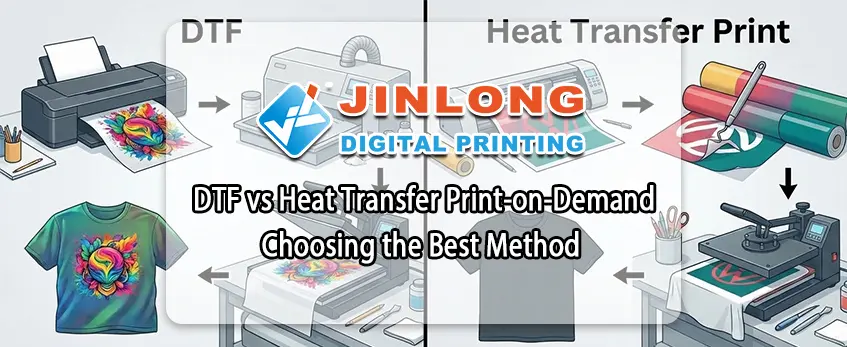
DTF vs Transfert de chaleur Impression à la demande Choisir la meilleure méthode
Comparaison des flux de travail : Vitesse et main d'œuvre dans le DTF par rapport au transfert de chaleur
Lorsqu'il s'agit de choisir entre le DTF (procédé d'impression directe sur film) et le vinyle à transfert de chaleur (HTV), il est important de comprendre les caractéristiques du DTF et du HTV. la rapidité du flux de travail et la main d'œuvre est la clé. Voici un aperçu des deux méthodes.
Le goulot d'étranglement du transfert de chaleur
Le transfert thermique consiste à découper des rouleaux de vinyle en motifs, puis à les découper manuellement. désherbage - enlever l'excès de vinyle autour de votre œuvre.
- Coupe et désherbage: Vous utilisez un découpeur de vinyle pour découper votre dessin vectoriel, puis vous enlevez (désherbez) le vinyle non désiré.
- Impact de la conception complexe: Des dessins plus complexes (lignes fines, petits détails) impliquent un temps de désherbage plus long, ce qui augmente la main-d'œuvre et ralentit la production.
- à forte intensité de main-d'œuvre, La qualité de l'impression est très élevée, en particulier pour les impressions très détaillées ou les textes comportant des micro-espaces.
L'avantage de l'absence de mauvaises herbes du DTF
DTF élimine entièrement l'étape de la coupe et du désherbage. Au lieu de cela, vous :
- Imprimer le dessin directement sur un film spécial.
- Appliquer une couche de poudre thermofusible.
- Guérison la poudre pour fixer l'encre.
- Presse à chaud le transfert sur le vêtement.
Ce flux de travail “imprimer, poudrer, durcir, presser” signifie qu'il n'y a pas de désherbage manuel, ce qui permet d'économiser beaucoup de temps.
Comparaison de l'efficacité : 1 chemise contre 100 chemises
| Méthode | 1 Chemise Délai de production | 100 chemises Délai de production | Intensité du travail |
|---|---|---|---|
| Transfert de chaleur (HTV) | ~15-20 minutes (y compris le désherbage) | Les heures de travail augmentent car chaque modèle est coupé/ désherbé individuellement | Élevé pour les conceptions complexes |
| DTF | ~10 minutes (impression et cuisson) | Beaucoup plus rapide grâce aux gang sheets (plusieurs transferts imprimés sur un seul film) | Faible, pas de désherbage nécessaire |
Principaux enseignements :
Pour les petits tirages, le HTV peut être gérable mais nécessite beaucoup de main-d'œuvre. Le DTF brille dans la production de masse avec une vitesse modulable et une main d'œuvre réduite, ce qui est parfait pour les marges de profit de l'impression à la demande.
En éliminant le goulot d'étranglement du désherbage, DTF offre un flux de travail rationalisé idéal pour les entreprises de POD qui cherchent à s'étendre efficacement.
Qualité d'impression et polyvalence de la conception
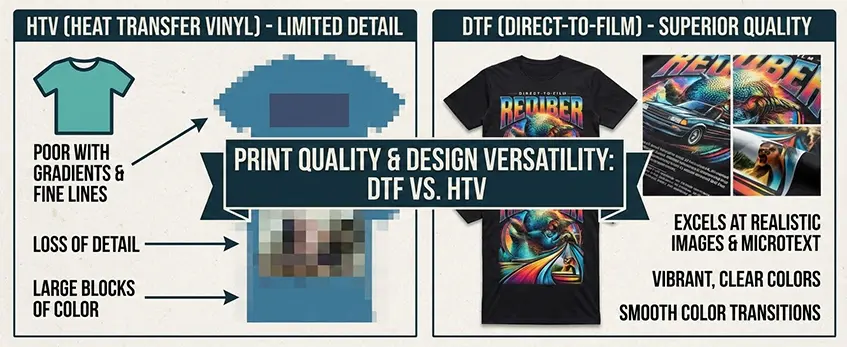
Lorsqu'il s'agit de qualité d'impression, L'impression DTF surpasse nettement le transfert thermique traditionnel, en particulier pour les dessins complexes. Le vinyle à transfert thermique (HTV) a des difficultés avec les dégradés, les lignes fines et les détails photographiques, car la découpe du vinyle ne peut pas reproduire correctement les fondus de couleurs lisses ou les détails serrés. Vous vous retrouvez souvent avec des blocs de couleur plus gros ou des nuances manquantes. En revanche, le DTF excelle dans l'impression images photoréalistes, dégradés et micro-textes avec des couleurs vives et nettes dès la sortie de l'imprimante. DTF est donc un choix de premier ordre lorsque vous avez besoin d'impressions détaillées et en couleur qui sautent aux yeux.
The \”Hand Feel\” (Texture)
Un facteur important de la satisfaction du client est la sensation de l'impression sur le vêtement. L'HTV offre généralement cette sensation classique. “sensation de ”plastique“ ou d”"autocollant, qui peut parfois être épaisse ou rigide. Cette texture n'est pas idéale pour ceux qui recherchent un toucher doux et naturel. Le DTF, en particulier avec les films et les poudres thermofusibles de qualité supérieure de Jinlong, produit une texture beaucoup plus douce. sensation de main plus douce et plus fine qui se fond presque parfaitement dans le tissu. Non seulement il est plus agréable au toucher, mais il donne l'impression de faire partie intégrante de la chemise plutôt que d'être une couche séparée.
Compatibilité des tissus
Les méthodes de transfert thermique ont leurs limites en ce qui concerne les types de tissus. La sublimation nécessite du polyester ou des mélanges à forte teneur en polyester, et le vinyle HTV n'adhère pas toujours bien aux tissus synthétiques ou aux matériaux délicats comme le nylon et le cuir. DTF propose compatibilité supérieure avec les tissus, Cette polyvalence permet de travailler sans problème sur le coton, le polyester, les mélanges, le nylon, le cuir et bien d'autres encore. Cette polyvalence en fait un outil idéal pour les entreprises ayant des gammes de produits variées, car un seul procédé suffit pour couvrir presque tous les types de vêtements.
Pour ceux qui souhaitent comprendre comment les films et les poudres de haute qualité influencent la texture et la durabilité des impressions, consultez cette explication détaillée sur le thème de l'impression. Types de films de transfert DTF et revêtements, Ce qui montre bien que tous les consommables DTF ne sont pas égaux.
Test de durabilité et de lavabilité
Lorsqu'il s'agit de durabilité, la tenue de votre impression dans le temps et au fil des cycles de lavage est essentielle. Avec le vinyle à transfert de chaleur (HTV), les impressions ont tendance à se craqueler et à se décoller lorsque le vêtement s'étire. Si vous tirez ou pliez le tissu, le vinyle réagit souvent de manière rigide, provoquant des fissures ou même des bords qui se soulèvent après plusieurs lavages. Ce phénomène est dû au fait que le HTV repose sur le tissu, ce qui le rend moins souple.
En revanche, les impressions DTF sont beaucoup plus résistantes à l'étirement et au rebond. Grâce à la poudre thermofusible qui se lie directement aux fibres du tissu lors du pressage, les transferts DTF se déplacent avec le vêtement et non contre lui. Cela permet de réduire les craquelures et de conserver votre motif intact, même après plusieurs cycles de lavage.
En ce qui concerne la lavabilité, le HTV commence généralement à se dégrader au bout de 20 à 30 lavages, avec des bords qui s'écaillent et des couleurs qui s'estompent. Le DTF fait beaucoup mieux, il dure plus longtemps sans perdre de luminosité ni d'adhérence. L'un des grands avantages du processus d'impression directe sur film est la possibilité de maintenir une qualité d'impression constante sur des vêtements sombres avec une encre blanche vibrante. La couche d'encre blanche du DTF conserve l'opacité et empêche les craquelures ou la décoloration - un problème souvent rencontré avec d'autres méthodes.
Cette combinaison de flexibilité, de durabilité et de résistance au lavage fait du DTF un concurrent de poids pour tous ceux qui souhaitent des impressions de haute qualité et de longue durée sans les problèmes d'entretien propres au HTV.
Pour en savoir plus sur l'impact des techniques d'impression textile sur la durabilité et la solidité des couleurs, consultez le guide suivant comment les techniques d'impression textile affectent la qualité, la couleur et la durabilité.
Analyse des coûts : Le retour sur investissement pour les chefs d'entreprise
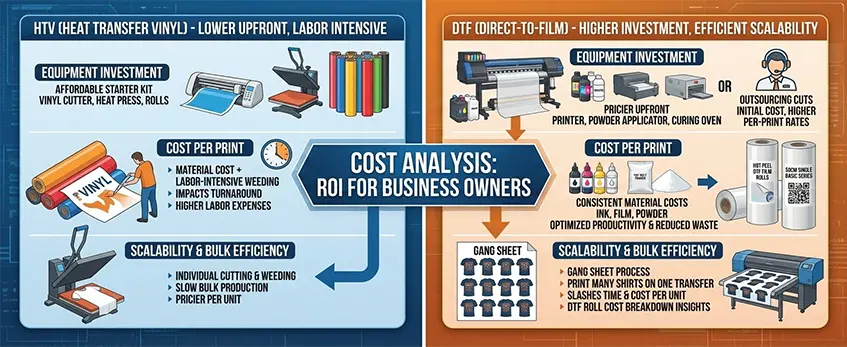
Lors de la pesée DTF vs transfert de chaleur pour votre entreprise d'impression à la demande, l'argent parle. Examinons les principaux facteurs de coût et le retour sur investissement :
Investissement en matériel
- Transfert de chaleur (HTV) commence généralement par une découpeuse de vinyle abordable pour les petits magasins. Vous disposez d'un massicot, d'une presse à chaud et de rouleaux de vinyle sans vous ruiner.
- Imprimantes DTF sont plus coûteux au départ, car ils nécessitent une imprimante spécialisée, un applicateur de poudre et un four de séchage. L'externalisation de vos transferts DTF peut réduire les coûts initiaux mais peut augmenter les tarifs par impression.
Coût par impression
- Transfert de chaleur Les coûts s'accumulent en raison des rouleaux de vinyle et du processus de “désherbage” à forte intensité de main-d'œuvre (découpe et décollage du vinyle non désiré). Cela a un impact sur les délais d'exécution et augmente les frais de main-d'œuvre.
- DTF comprennent l'encre, le film de transfert spécialisé et la poudre thermofusible. Vous constaterez que les coûts des matériaux sont constants et que les technologies modernes de l'information et de la communication (TIC) ont fait leurs preuves. Rouleaux de film DTF pelables à chaud optimiser la productivité et la réduction des déchets. Pour une ventilation détaillée des coûts, consultez les ressources suivantes Film de transfert DTF 50cm simple série de base.
Évolutivité et efficacité en vrac
- Le DTF brille par son volume. Son processus d'impression en bandes vous permet d'imprimer de nombreuses chemises sur un seul transfert, ce qui réduit le temps et le coût par unité. En revanche, le HTV nécessite une découpe et un désherbage individuels pour chaque motif, ce qui ralentit la production en masse et la rend plus onéreuse.
- Pour une tarification modulable et des bénéfices matériels, consultez les informations suivantes Ventilation des coûts du rouleau de DTF.
Dans : Si vous vous concentrez sur l'édition à grand tirage, Le DTF offre un meilleur retour sur investissement grâce à une production plus rapide, moins exigeante en main-d'œuvre et à des avantages en termes de coûts modulables. Toutefois, pour les petits volumes ou les travaux spécialisés, le HTV reste un choix judicieux pour de nombreux propriétaires de petites entreprises.
Quand utiliser Which ? Cas d'utilisation spécifiques
Quand s'en tenir au transfert thermique (HTV) ?
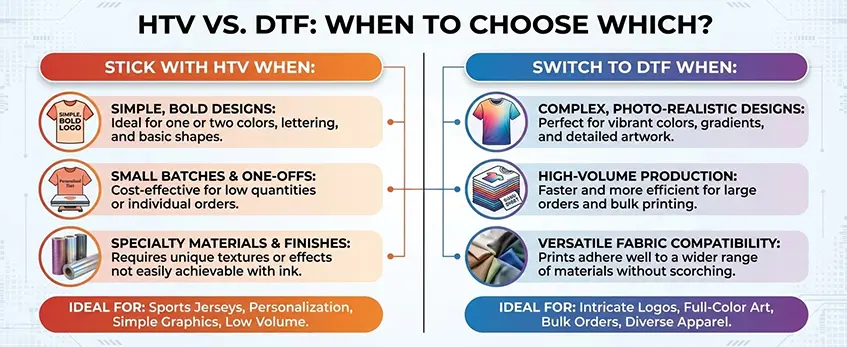
Le vinyle à transfert de chaleur (HTV) continue de briller pour les effets spéciaux que le DTF n'a pas encore totalement égalés. Si vos créations exigent à paillettes, à houppettes, réfléchissantes ou phosphorescentes le HTV reste le meilleur choix. Ces effets permettent d'obtenir des textures qui attirent l'attention et qui sont difficiles à reproduire avec les produits DTF. technologie de transfert sans désherbage.
En outre, pour les les emplois à très faible volume Comme pour les textes, noms ou chiffres personnalisés uniques, le HTV peut être plus rentable et plus rapide à produire sans le temps d'installation qu'exige une imprimante DTF. Le processus est simple si vous ne réalisez qu'une poignée d'impressions simples.
Quand passer au DTF
DTF excelle lorsque vos conceptions sont des logos en couleur ou des illustrations complexes, La plupart du temps, il s'agit d'un travail de précision, en particulier pour les dégradés et les détails photographiques que le HTV ne peut pas traiter facilement. Pour les les commandes en gros et l'impression à la demande (POD) à haut volume., Le flux de travail du DTF et sa capacité à imprimer des feuilles en bandes rendent le processus plus rapide et plus évolutif, réduisant ainsi vos coûts de temps et d'encre par impression.
Le DTF fonctionne également mieux sur tissus difficiles-qu'il s'agisse de coton, de polyester, de mélanges, de nylon ou même de cuir, sans les limites imposées par le transfert thermique ou la sublimation, ce qui offre une plus grande compatibilité avec les tissus en général.
En , utilisez le HTV pour les textures spéciales et les petits tirages, mais passez au DTF pour les motifs complexes et colorés et les travaux POD à grand volume, où la vitesse, la polyvalence et l'efficacité sont essentielles. marges bénéficiaires de l'impression à la demande sont essentiels.
Pour en savoir plus sur la façon dont la poudre thermofusible et les films de qualité supérieure de DTF améliorent la qualité du transfert, consultez le site Web de DTF. Film et poudre de transfert Jinlong DTF et comment optimiser vos tirages à la maison ou dans de petits ateliers avec Guide d'impression DTF de Jinlong.
Pourquoi les consommables de qualité sont importants : La différence Jinlong DTF
Tous les films et poudres DTF ne donnent pas les mêmes résultats. Lorsqu'il s'agit d'impression à la demande, des consommables de qualité le choix du bon film, de la bonne encre et de la bonne poudre thermofusible peut faire ou défaire votre production.
Qualité du film : Pelage à froid et pelage à chaud
- Films à pellicule froide: Se décolle après le refroidissement de la presse, ce qui permet d'obtenir des impressions nettes et détaillées.
- Hot Peel Films: Peler immédiatement après le pressage ; le flux de travail est plus rapide mais nécessite une synchronisation précise.
- Qualité du revêtement garantit une bonne adhérence de l'encre et empêche le décollement ou la décoloration.
Le choix d'un film de qualité supérieure a une incidence sur l'adhérence de votre dessin et sur l'éclat des couleurs.
Consistance de l'encre et de la poudre
- Cohérent Compatibilité des encres DTF évite le colmatage des têtes d'impression, un problème courant dans l'impression DTF.
- Uniforme application de la poudre thermofusible fusionne fermement les dessins dans les fibres du tissu, améliorant ainsi la durabilité et la lavabilité.
Éviter le colmatage des têtes d'impression et améliorer la durabilité
Des consommables de mauvaise qualité entraînent l'obstruction des buses, des temps d'arrêt et une maintenance coûteuse. Les consommables Jinlong sont conçus pour une impression fluide et des résultats durables, ce qui en fait un choix fiable pour les opérations POD sérieuses.
Solutions DTF de Jinlong pour les entreprises de POD
| Fonctionnalité | Bénéfice |
|---|---|
| Films de transfert de qualité supérieure | Impressions nettes, pas de décollement |
| Poudre de colle thermofusible écologique (lien) | Collage durable + moins de déchets |
| Compatibilité des encres | Évite le colmatage, couleur uniforme |
L'utilisation de consommables Jinlong de confiance garantit une qualité professionnelle et reproductible qui augmente les marges bénéficiaires de l'impression à la demande et la satisfaction des clients.
Découvrez comment Options de film de transfert Jinlong peut améliorer votre flux de travail d'impression DTF.


 English
 Español
 Deutsch
 Français