



DTF White Ink 2026 Innovations for Inkjet Printers High Opacity
If you’re in the DTF printing world, you know that white ink isn’t just another color — it’s the backbone of vibrant prints on dark fabrics. But let’s be honest: the current inks often clog nozzles, settle too fast, and lose opacity after a few washes. So, what’s changing by 2026? This next-gen DTF white ink for inkjet printers promises nano-dispersion tech, better wash fastness, and improved printhead compatibility that will let you print faster, cleaner, and brighter without the headache. Ready to see how innovation is redefining white ink for the future? Let’s dive into the breakthroughs shaping 2026.
Chemical Engineering: What’s Changing in Formula Stability?
In 2026, the DTF white ink for inkjet printers sees major advancements in formula stability, driven by cutting-edge chemical engineering breakthroughs. These changes are tailored to meet the needs of modern inkjet systems, especially those using piezoelectric printheads where stability and consistency are critical.
Nano-Dispersion Technology
- Enhanced pigment distribution: Nano-dispersion technology breaks down Titanium Dioxide (TiO2) particles into ultra-fine sizes, ensuring uniform suspension.
- Improved printhead compatibility: This finer dispersion reduces clogging, enhancing anti-clogging formulation efficiency.
- Consistent color output: The result is sharper CMYK+W color gamut and perfect layering during transfers.
Anti-Sedimentation Agents
- Longer ink stability: New anti-sedimentation agents prevent TiO2 particles from settling, maintaining the high-opacity underbase for extended print runs.
- Reduced maintenance: By keeping the pigment evenly suspended, these agents lower downtime caused by clogged nozzles and improve printhead damper maintenance intervals.
- Better shelf life: This results in a more reliable decrease of ink downtime and longer effective DTF ink viscosity retention.
Moisturizing Components
- Optimized flow and print quality: Advanced moisturizing additives regulate ink moisture balance, allowing smoother flow through tiny nozzles without sacrificing opacity.
- Preserves rheology: These components improve ink’s viscosity optimization, ensuring it remains filter-friendly and suitable for diverse substrates like PET film.
- Printhead health: Proper moisture levels reduce wear and tear on piezoelectric printheads, enhancing their longevity under typical curing temperature profiles.
Together, these chemical engineering advances position 2026 DTF white inks to deliver unmatched formula stability, superior printing reliability, and minimized printhead maintenance challenges.
Performance Metrics: Opacity and Whiteness Levels

When it comes to DTF white ink for inkjet printers in 2026, opacity and whiteness have taken a huge leap forward. The high-coverage formulas now use advanced Titanium Dioxide (TiO2) suspension techniques that produce a thicker, more consistent underbase. This means prints look vibrant and sharp on any garment, especially darker fabrics.
The whiteness index has improved dramatically, delivering a brighter, more neutral white that doesn\’t yellow over time. This boost really sharpens up the CMYK+W color gamut, so your designs pop with eye-catching clarity.
Plus, thanks to innovations like variable droplet technology, many inks now offer a \”one-pass\” capability. That cuts down on printing time and ink use while maintaining strong opacity — ideal for busy shops looking to scale without sacrificing quality.
If you’re looking to upgrade your setup or streamline production, getting familiar with these new performance standards is a must. For insights on integrating these high-opacity inks and maximizing durability, check out how every high-volume print shop benefits from a DTF printer with shaker and oven for consistent print results.
Compatibility and Rheology (Flow Properties)
One big leap for DTF white ink for inkjet printers in 2026 is viscosity optimization. Manufacturers have fine-tuned ink flow to ensure it runs smoothly through piezoelectric printheads without clogging. This anti-clogging formulation improves printhead damper maintenance and extends the life of your printer while maintaining sharp, consistent prints.
Filter friendliness is another focus area. The newer white inks feature titanium dioxide (TiO2) suspension technologies that keep particles evenly dispersed, reducing filter blockages and downtime. This means fewer interruptions and better reliability during long print runs.
When it comes to substrate versatility, these inks stick better on a wider range of materials—especially PET film adhesion has been enhanced for durable, vibrant transfers. Plus, improved rheology means the ink adapts well whether you’re printing fine details or broader coverage, supporting the full CMYK+W color gamut commonly needed in direct-to-film designs.
For those looking to upgrade their DTF printing setup in 2026, staying on top of these flow and compatibility improvements is essential for efficient, high-quality results. For a deep dive on innovations in DTF printing technology, check out why global apparel brands are switching to DTF in 2026.
Durability and Wash Fastness: The New Standard

When it comes to DTF white ink for inkjet printers in 2026, durability is a top priority. New formulations focus on stretch and rebound properties, allowing prints to flex with fabrics without cracking or peeling. This means whether you’re printing on stretchable TPU films or cotton blends, the ink keeps its integrity through everyday wear.
Wash cycle resistance has also improved significantly. Advanced binding agents and a refined Titanium Dioxide (TiO2) suspension help the ink withstand multiple washings without fading or losing opacity. This enhancement is crucial for apparel that undergoes repeated laundering, keeping the white underbase bold and vibrant.
Chemical resistance is another big leap forward. Modern DTF inks resist damage from detergents and solvents, making them ideal for activewear and industrial use. Whether you’re using high-opacity underbase prints for fashion or promotional items, these inks maintain their look and feel even under tough conditions.
For printers aiming to meet this new durability standard, check out reliable solutions like the JL DTF302S digital printer that support these advanced inks with optimized curing temperature profiles and ink circulation systems, ensuring consistent, long-lasting results.
Environmental Compliance and Safety (The 2026 Shift)
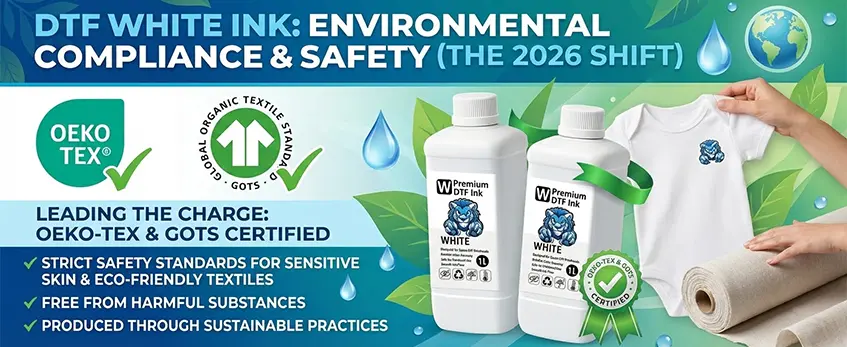
In 2026, environmental compliance for DTF white ink for inkjet printers is stepping up significantly. Leading the charge are certifications like OEKO-TEX and GOTS, ensuring inks meet strict standards for safety, especially for sensitive skin and eco-friendly textiles. This means using inks free from harmful substances and produced through sustainable practices.
Another big move is the reduction of glycol content in ink formulas. Glycol, commonly used as a solvent, is being minimized to lower environmental impact and improve workplace safety. This shift supports cleaner air and safer handling, which is crucial for print shops focusing on health standards and regulatory compliance.
Jinlong DTF is committed to these greener practices, integrating eco-friendly components without sacrificing the ink’s quality or performance. Their dedication to environmental responsibility makes their products a reliable choice for U.S. businesses aiming to stay ahead with sustainable, OEKO-TEX certified ink options. For those interested in high-quality, compliant materials, exploring Jinlong’s DTF transfer film options offers a glimpse into how sustainability and performance go hand in hand.
Troubleshooting vs. Prevention: Future-Proofing Your Setup
Keeping your DTF white ink for inkjet printers running smoothly in 2026 means focusing on prevention rather than constant troubleshooting. Establishing solid maintenance routines is key. Regular cleaning of the printhead damper and using an anti-clogging formulation helps avoid buildup that can disrupt the Titanium Dioxide (TiO2) suspension and cause print quality issues.
Additionally, managing the DTF ink viscosity through proper storage and circulation extends the shelf life and keeps the ink flowing well, ensuring consistent prints with your piezoelectric printhead compatibility. Using the right storage conditions, like controlling temperature and humidity, also supports the ink\’s chemical stability and prevents sedimentation, which in turn improves performance over time.
For those looking to boost productivity, preventing downtime with routine care is smarter than repeatedly fixing problems. This approach lets you enjoy the benefits of high-opacity underbase layers and reliable PET film adhesion for long-lasting vibrant prints.
For detailed tips on keeping your DTF setup in top shape, check out our guide on the 2026 year DTF printer with white ink for dark fabrics. It covers practical maintenance and storage strategies to protect your investment and deliver consistent quality.
By focusing on prevention over troubleshooting, you future-proof your inkjet printer setup and get the most out of the advanced features in 2026’s DTF white ink technology.
Recommended Products
-
DTF Ink white 100ml [Pro Series]
View more View more原价为:$3.50。$2.51当前价格为:$2.51。 -
DTF Ink white 1L/1000ml [Pro Series]
View more View more原价为:$29.00。$25.10当前价格为:$25.10。 -
DTF Ink white 1L/1000ml [Basic Series]
View more View more原价为:$15.00。$8.00当前价格为:$8.00。 -
DTF Ink white 1L/1000ml [Std Series]
View more View more原价为:$17.00。$10.90当前价格为:$10.90。 -
DTF Ink Cmyk 100ml [Basic Series]
View more View more原价为:$2.00。$0.80当前价格为:$0.80。
![DTF Ink white 100ml [Pro Series]](http://jinlongprints.com/wp-content/uploads/2025/08/P-白-2-300x300.webp)
![DTF Ink white 1L/1000ml [Pro Series]](http://jinlongprints.com/wp-content/uploads/2025/07/JL-ink604p-w-300x300.webp)
![DTF Ink white 1L/1000ml [Basic Series]](http://jinlongprints.com/wp-content/uploads/2025/07/JL-ink604B-W-1-300x300.webp)
![DTF Ink white 1L/1000ml [Std Series]](http://jinlongprints.com/wp-content/uploads/2025/07/JL-ink604S-W-300x300.webp)
![DTF Ink Cmyk 100ml [Basic Series]](http://jinlongprints.com/wp-content/uploads/2025/08/B系列1-300x300.webp)



 English
  Español
  Deutsch
  Français