
No products in the cart.

JinlongPrints
Cold Peel vs Hot Peel vs Instant Peel DTF Film | How to Choose DTF Transfer Film
When operating a garment printing business using DTF technology, your choice of transfer film directly determines production stability, print quality, hand feel, production speed and reject rate. Three primary DTF film types are widely used worldwide: cold peel, hot peel, and instant peel. Many print shop owners still get confused about which one matches their production line.
Below we explain each DTF film in detail, including working methods, pros, cons and suitable application scenarios.
1. Hot Peel DTF Film
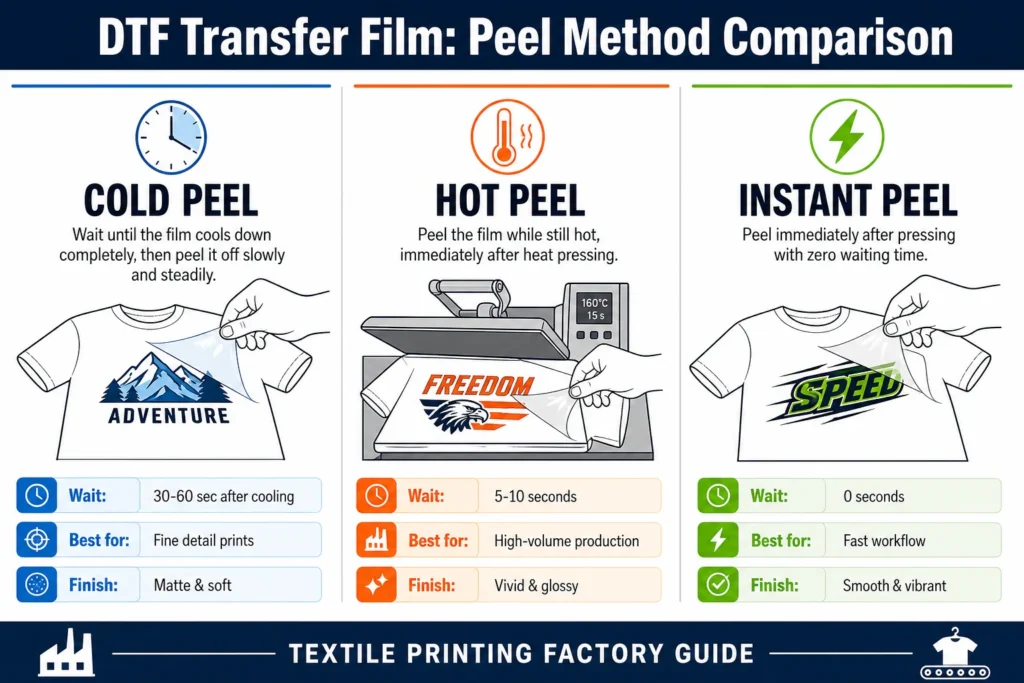
How to use: Peel the film right away while the transfer is still hot after heat pressing.
Advantages
- Provides the softest hand feel among three types;
- Better ink penetration, great wash resistance and less cracking;
- Clean edges for fine, intricate artwork.
Disadvantages
- Requires experienced operators; improper peeling may cause pattern lifting;
- Not ideal for ultra-high-speed mass production.
Best fit: High-end fashion apparel, small-batch custom clothing, cotton garments.
2. Cold Peel DTF Film
How to use: Wait 10–25 seconds after heat transfer. Peel the film only after the print cools fully.
Advantages
- Very stable and beginner-friendly, low failure rate;
- Good opacity, performs excellently on dark fabrics;
- Less static and ink scattering during peeling.
Disadvantages
- Extra cooling waiting time reduces overall production efficiency;
- Hand feel is firmer compared with hot peel film.
Best fit: New print shops, bulk casual apparel, dark t-shirt printing.
3. Instant Peel DTF Film
How to use: Complete peeling immediately once heat pressing finishes, zero waiting time.
Advantages
- Highest production efficiency, perfect for large-volume factories;
- Consistent peeling performance, saves plenty of working hours;
- Compatible with most mainstream DTF printers and powder shakers.
Disadvantages
- Hand feel is slightly harder than hot peel DTF film.
Best fit: Large printing factories, seasonal bulk orders, high daily output demands.
Quick Selection Checklist
✅ Soft touch & premium quality requirements → Hot Peel DTF Film
✅ Stable operation & minimum waste rate → Cold Peel DTF Film
✅ Max production speed & huge order volume → Instant Peel DTF Film
Important Reminders
The final peeling result is also affected by fabric composition, heat press temperature, pressure, dwell time and matched DTF ink. We strongly recommend testing film samples on your own fabrics before bulk orders.
If you are not sure which DTF film suits your workflow, contact us to get free samples for testing.


 English
 Español
 Deutsch
 Français