
No products in the cart.

Jinlong
TPU Powder Compatibility Guide for Film Ink and Fabric Adhesion
Understanding TPU Powder Characteristics
When working with TPU powder, knowing the basics can save you from common pitfalls in your DTF process. Let’s break down the key factors affecting performance and compatibility.
Particle Size Matters (Mesh Count)
TPU powder comes in different particle sizes that impact the print’s final look and durability:
| Particle Size (Microns) | Best Use Case |
|---|---|
| Fine (0-80 microns) | Detailed designs, small text, fine lines |
| Medium/Coarse (80-200 microns) | Heavy coverage, thick designs, max durability |
- Fine powder melts evenly for crisp edges and smooth finishes on intricate images.
- Coarse powder creates robust layers, perfect for long-lasting prints and bold graphics.
Melting Points: Low-Melt vs. High-Melt TPU Powder
Choosing the right melting point really depends on the fabric you’re pressing onto:
- Low-melt TPU powder is gentler, ideal for sensitive fabrics like nylon or blends that can’t take high heat.
- High-melt TPU powder provides stronger adhesion and durability on tougher substrates like cotton or polyester but requires higher pressing temperatures.
Color Variations: White vs. Black TPU Powder
Using the right color TPU powder is crucial for your design’s integrity and wash fastness:
- White TPU powder is the standard choice for most applications, providing a clean base for prints on light fabrics.
- Black TPU powder (anti-migration black powder) is specially formulated to prevent dye migration on dark polyester garments, reducing discoloration and bleeding issues.
Understanding these TPU powder characteristics helps you match the powder to your design, film, and fabric — setting a solid foundation for flawless prints every time.
Compatibility Vector A: TPU Powder & DTF Ink
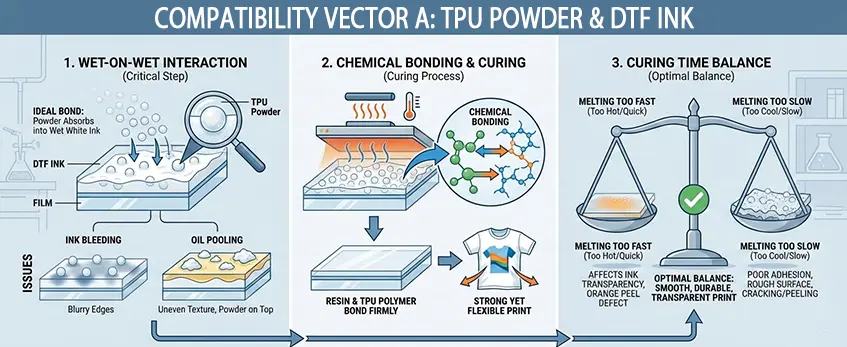
When working with TPU powder and DTF ink, the wet-on-wet interaction is critical. The powder must properly absorb into the wet white ink layer to avoid common issues like ink bleeding or oil pooling. If the powder sits on top instead of bonding well, it can cause blurry edges or uneven texture.
Chemical bonding plays a major role here. The resin in the DTF ink needs to aggressively bind with the TPU polymer during curing to create a strong, flexible print. Without this bond, the design risks cracking or peeling after transfer.
Curing times are another key factor. Balancing the ink’s drying time with the TPU powder’s melting point prevents defects such as orange peel textures or rough surfaces. Too fast a melt can ruin ink clarity, while too slow leads to poor adhesion. Finding a sweet spot ensures smooth, durable prints.
For optimizing this entire process, following a proper DTF consumables workflow can help you maintain consistent results with TPU powder and ink compatibility.
Compatibility Vector B: TPU Powder & PET Film
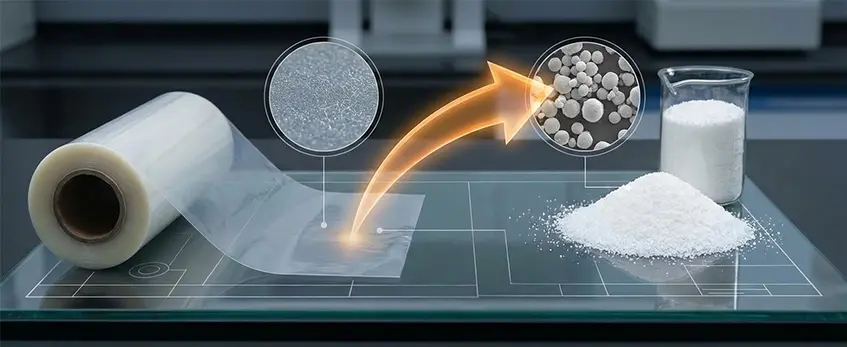
When working with TPU powder and PET transfer film, understanding their interaction is key to clean, durable transfers. The film’s release coating can cause static, making stray powder stick where it shouldn’t. To solve this, use anti-static measures or powders designed for better electrostatic adhesion, which keeps the powder in place without excess residue.
Matching the TPU powder to your film’s peel type is crucial. Hot peel films require powders with a melting point that supports strong bonding without sticking to the peel surface, while cold peel films need powders that stay tacky longer to ensure complete transfer. Using the wrong powder might cause parts of your design to lift or peel off during removal, leading to frustrating reprints and wasted materials.
For best results, consider the powder’s melting behavior in relation to the PET transfer film\’s release properties. This subtle pairing is what guarantees crisp lines and a long-lasting print.
For more on selecting the right PET film and optimizing your DTF workflow, check out this detailed guide on DTF transfer film options and performance.
Compatibility Vector C: TPU Powder & Fabrics (Substrates)
When working with TPU powder on different fabrics, knowing the right match is crucial for durability and comfort.
Cotton & Natural Fibers
These fabrics need breathability and a soft hand feel. Using a medium grain powder helps the TPU penetrate deeply into the fibers without making the print stiff. This balance maintains comfort while ensuring a strong bond.
Polyester & Synthetics
Polyester tends to have dye migration issues during heat pressing, which can cause unwanted color bleeding. Using Black TPU powder with anti-migration properties prevents this, locking in vibrant colors without transfer defects. This approach is essential for high-quality prints on synthetic fabrics.
Nylon & Waterproof Materials
Adhesion can be tricky on nylon and waterproof textiles like windbreakers. Low-temperature, high-tack TPU powders are your best bet here. They stick well without damaging the fabric’s waterproof coating or texture.
Stretchability (Spandex/Lycra)
For stretchy fabrics, TPU powders must have high elasticity to prevent cracking when the fabric stretches. Look for TPU powders specifically formulated for spandex or Lycra blends to maintain flexibility and durability.
To dive deeper into optimizing your fabric printing workflow, check out our guide on top textile printing techniques. This will help you understand how TPU powder fits into the bigger picture of fabric print compatibility.
The Jinlong DTF Compatibility Protocol (Best Practices)
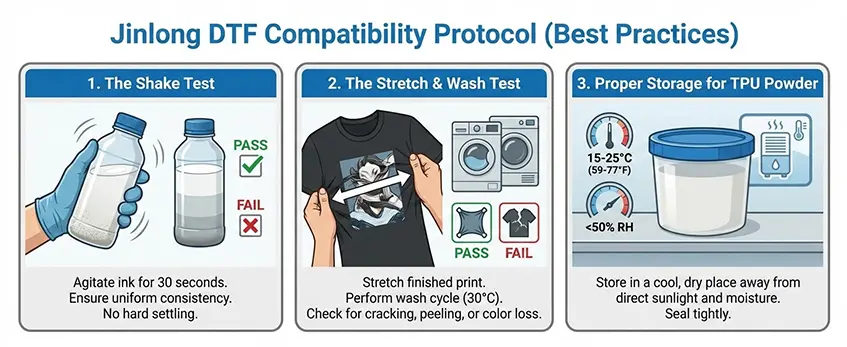
To get the best results with TPU powder in your DTF printing, Jinlong recommends a few key tests and storage tips.
The Shake Test
Before curing, gently shake the film to check for powder adhesion. If powder falls off easily, it signals poor electrostatic adhesion or ink viscosity issues that need correction to avoid weak bonding later on. This quick step helps ensure the TPU powder properly sticks to the wet white ink layer on your DTF transfer film.
The Stretch & Wash Test
After curing and heat pressing, always perform a stretch and wash test on the fabric. This standard quality check confirms the TPU powder’s wash fastness and elasticity. It helps spot early signs of cracking, peeling, or dye migration so you can adjust your powder’s melting point or particle size accordingly.
Proper Storage for TPU Powder
Humidity can degrade TPU powder performance and mess with ink compatibility. Store your powders in a dry, climate-controlled environment to maintain consistent melting behavior and prevent clumping. Proper storage safeguards your entire DTF consumables workflow and ensures print quality stays top-notch.
For a smoother workflow, pair these best practices with high-quality DTF ink formulas and premium PET transfer films. These products are designed to work seamlessly with TPU powders to give you vibrant, durable prints every time.
Troubleshooting Common Mismatch Issues with TPU Powder
When your print falls off after washing, it often means the TPU powder’s melting point was too low or you chose the wrong powder type for the fabric. Using a low-melt powder on heavy fabrics or a high-melt powder on sensitive ones can cause weak adhesion and premature peeling.
Pinholes appearing in your design? This usually happens when the powder’s particle size is too coarse compared to the ink density. Coarse particles won’t evenly fill all the ink gaps, leaving tiny holes that ruin the print’s smooth finish.
Noticed white edges on dark shirts? That’s a classic sign of powder static issues with your PET transfer film. Static causes stray TPU powder to cling where it shouldn’t, creating unsightly white halos around your design. Managing electrostatic adhesion and sometimes adjusting humidity levels can fix this.
These troubleshooting tips help maintain a solid bond and sharp print quality, boosting your wash fastness rating and overall durability. For deeper insights into film and powder compatibility, check out our detailed guide on DTF film vs. regular transfer film.


 English
 Español
 Deutsch
 Français