

No products in the cart.

Jinlong
DTF Printer White Ink vs CMYK Only Differences and Benefits
The Technical Basics: CMYK vs. CMYK+W
When choosing a DTF printer, understanding the difference between CMYK only and CMYK+W (white ink) setups is critical. Let’s break down the basics.
What is CMYK Only?
CMYK stands for Cyan, Magenta, Yellow, and Key (Black)—the standard 4-color printing process used worldwide. Each color layer overlaps to reproduce a wide range of hues.
| Color | Purpose |
|---|---|
| Cyan | Primary blue-green tone |
| Magenta | Red-pink shades |
| Yellow | Bright yellow highlights |
| Black (Key) | Depth, shading, and contrast |
CMYK printing relies heavily on the background color—especially white—to create lighter shades. When printing on white paper or light-colored fabric, the white base reflects the light, making colors appear bright and accurate. Without a white background, the ink’s translucency makes colors dull or “washed out.”
What is the White Ink Channel (W)?
The white ink channel adds a fifth color—white—into the mix. This \”fifth color\” acts as an opacity layer, creating a solid barrier between the substrate (fabric or garment) and the color print on top.
- White ink prevents colors from blending with the garment’s base color.
- It acts like a primer or underbase, making prints vibrant on any color fabric—even dark ones.
Think of it this way: without white ink, you’re painting on glass—colors don’t block what’s underneath. With white ink, it’s like painting on a white wall; everything pops.
| Feature | CMYK Only | CMYK+W (White Ink) |
|---|---|---|
| Colors printed | 4 (C, M, Y, K) | 5 (C, M, Y, K + White) |
| Opacity | Translucent | Solid white underbase |
| Works well on | White/light fabric | All fabric colors |
| Print vibrancy | Limited | High |
To sum it up: CMYK only depends on a white or light substrate to shine, while CMYK+W uses white ink to create a neutral canvas under the colors—boosting vibrancy and opacity for all garment colors. This is the foundation of why white ink is a game changer for DTF printing.
The Heart of the Issue: Substrate Compatibility
Scenario A: Printing on White/Light Garments
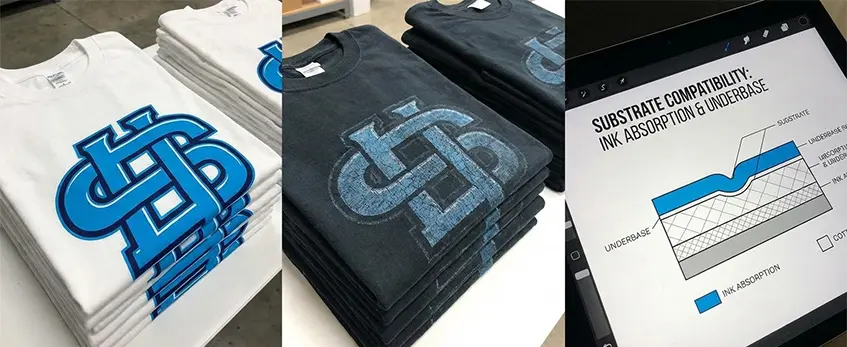
With a CMYK-only setup, printing on white or light-colored fabrics like polyester or cotton is possible, somewhat similar to sublimation. Since the garment itself provides the white background, the inks rely on that to show lighter tones and highlights. However, without a dedicated white underbase, the colors can appear washed out or less vibrant than expected. This happens because CMYK inks are translucent, so the fabric color affects the final print’s brightness and clarity.
Scenario B: Printing on Dark/Black Garments (The Dealbreaker)
Here’s where CMYK-only printers hit a wall—literally. When printing on dark or black garments, CMYK inks don’t provide a solid base, so colors, especially reds and lighter shades, seem to vanish into the fabric. It’s like trying to paint bright colors directly onto a black wall—they just don’t pop without a primer.
That’s why the white underbase is crucial. White ink acts as a solid barrier between the fabric and the color inks, making your designs vibrant and true-to-color on dark surfaces. Think of it as that essential white primer that prepares the black canvas, ensuring colors “pop” and don’t get swallowed up by the dark background.
This is a key reason why DTF printers with white ink are favored for versatility—they handle printing across all garment colors without compromising vibrancy or detail. For those looking to expand into dark garment transfers profitably, investing in a white ink-enabled setup is a must.
For more on DTF printing materials that work seamlessly with white ink, consider checking out our TPU DTF hot melt adhesive powder, designed to enhance durability and wash fastness on all substrates.
Print Quality and Vibrancy
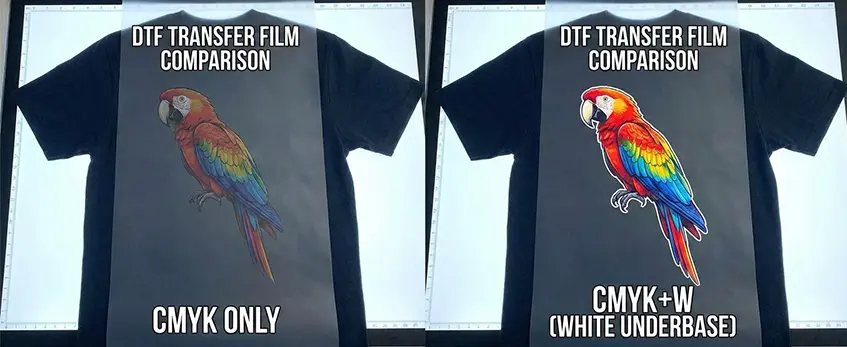
When it comes to print quality, using a DTF printer with white ink makes a huge difference. White ink acts like a neutral canvas underneath your colors, ensuring that the printed design shows true color accuracy no matter the color of the garment. Without this white underbase, CMYK-only prints can appear dull or washed out, especially on darker fabrics.
The texture and feel of transfers from CMYK+W printers are noticeably better too. Adding white ink creates a more durable, professional-grade transfer that feels smoother and less stiff—giving your prints a premium \”hand\” that customers appreciate.
Versatility is another major plus. Printers with white ink can handle virtually any garment color, from bright whites to rich blacks and everything in between. On the other hand, CMYK-only setups are mostly limited to printing on white or very light-colored shirts, which restricts your product range and potential sales.
For more on how white ink improves direct-to-film vibrancy and overall print quality, check out this detailed DTF printer setup guide from printing to heat press.
The Elephant in the Room: White Ink Maintenance
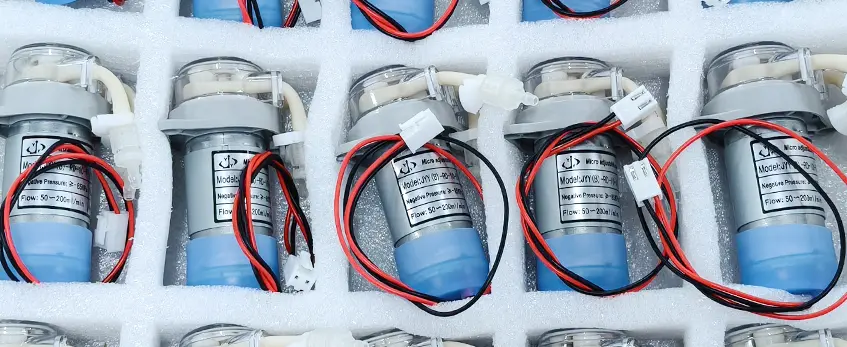
White ink brings serious benefits but also some real challenges—especially when it comes to maintenance. The main issue is titanium dioxide sedimentation. Since white ink contains heavy pigments like titanium dioxide, it tends to settle at the bottom of the ink tanks. This sediment can cause clogged piezoelectric printheads if not handled properly, leading to downtime and costly repairs.
This is where the Jinlong DTF solution stands out. Jinlong DTF printers come equipped with advanced white ink circulation and stirring systems. These systems keep the white ink moving constantly, preventing sediment buildup and reducing the risk of printhead clogging. Plus, Jinlong automates this entire process, so operators don’t have to worry about manual stirring or frequent cleaning cycles.
By automating white ink management, Jinlong DTF printers make maintaining white ink simple and reliable, ensuring consistent, high-quality prints without the headaches typically associated with titanium dioxide sediment. For more tips on avoiding print issues and keeping your DTF transfers flawless, check out our detailed guide on how to avoid cracking and fading in DTF transfers.
Cost vs. Value Analysis
When it comes to setting up a DTF printer with white ink versus a CMYK-only machine, the initial investment is definitely a factor. CMYK-only setups tend to be cheaper upfront since they skip the white ink channel and its added components. This makes them attractive for those just starting or focusing strictly on light-colored garments.
However, the opportunity cost is where things get interesting. Using CMYK-only significantly limits your market—you’ll miss out on profitable orders involving dark garment transfers. Without white ink, your prints on black or colored fabrics won’t pop. That means turning down clients or losing potential revenue just because your printer can’t produce vibrant results on dark shirts.
On the consumables side, white ink is pricier than standard CMYK inks. It contains titanium dioxide, which adds to the material cost and requires special maintenance like circulation systems to prevent printhead clogging. But look at it as an investment in quality and versatility. White ink-enabled printers open up a wider color gamut and allow you to charge premium prices for crisp, professional prints on any garment color.
In short: while CMYK-only DTF printers save money upfront, the value white ink brings through expanded business opportunities and better print quality often outweighs the extra cost—especially if you’re serious about growing your apparel printing business.
For a deeper dive into white ink management and its benefits, check out our detailed guide on why white inkjet ink is essential for DTF printing.




 English
 Español
 Deutsch
 Français