
No products in the cart.


Jinlong
DTF Printers 2026 Prices and Key Cost Factors Explained
2026 Price Breakdown by Printer Category
When considering how much are DTF printers in 2026, it\’s important to understand the price differences based on printer categories. Whether you need a simple desktop model or an industrial-grade system, costs vary widely depending on size, features, and intended use.
Entry-Level / Desktop Systems (A3/A4 Size)
- Price range: $1,200 – $3,500
- These compact A3/A4 size DTF printers are perfect for hobbyists, startups, or small businesses looking to produce lower volumes.
- They often come as all-in-one units with integrated powder shakers but may lack advanced automation.
- Ideal for limited workspace and lower initial investment, but expect moderate speed and print quality.
Mid-Range Commercial Systems (60cm / 24-inch)
- Price range: $6,000 – $15,000
- Mid-level 60cm DTF printers are the sweet spot for growing businesses.
- They offer faster print speeds, higher resolution, and more robust build quality compared to entry-level systems.
- These printers include better printhead technology and often support RIP software for DTF processing, boosting efficiency.
- Suitable for commercial shops aiming for consistent volume without the industrial price tag.
Industrial / Mass Production Systems (60cm – 120cm Multi-head)
- Price range: $20,000 – $75,000+
- These are high-capacity machines designed for mass production with multiple printheads covering widths from 60cm up to 120cm.
- Equipped with advanced mechanics, automated powder shakers, and curing units, they maximize throughput and minimize downtime.
- This category supports bulk orders and extensive textile printing needs, often backed by extensive service and upgrade options.
- Industrial DTF printer specifications prioritize durability, speed, and seamless integration into production lines, making them the top choice for large-scale commercial printers.
Understanding this 2026 DTF printer price list helps you match your business demands with the right technology and investment level. The right choice not only fits your budget but also supports your growth and operational goals.
What Affects the Cost? (The Technical Deep Dive)
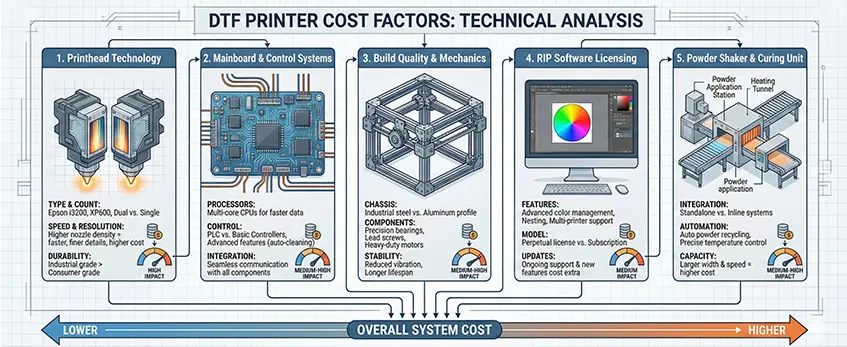
Several key components influence the price of DTF printers in 2026, and understanding these factors helps explain why some machines cost more than others.
| Component | Impact on Price | Details |
|---|---|---|
| Printhead Technology | Highest cost driver | Printheads are the heart of any DTF printer. Advanced models like Epson i3200 push prices up but offer better quality and durability. Dual head DTF printer price also rises with more printheads for speed. |
| Mainboard & Control Systems | Medium to high | Reliable electronics ensure stable operation and precision. More advanced control boards add to the cost but improve performance and ease of use. |
| Build Quality & Mechanics | Medium to high | Heavy-duty frames and precise mechanics increase durability and print consistency. Industrial DTF printer specifications demand high-quality parts to handle continuous use. |
| RIP Software Licensing | Moderate | Professional RIP software, crucial for color management and print control, often requires a license fee, impacting the overall cost. |
| Powder Shaker & Curing Unit | Moderate to high | Automated DTF powder shaker units and curing equipment add convenience and efficiency but are an extra cost outside the basic printer price. |
Each factor plays a role in the total cost of ownership and affects not just upfront pricing but also long-term reliability and print quality. When comparing cheap vs expensive DTF printers, it’s critical to consider these technical components rather than just the sticker price.
For a better understanding of how to handle key supplies like DTF powder, check out our guide on the best DTF powder for wash resistance and stretchability.
Hidden Costs of Ownership (TCO)
When budgeting for a DTF printer in 2026, it’s crucial to look beyond the upfront purchase price. The total cost of ownership (TCO) includes several ongoing expenses that can significantly impact your bottom line.
Consumables: Ink, Film, and Powder Costs
DTF ink, transfer film, and hot-melt powder are essential for printing, and their costs add up over time. Quality ink and powder are vital for consistent prints and durability, but they come at a premium. Understanding the ongoing DTF ink and powder costs helps avoid surprises, especially with mid-range and industrial printers that use higher volumes.
Maintenance Parts
Parts like printheads, wiper blades, and rollers wear out and need regular replacement. Maintenance isn’t optional—neglecting it can lead to downtime and costly repairs. Budget for routine part replacements and unexpected repairs to keep your printer running smoothly.
Shipping & Import Duties
For U.S. buyers importing commercial or industrial DTF printing machines, shipping fees and import duties add a notable expense. Weigh these costs when selecting international models, as they can vary widely based on size and origin.
Power Consumption
Industrial and mass production DTF printers with multiple heads or larger sizes consume more electricity. Even entry-level systems require steady power. Calculating estimated energy use can help you anticipate monthly operating costs and improve your overall ROI.
Considering hidden costs is key when evaluating how much are DTF printers in 2026, as these ongoing expenses often surpass the initial price tag over time. For a clear picture of operating needs, explore detailed specifications of industrial and commercial DTF printers, and understand the maintenance requirements to achieve the best value.
For more on the materials that affect cost and quality, check out our guide on hot melt glue powder particle sizes explained.
2026 Trends Influencing Pricing
Several trends are shaping the DTF printer price list 2026, affecting what buyers can expect to pay. Understanding these factors helps you make smarter purchasing decisions, especially if you\’re balancing cost and long-term value.
| Trend | Impact on Cost | Why It Matters |
|---|---|---|
| Automation Features | Raises upfront price | Automated powder shakers and curing units cut labor costs but add to machine complexity and cost. These upgrades lead to better efficiency and consistent quality for commercial users. |
| Eco-Friendly Technologies | Moderate price increase | Eco-conscious ink and powder options help reduce environmental impact. Machines with energy-saving modes or less wasteful processes come at a premium but appeal to sustainable brands. |
| Supply Chain Stability | Can cause price fluctuations | Ongoing supply chain issues impact availability and cost of key components, like printheads and mainboards, sometimes causing sudden spikes or delays in industrial DTF printer specifications. |
Automation is a key trend, especially for mid-range and industrial models, where features like an automated powder shaker streamline production and improve output. This is reflected in pricing, with fully automated systems typically costing more initially but lowering overall operational costs.
Eco-friendly tech is another crucial factor. Printers incorporating sustainable materials or energy-saving designs may carry a slightly higher price tag, but they align with growing consumer and regulatory demands.
Lastly, supply chain stability plays a less predictable role. While it doesn\’t always drive steady price increases, sudden shortages or tariffs can impact delivery times and add hidden costs.
For those concerned about ink and powder management, proper storage and handling can also influence the total cost of ownership. Our guide on how to store white inkjet ink properly to prevent settling and clogging offers useful tips to keep consumable costs in check.
Overall, watching these trends can save you money and future-proof your investment in 2026’s DTF printing equipment.
ROI Analysis: When Does the Printer Pay for Itself?
Understanding the return on investment (ROI) for a DTF printer is crucial before making any purchase in 2026. The big question: How long until your printer pays for itself? This depends on several key factors like initial cost, print speed, and ongoing expenses.
Break-even Calculation
To calculate the break-even point, start by tallying the total cost of your printer — including hidden costs like DTF ink and powder costs, maintenance, and software licenses. Then, estimate how many prints you need to sell to cover that upfront investment. For example, if your printer and setup cost $10,000, and your profit per print is $5 after consumables, you’ll need to deliver 2,000 prints to break even.
Speed vs. Profit
Speed plays a huge role. Faster printers, especially those industrial or mid-range commercial DTF printing machines, can produce more prints per hour, shortening your break-even time but usually at a higher initial price. Slower, entry-level or desktop printers mean lower upfront costs but slower ROI due to limited output capacity.
Keep in mind: the most expensive printer isn\’t always the best choice if your workload doesn’t justify it. Balancing printer speed with your business size and print volume is vital. To get a clearer picture, consider tools like total cost of ownership (TCO) models, factoring in consumables and maintenance.
If you’re curious about optimizing your ROI further, exploring high-quality supplies such as premium transfer films can improve print durability and appeal, which you can learn more about in our guide on DTF transfer film quality.
By aligning printer capabilities with your production needs, you’ll find the sweet spot where your DTF printer starts putting money back into your business quickly and efficiently.
Why Choose Jinlong DTF?
When considering how much are DTF printers in 2026, Jinlong offers compelling advantages that blend competitive pricing with strong support and future-proof features.
Competitive Pricing Advantages
Jinlong DTF printers strike a solid balance between cost and performance. Unlike some cheap vs expensive DTF printers, Jinlong models provide high-quality print output without a huge upfront investment. Their pricing remains competitive across the board—whether you\’re looking at entry-level desktop machines or industrial DTF printer specifications for mass production. This makes them a great choice for U.S. businesses aiming to maximize ROI without compromising on quality.
| Printer Category | Jinlong Approx. Price (USD) | Key Benefit |
|---|---|---|
| Entry-Level (A3/A4) | $1,200 – $2,500 | Affordable for startups |
| Mid-Range Commercial (24\”) | $6,000 – $10,000 | Balanced speed and volume |
| Industrial (Multi-head) | $15,000 – $30,000 | High-speed, large-volume runs |
Support Ecosystem
Jinlong shines with its comprehensive U.S.-based support. This includes quick access to maintenance parts, responsive customer service, and handy resources for troubleshooting. Their support helps minimize downtime and maintenance costs, key factors when calculating the total cost of ownership DTF. Plus, their knowledgeable team guides new users through software setups, including RIP software for DTF.
Future-Proofing and Upgradeability
Investing in a Jinlong printer means you’re set for the future. Many models come with upgrade options for heads, firmware, and automation add-ons like the automated DTF powder shaker and curing units. This flexible approach means your system can grow with your business needs, protecting your initial purchase from depreciation and obsolescence.
For businesses interested in lowering powder-related issues, check out how a DTF printer with shaker and oven significantly improves transfer durability and efficiency.
Choosing Jinlong means you’re backed by competitive pricing, strong support, and scalable technology—key for U.S. textile printers looking to stay ahead in 2026 and beyond.


 English
 Español
 Deutsch
 Français