


Why Professional Print Shops Choose DTF Printers and Shaker Systems
What Is DTF Printing and Why the Complete System Matters
Direct-to-Film (DTF) printing is an innovative method that involves printing designs directly onto a special film before transferring them onto fabrics like cotton, polyester, and blends. This process uses water-based inks paired with a hot melt adhesive powder, which ensures vibrant color transfer and durable prints. A complete DTF system includes a high-quality DTF printer, an automated powder shaker, and a curing oven – all essential to achieve consistent, professional results.
The automated shaker plays a critical role by evenly applying adhesive powder over the wet ink, which then cures uniformly with heat. This precision eliminates common problems such as patchy adhesion or powder clumps, which can compromise print durability and appearance. Manual powder application, by contrast, often leads to inconsistent finishes and increased labor costs.
An integrated Jinlong DTF printer and shaker setup offers streamlined workflow benefits. By synchronizing printing, powder application, and curing steps, Jinlong’s system significantly reduces processing time and labor, while delivering repeatable, high-quality results. This seamless synergy is why professional print shops rely on such complete systems for superior Direct-to-Film printing performance.
Key Advantages Driving Professional Adoption
Professional print shops are turning to DTF printers and shaker systems because of the strong benefits they bring to various print jobs. One of the biggest advantages is versatility—DTF printing works well on a wide range of fabrics, from cotton and polyester to blends, making it great for diverse apparel needs. This flexibility lets shops expand their offerings without investing in multiple machines.
Print quality and durability are also standout reasons pros choose DTF. The direct to film transfer durability ensures vibrant, long-lasting prints that hold up through many washes. This means customers get high-quality results that resist cracking and fading, helping shops build strong reputations.
Efficiency is key in short-to-medium print runs where turnaround time matters. DTF systems streamline production without sacrificing quality, making small batches profitable. Plus, automation with a shaker system cuts down on labor and space requirements, which keeps operational costs low.
Cost-effectiveness comes from reduced waste too. Precise powder application means less material is wasted, saving money over time. And when it’s paired with a reliable DTF printer, the scalability to handle high-volume production becomes a real asset for growing businesses.
Overall, DTF printing offers a blend of quality, speed, and cost control that’s hard to beat, making it the go-to choice for many US print shops looking to stay competitive.
The Critical Role of the DTF Shaker System
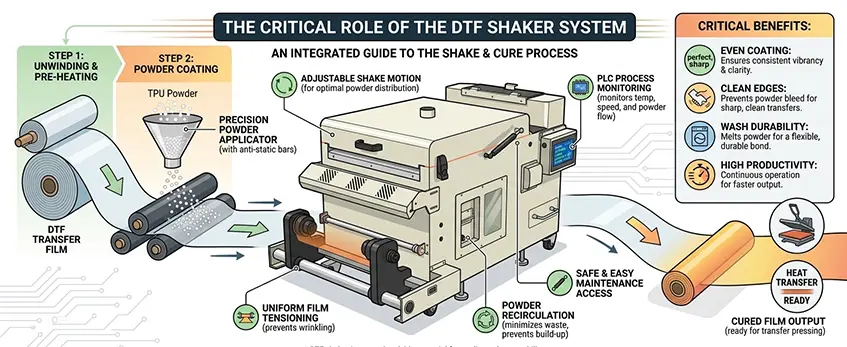
A quality DTF shaker system is a must-have for consistent powder application. Without uniform distribution of the hot melt adhesive powder, prints risk uneven curing, leading to poor durability and faded colors after washing.
Why Automated Shakers Outperform Manual Methods
| Feature | Manual Shaker | Automated DTF Shaker |
|---|---|---|
| Powder Consistency | Uneven, depends on operator | Uniform, precise shaking cycle |
| Labor Intensity | High, repetitive task | Low, hands-free operation |
| Workspace Cleanliness | Powder spills common | Controlled powder dispersion |
| Print Durability | Risk of weak adhesion | Stronger wash resistance |
| Speed & Efficiency | Slower, limited throughput | Faster batch processing |
Automated shaking combined with integrated curing ovens guarantees that the powder melts evenly and bonds well to the print. This process improves wash durability and leaves the workspace cleaner—cutting down on wasted powder and cleanup time.
Using an automated system, like the Jinlong DTF shaker, boosts not just print quality but also shop efficiency. It reduces labor costs and minimizes errors from inconsistent powder coverage, making it a game-changer for professional print shops looking to scale production and maintain top-notch prints.
For more on perfectly matching DTF powder and inks, check out the benefits of the environmental protection DTF ink for long-lasting prints.
DTF vs. Traditional Methods: Why Shops Are Switching
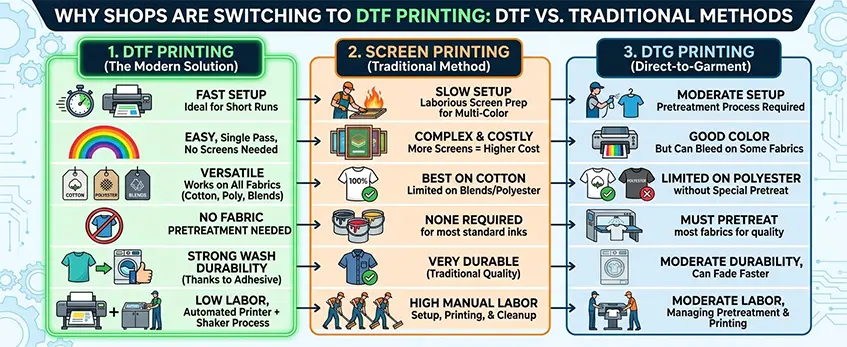
When it comes to apparel printing, many shops are ditching traditional methods like screen printing and DTG for DTF printing. Here’s a quick look at why DTF is gaining traction:
| Feature | DTF Printing | Screen Printing | DTG Printing |
|---|---|---|---|
| Setup Speed | Fast setup, ideal for short runs | Slow setup, especially for multi-color jobs | Moderate setup but requires pretreatment |
| Multi-Color Prints | Easy, no extra screens needed | Complex and costly with more colors | Good, but can bleed on some fabrics |
| Fabric Compatibility | Works on cotton, polyester, blends, and more | Works best on cotton | Limited on polyester without special pretreat |
| Pretreatment | No pretreatment needed on fabric | None required | Must pretreat most fabrics for high quality |
| Print Durability | Strong wash durability, thanks to adhesive powder | Very durable | Moderate durability, can fade faster |
| Labor Intensity | Low labor due to automation with printer + shaker | High manual labor for setup & cleanup | Moderate labor, especially for pretreatment |
Real-World Scenarios for Choosing
- Short to medium runs with quick turnaround: DTF’s fast setup and no pretreatment make it the go-to.
- Multi-color or photographic designs: DTF handles complex colors easily without the overhead of screen setup.
- Polyester-heavy orders or blends: DTF excels here, unlike DTG which struggles without extra steps.
- Cost-conscious shops: DTF’s efficient powder use and less waste reduce overall expenses.
For professional shops aiming to expand efficiently, systems like the Jinlong DTF printer and shaker offer a streamlined, cost-effective path away from the limitations of traditional methods.
Workflow Optimization with a Professional DTF Printer and Shaker
Optimizing your workflow with a professional DTF printer and shaker system is key to achieving consistent, vibrant results while saving time and labor. Here’s a streamlined process:
- Printing: Start by printing your design directly onto the DTF film using a high-quality ink setup. Precision and ink compatibility matter to avoid color issues.
- Powder Shaking: Next, apply the DTF hot melt powder evenly using an automated shaker system. This ensures uniform adhesive coverage, essential for a durable transfer.
- Curing: Move the coated film through a curing unit or oven to melt the powder properly, ensuring strong adhesion to the fabric.
- Cutting: Once cured, trim the designs carefully for easy application.
- Heat Pressing: Finally, use a heat press to transfer the design onto your garment, adjusting temperature and time based on fabric type.
For consistent results, pay close attention to powder choice—select one compatible with your ink and fabric. Temperature control during curing and pressing is critical; you can find detailed guidance on setting the right heat press temperatures in the DTF temperature guide for different fabrics and transfer films. Regular maintenance of both printer and shaker keeps your setup running smoothly and ensures top print quality.
The integration of the Jinlong DTF printer and shaker system brings key benefits like automated powder application and synced curing processes. This harmony not only reduces manual labor but also cuts down on wasted materials, making your professional DTF workflow highly efficient and scalable for short-to-medium runs.
Business Impact: ROI and Growth Opportunities
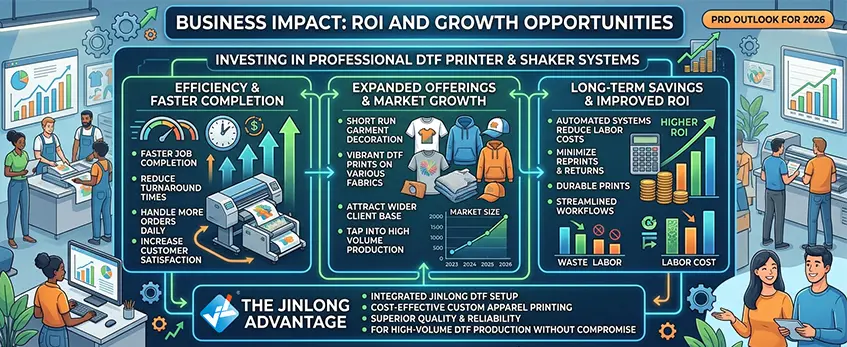
Investing in a professional DTF printer and shaker system delivers clear business advantages that impact your bottom line. Faster job completion means you can handle more orders daily, reducing turnaround times and increasing customer satisfaction. This efficiency opens doors to expanded offerings, including short run garment decoration and vibrant DTF prints on various fabrics, which attract a wider client base.
While the initial investment in a quality DTF setup may seem significant, the long-term savings are substantial. Automated systems reduce labor costs and waste, while durable prints minimize reprints and returns. Many shops report improved output and quicker job cycles after integrating a harmonized printer and shaker solution, resulting in better ROI.
For example, print shops utilizing integrated Jinlong DTF printer + shaker setups have experienced noticeable market growth by offering cost-effective custom apparel printing with superior quality and reliability. By streamlining workflows and increasing production capacity, they tap into high volume DTF production without compromising quality.
To dive deeper into maximizing your apparel printing business, exploring the balance between initial costs and ongoing savings can set your shop up for sustainable growth in 2026 and beyond.
Choosing the Right DTF Setup for Your Shop
When selecting a DTF printer and shaker system, key factors like print width, speed, and automation level play a big role in meeting your shop’s daily needs. Larger print widths let you handle wide-format jobs, while faster speeds boost throughput for busy periods. Automation in powder shaking and curing cuts labor time and improves consistency, which is a major plus.
Consumable compatibility is another must-check. Using the right adhesive powders and films ensures vibrant, durable prints and smooth workflow. Jinlong offers a harmonized printer and shaker ecosystem designed to work seamlessly together, reducing downtime and simplifying maintenance. This integration means less guesswork and better reliability for your US-based print shop.
Looking ahead to 2026 and beyond, choosing modern, scalable DTF solutions prepares your business for growth. Investing in a system that supports roll-to-roll printing and high-volume output safeguards your shop’s future in the expanding custom apparel market. For details on powder choices that match your films and inks, check out Jinlong’s comprehensive TPU powder compatibility guide.


 English
  Español
  Deutsch
  Français