


DTF Ink vs Traditional Printing Inks Which Delivers Best Quality and Durability
If you’re running a custom apparel business, you’ve probably faced the frustration of cracked prints on fabric blends or the high minimums that come with traditional screen printing. That’s where DTF ink steps in—a pigment-based powerhouse designed for direct-to-film transfers that might just change your game. But how does it stack up against traditional printing inks like screen, DTG, or sublimation inks? In this guide, we’ll break down the key differences so you can decide which option fits your production volume, fabric choices, budget, and quality needs. Whether you’re curious about durability, cost, or fabric compatibility, stick around to explore why jinlong DTF inks are becoming the go-to for vibrant, lasting prints on virtually any material.
What Is DTF Ink and How Does It Work?
DTF ink, or Direct to Film ink, is a water-based pigment ink designed for printing on a special PET film. The process starts by printing your design onto this film using pigment inks. After printing, an adhesive powder is applied while the ink is still wet. The powder sticks to the ink and is then melted to form a strong bonding layer.
A key feature of DTF printing is the use of a white base layer beneath the colors. This white layer enhances opacity and vibrancy, allowing bright, vivid prints even on dark fabrics. Unlike traditional printing inks that soak directly into the fabric (like in DTG or screen printing), DTF ink sits on a transfer film first, then is heat-pressed onto the garment.
| Feature | DTF Ink | Traditional Ink Integration |
|---|---|---|
| Printing Substrate | PET film with pigment inks and adhesive powder | Direct onto fabric (DTG, screen printing) |
| White Base | Yes, for opacity and vibrancy on dark materials | Often limited or requires extra steps |
| Ink Type | Water-based pigment with adhesive for transfer | Plastisol, water-based, discharge, sublimation, or solvent-based |
| Transfer Method | Heat press transfers the design from film to garment | Direct application on garment surface |
DTF ink’s unique film-based approach offers versatility, allowing vibrant prints on various fabric types and colors with consistent opacity, which traditional printing inks may struggle to achieve without additional processes.
Understanding Traditional Printing Inks
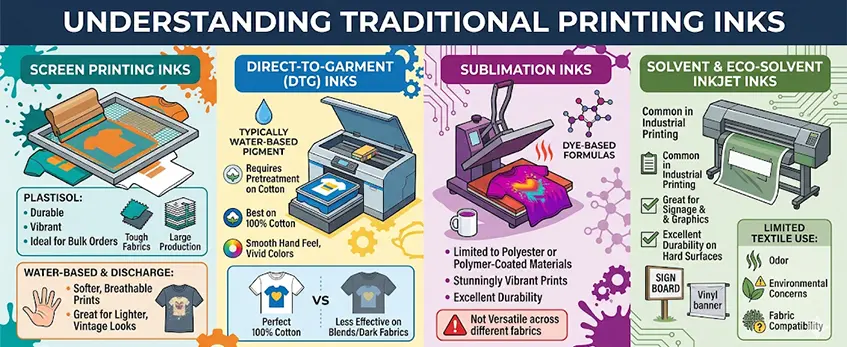
Traditional printing inks cover a broad range, each suited to different printing methods and fabric types. Screen printing inks are among the most common for high-volume runs. Plastisol inks are durable and vibrant, ideal for bulk orders, while water-based and discharge inks offer softer, more breathable prints—great for lighter, vintage looks.
Direct-to-garment (DTG) inks are typically water-based pigment inks that require pretreatment on cotton fabrics to achieve softness and vivid colors. These inks work best on 100% cotton, providing a smooth hand feel but can be less effective on blends or darker fabrics without special processing.
Sublimation inks use dye-based formulas but are limited to polyester or polymer-coated materials. They offer stunningly vibrant prints with excellent durability but aren’t versatile across different fabrics.
Solvent and eco-solvent inkjet inks are common in industrial printing for signage and graphics. While they provide excellent durability on hard surfaces, their use on textiles is limited due to odor, environmental concerns, and fabric compatibility.
Each traditional ink type brings specific advantages and constraints, making it important to choose based on fabric type, design complexity, and production volume.
Head-to-Head Comparison: DTF Ink vs. Traditional Printing Inks
When deciding between DTF ink and traditional printing inks, several key factors come into play, from fabric compatibility to cost and environmental impact. Here\’s a straightforward breakdown to help you weigh your options:
| Factor | DTF Ink | Traditional Printing Inks |
|---|---|---|
| Fabric Compatibility | Works on cotton, polyester, blends, dark & light garments | Screen printing favors cotton; sublimation limited to polyester; DTG best on cotton |
| Print Quality & Vibrancy | High opacity with vibrant colors especially on dark fabrics due to white base layer | Depends on process; screen printing vivid but limited on dark shirts without extra steps |
| Durability & Wash Resistance | Excellent wash resistance thanks to strong adhesive powder binding | Screen printing and sublimation are durable; DTG less so on frequent washes |
| Hand Feel & Comfort | Slightly thicker feel due to transfer layer; varies with powder quantity | DTG and water-based inks are softer; screen printing can be thicker or plasticky |
| Production Speed & Scalability | Fast digital setup, good for small to medium runs; easy on-demand printing | Screen printing ideal for large volumes; DTG slower per print; sublimation fast on polyester |
| Cost Analysis | Lower upfront cost; per-print cost moderate | Screen printing has high setup cost but low per-print cost; DTG and sublimation moderate expenses |
| Ease of Use & Workflow | Requires practice for consistent transfers; straightforward digital workflow | Screen printing needs screens and setup; DTG needs pretreatment; sublimation demands polyester |
| Environmental & Safety | Uses pigment ink and adhesive powder; less water usage; film waste to consider | Water-based inks eco-friendlier; plastisol cartridges involve chemicals; sublimation mostly safe |
DTF shines when versatility is needed across fabric types and colors, especially for vibrant, opaque prints on dark fabrics. For high-volume, simple designs on cotton, traditional screen printing often wins in price and speed.
For those learning the process or working with small batches, DTF printing — including using quality DTF transfer films — offers a flexible, reliable solution.
Balancing all these factors helps you pick the best printing method tailored to your business scale, fabric choices, and quality expectations.
Advantages of DTF Ink Over Traditional Inks
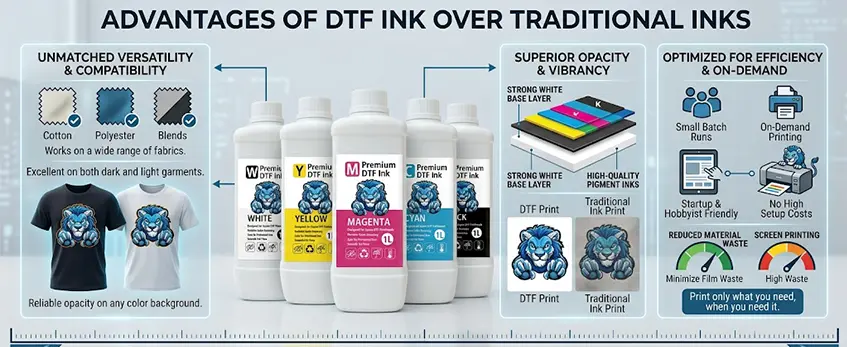
DTF ink stands out for its versatility, working well on a wide range of fabrics and colors—from cotton blends to polyester and even dark garments. Unlike some traditional printing methods that struggle with opacity on dark fabrics, DTF delivers vibrant, opaque results thanks to its strong white base layer and high-quality pigment inks.
This printing method is ideal for small batch runs and on-demand printing, making it accessible for startups and hobbyists who want to avoid the high setup costs and waste associated with screen printing or sublimation. Using DTF reduces material waste because you print only what you need, when you need it.
Another big plus is the reliable consistency you get with premium products like jinlong DTF inks. These inks provide stable pigment quality and great adhesion, ensuring every print looks sharp and holds up wash after wash. To get the full benefit, consider pairing jinlong inks with their compatible transfer films for best results. For those new to DTF or looking to optimize their workflow, resources on DTF RIP software for beginners can be a helpful start.
Potential Drawbacks of DTF Ink and When Traditional Inks May Be Preferable
While DTF ink offers great versatility, it does come with some downsides worth considering. One common issue is the thicker hand feel compared to premium DTG prints, which might not be ideal if you’re after ultra-soft, breathable designs. DTF printing also depends heavily on quality PET film and adhesive powder; using lower-grade materials can affect transfer durability and print consistency. This adds a bit of a learning curve, especially for maintaining consistent transfers and avoiding defects.
Another concern is the waste generated by PET films—though recycling options are improving, disposal can be an issue for eco-conscious businesses. Because of these factors, traditional inks still shine in specific scenarios: ultra-soft cotton garments printed with DTG water-based inks, very large volume jobs leveraging screen printing’s efficiency, and polyester dye infusion via sublimation which offers unmatched softness and vibrancy on polyester fabrics.
For more on how adhesive powders affect DTF quality and durability, check out this detailed guide on TPU powder properties, adhesion, elasticity, and durability. If you want to understand the interplay between film, ink, and powder materials for consistent prints, the compatibility guide for TPU powder, film, and inks is a great resource.
Which Is Better for Your Specific Needs? Decision Framework
Choosing between DTF ink and traditional printing inks depends on your project’s details. Here’s a simple decision framework to help you figure out what fits best:
- High-volume simple designs: Screen printing is often the go-to. It’s cost-effective and fast for bulk runs with fewer colors.
- Soft, breathable prints on cotton: DTG (Direct to Garment) printing shines here, especially when you want that premium, soft hand feel on 100% cotton.
- Mixed fabrics and dark garments: DTF ink stands out thanks to its versatility and vibrant, opaque prints on a wide range of colors and fabric types.
- Startups and hobbyists: DTF offers a lower entry cost with less setup hassle, making it ideal for small batch runs or customized items.
To make your choice easier, use a checklist or flowchart evaluating:
- Print volume and speed requirements
- Fabric type and color
- Design complexity and color vibrancy needs
- Durability and wash resistance expectations
This approach helps you match your needs to the best print method and ink type. For example, if you’re working with dark fabrics and want vibrant visuals with less overhead, DTF ink could be your best bet. If soft cotton garments in large quantities are your focus, traditional DTG or screen printing might be the way to go.
With this framework, you can confidently pick the printing ink that suits your apparel business or creative projects.
Tips for Choosing and Using High-Quality DTF Ink
When selecting DTF ink, prioritize pigment stability and clog resistance to ensure smooth printing and vibrant results. High-quality inks like jinlong DTF inks offer consistent performance with less downtime, making them ideal for busy shops. Make sure the ink is compatible with popular DTF printers to avoid nozzle issues or color mismatches.
Proper storage and mixing are essential. Store inks in a cool, dark place to maintain pigment quality, and gently stir before use to keep the pigment evenly distributed. This practice helps prevent clogging and maintains print consistency.
Pair your ink with quality transfer film and adhesive powder; this combo is key for vibrant, durable prints that last through multiple washes. Precise heat press settings—typically around 320–340°F with 15–20 seconds of pressing—will maximize adhesion without damaging fabrics.
For more detailed guidance on getting the most out of your DTF prints, check out this article on how a DTF ink printer delivers high-quality prints on any fabric type. Following these tips will help you consistently produce sharp, durable, and colorful results with minimal hassle.
Real-World Applications and Case Studies
DTF ink is making waves across different segments of the apparel and promotional industries thanks to its versatility and ease of use. Custom streetwear brands love using DTF on fabric blends because it delivers vibrant, durable prints even on tricky mixed materials. This flexibility lets designers experiment with colors and textures without worrying about fabric limitations.
Promotional product companies also benefit from DTF’s ability to handle varied orders efficiently. Whether it’s small batches or multiple garment colors, DTF transfers streamline production while keeping costs manageable. This is a game-changer compared to traditional printing methods that often require large runs to be cost-effective.
For home-based sellers or startups, DTF ink lowers the entry barrier with minimal setup and no need for extensive pretreatment or complex equipment. The quick turnaround and low minimums make scaling up much easier while maintaining high print quality. This solves many traditional printing pain points like high startup costs and material waste.
By combining vibrant pigment inks with the adhesive powder process on PET film—topics covered in detail on pages about DTF film rolls compatibility with ink, powder, and printers and hot peel DTF transfers for T-shirts—DTF printing continues to evolve as a reliable option that blends ease, quality, and versatility for a wide range of printing needs.


 English
  Español
  Deutsch
  Français