
Es befinden sich keine Produkte im Warenkorb.


Jinlong
Is DTF Printing on Clothes Worth It for Your Business in 2026
What Is DTF Printing and How Does It Work on Clothes?
DTF printing, or Direct to Film printing, is a modern, versatile method of transferring vibrant, full-color designs onto garments and other fabric items. The process starts with printing your artwork onto a specialized, clear film using water-based pigment inks. Next, a hot adhesive powder is evenly applied to the printed film. This powder sticks to the wet ink and then goes through a curing phase, where it’s melted and bonded to the design in preparation for transfer.
The final step is heat-pressing the film onto the target fabric. By applying heat and pressure, the design transfers seamlessly, creating sharp, vivid images with a soft hand feel that’s durable through multiple washes.
One of DTF printing’s biggest advantages is its compatibility with a wide variety of materials — including cotton, polyester, blends, and even dark-colored fabrics that often pose challenges for other methods. This versatility extends beyond t-shirts to items like hoodies, bags, and other custom apparel, making it an excellent choice for many businesses.
For business owners looking for reliable, high-quality equipment, jinlong DTF stands out as a trusted provider. Their solutions are designed to deliver consistent results, helping print shops and apparel businesses maintain vibrant prints with sharp details and long-lasting durability. Using jinlong DTF systems, many businesses gain a competitive edge by producing professionally finished items that meet diverse customer demands.
In short, DTF printing on clothes combines innovative technology with practical flexibility, making it a compelling option for any custom clothing business aiming for quality and variety.
DTF Printing vs. Other Methods: A Head-to-Head Comparison
When deciding on the best custom clothing printing method, it helps to see how DTF printing on clothes stacks up against popular alternatives like DTG, screen printing, sublimation, and HTV/vinyl. Here’s a quick, clear comparison by key factors small businesses care about:
| Faktor | DTF-Druck | DTG | Siebdruck | Sublimation | HTV/Vinyl |
|---|---|---|---|---|---|
| Einrichtungszeit | Moderate — print, powder, cure, heat press | Low per print, but needs pretreatment | High — screen prep needed | Mäßig bis hoch | Low to moderate (cut/press) |
| Min. Order Qty | Very low (one-offs easy) | Low, but less efficient on dark fabrics | High (bulk orders preferred) | Low, but only on polyester | Very low |
| Vielseitigkeit der Stoffe | Cotton, polyester, blends, dark & light | Best on cotton/light fabrics | Funktioniert auf den meisten Stoffen | Only polyester or polymer | Funktioniert auf den meisten Stoffen |
| Farbschwingung | Vibrant & full-color | Vibrant, less on dark fabric | Vibrant but limited by screens | Very bright on suitable fabric | Solid colors, limited blends |
| Dauerhaftigkeit | Very durable, wash resistant | Durable, but fades faster | Äußerst langlebig | Durable but only on polyester | Durable but can crack |
| Cost Per Unit | Moderate, better with volume | Higher on small runs | Lowest on bulk orders | Moderate, depends on fabric | Moderate to high on complex designs |
| Ideale Anwendungsfälle | Small-to-medium custom runs, dark & mixed fabrics | Low-volume, quick cotton prints | Large bulk orders, simple designs | Polyester-only, photo prints | Simple designs, personalization |
Why DTF Often Bridges Gaps for Small Businesses
- Vielseitigkeit: Unlike sublimation (polyester-only) or DTG (struggles on dark fabrics), DTF works well on most materials including cotton, polyester, blends, even bags and hoodies.
- Setup & Cost: DTF’s moderate setup time and low minimum order size suit small custom shops who want premium, colorful prints without bulk.
- Quality & Durability: The prints are vibrant and hold up well after washing, often better than DTG.
If you\’re running a small or growing apparel business, DTF ready-to-press transfers give you flexibility and quality without locking you into costly minimums or labor-intensive processes.
For a deep dive on printer choices and setups that support these advantages, check out this detailed Checkliste für den Kauf von Desktop-DTF-Druckern.
The Pros and Cons of DTF Printing for Apparel Businesses
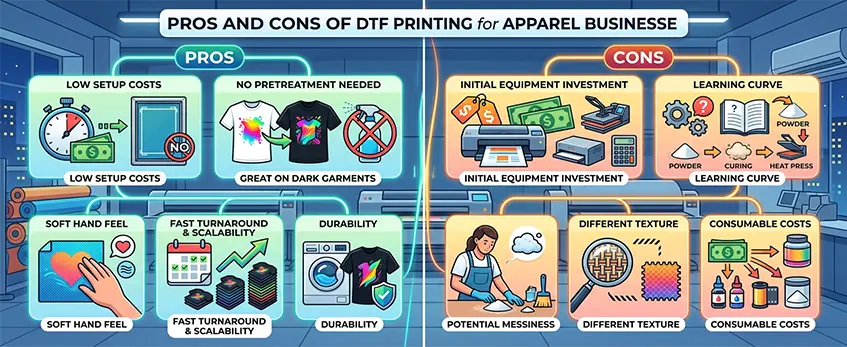
DTF printing on clothes offers a solid balance of benefits and challenges that are important to know if you’re considering it for your apparel business.
Pros of DTF Printing
- Low setup costs per job: Unlike screen printing, DTF doesn\’t require expensive screens or long setup times, which keeps costs down for small batches.
- Keine Vorbehandlung erforderlich: This simplifies the workflow since you can print on both light and dark garments without extra prep.
- Great on dark garments: DTF shines on black or colored fabrics where other methods like sublimation fall short.
- Weiches Handgefühl: The prints stay flexible and comfortable, making your apparel wearable without that stiff vinyl feel.
- Fast turnaround and scalability: Quick print-to-press steps help meet tight deadlines and easily scale production as orders grow.
- Langlebigkeit: These prints hold up well through washes, maintaining vibrant colors and sharp details longer than some alternatives.
Cons of DTF Printing
- Initial equipment investment: You need to buy a DTF printer, heat press, and curing tools upfront, which can be pricey.
- Lernkurve: Some training is required to handle powder application, curing, and heat press settings properly.
- Potential messiness: Powder use means extra care during application and cleanup to avoid waste or uneven prints.
- Different texture: Although softer than vinyl, the print texture differs slightly from traditional screen prints and might not suit every customer.
- Consumable costs: Ink, special films, and adhesive powders add ongoing expenses that affect your margin if not managed well.
Why the Pros Outweigh the Cons
For many apparel businesses focused on flexibility, variety, and low-volume runs, the advantages of DTF printing far outweigh the downsides. The ability to print vibrant, durable designs on a wide range of fabrics including blends and dark colors without costly setups is a major win. Plus, trusted solutions like jinlong DTF\’s reliable printing systems help ease the learning curve and improve consistency, making DTF a smart investment for growing businesses.
If your business model values quick, versatile production without massive minimum orders, DTF printing is definitely worth considering.
Startup Costs and Equipment Needs for DTF Printing
Getting into DTF printing on clothes means understanding the real costs and gear you’ll need. Here’s a straightforward breakdown:
Entry-Level Setup
- Drucker: Small-format DTF printers start around $1,000 to $3,000.
- Wärmepresse: Basic models for applying transfers cost between $300 and $700.
- Shaker/curer: To keep your adhesive powder evenly coated, expect about $100 to $300.
- Software: Some printers come with basic RIP software included; otherwise, plan $200–$500.
- Initial supplies: Ink, film rolls, and adhesive powder usually run $200–$500 to start.
Mid-Range Setup
- Suitable for growing businesses needing better speed and quality.
- Drucker: $3,000 to $8,000 for wider prints and faster output.
- Wärmepresse: $700 to $1,500 with more precise temperature control.
- Shaker/curer: Automated or larger capacity, around $300–$600.
- Software: Advanced RIP tools with color management, $500+.
- Supplies and extras: Bulk purchasing lowers per-unit costs but upfront spend increases to $500–$1,000.
Professional Setup
- For high-volume or full-service print shops.
- Drucker: $10,000+ for large-format, high-res printers.
- Wärmepresse: Industrial-grade machines costing $2,000+.
- Shaker/curer: Integrated powder application systems can hit $1,000+.
- Software: Premium production suites, workflow automation.
- Verbrauchsmaterial: Large inventory for consistent operation.
Hidden and Ongoing Costs
- Verbrauchsmaterial: Ink, film, and adhesive powder are regular expenses. For example, jinlong DTF’s reliable TPU hot melt adhesive powder ensures great adhesion but must be replenished consistently (check product details here).
- Wartung: Keeping printers and presses clean, replacing worn parts.
- Versorgungsunternehmen: Electricity usage varies, heat presses especially use power during jobs.
- Training: Learning the ropes requires time and maybe courses.
Tips for Minimizing Risk
- Fangen Sie klein an: Begin with an entry-level kit to test demand and your workflow.
- Outsource transfers: Use third-party providers for transfers until you’re confident in-house.
- Choose reliable systems: Brands like jinlong DTF are known for dependable, high-quality results which help avoid costly downtime (learn about optimizing your printer here).
Knowing these costs upfront helps plan better, avoid surprises, and decide if DTF printing fits your apparel business budget and goals.
Cost Analysis and Profitability: Real Numbers for 2026
Das Verständnis der cost of DTF printing per shirt is key to running a profitable apparel business. When breaking down costs, consider the main components: ink, specialized film, adhesive powder, labor, and the blank garment itself. On average, ink and film combined run between $0.50 and $1.00 per transfer, powder adds another $0.10 to $0.20, and labor varies based on workflow efficiency. Blanks (like t-shirts or hoodies) typically cost $2 to $5 each, depending on quality.
To ensure healthy margins, pricing strategies should reflect not only material costs but also overhead and desired profit. For example, pricing a custom shirt at $15–$25 often hits the sweet spot for low-volume orders, while bulk runs allow for discounts due to economies of scale.
Here’s a quick overview of profitability scenarios for different business types:
- Low-volume custom orders: High per-unit cost but higher margins, great for print-on-demand shops.
- Bulk runs: Lower cost-per-garment, ideal for event merch or wholesale clients.
- E-commerce fulfillment: Mix of volume and customization calls for careful cost management and fast turnaround.
Profitability depends heavily on order volume—more orders mean better use of materials and labor efficiency. Design complexity also matters; simpler designs use less ink and film, cutting costs. Minimizing waste with well-planned prints and proper equipment maintenance further improves your bottom line.
For solid profit, focus on balancing quality and cost, and consider tools or software to track your DTF transfer profitability precisely. Businesses using dependable systems like jinlong DTF benefit from consistent, high-quality prints that reduce waste and returns, boosting overall margins.
For tips on reliable powders that improve print feel and durability, see our detailed guide on TPU powder for soft hand feel DTF prints.
ROI and Break-Even Analysis: When Does DTF Pay Off?
Understanding when your investment in DTF printing will pay off is crucial for any apparel business. The break-even timeline mostly depends on your production capacity and order volume. For many small to mid-size businesses, the payback period on DTF equipment ranges from 2 to 6 months, assuming consistent orders and efficient workflow.
Here’s why:
- Smaller runs and specialty fabrics often bring higher margins, pushing ROI faster compared to large bulk orders with slim profits.
- Businesses that focus on custom clothing printing methods can leverage DTF’s low setup costs and versatile fabric compatibility to turn profits quickly.
- Real-life case models show startups breaking even within months by targeting niche markets like event merch or personalized apparel.
For a quick DIY ROI calculation, consider these variables:
| Faktor | What to Track |
|---|---|
| Initial Costs | Equipment, startup supplies |
| Variable Costs | Ink, film, adhesive powder, labor |
| Revenue | Price per shirt × number sold |
| Produktionskapazität | Number of transfers per day/week |
| Time to Break Even | Initial cost ÷ (Revenue – Variable costs) |
To minimize risk, start with a modest setup and grow as orders increase. Tools like cost calculators tailored for DTF printing can simplify these formulas.
If you’re interested in reliable systems designed for smooth ROI, check out jinlong DTF printers and shaker solutions which are optimized to help businesses reach break-even faster.
By understanding your numbers clearly, you’ll know exactly when DTF printing on clothes starts making solid business sense.
Who Should Invest in DTF Printing? Ideal Business Models
DTF printing on clothes is a great fit for small custom shops, print-on-demand sellers, event merch creators, fashion startups, and hybrid operations that want to offer a variety of products without high upfront costs. If your business focuses on low volume apparel printing solutions or caters to customers who want vibrant, full-color designs on different fabrics, DTF can be a game changer.
However, DTF might be less ideal for pure high-volume screen-printing businesses or hobbyists without established sales channels. For those relying heavily on bulk orders where screen printing’s low per-unit cost dominates, sticking with traditional methods could make more financial sense.
When deciding if DTF printing is right for your business, ask yourself:
- What’s my typical order volume?
- Do I need versatility across fabric types and colors?
- Am I aiming for quick turnaround and design variety?
- What’s my target customer base—custom orders, small batches, or large runs?
- How important is print durability and washability to my clients?
Answering these will help you find if investing in DTF equipment like the jinlong DTF602S printer or starter kits fits your growth plans. For many small businesses and startups looking to enter or expand in the custom clothing printing market, DTF offers a flexible, profitable solution that handles both dark garments and blends with ease.
Common Challenges and How to Overcome Them
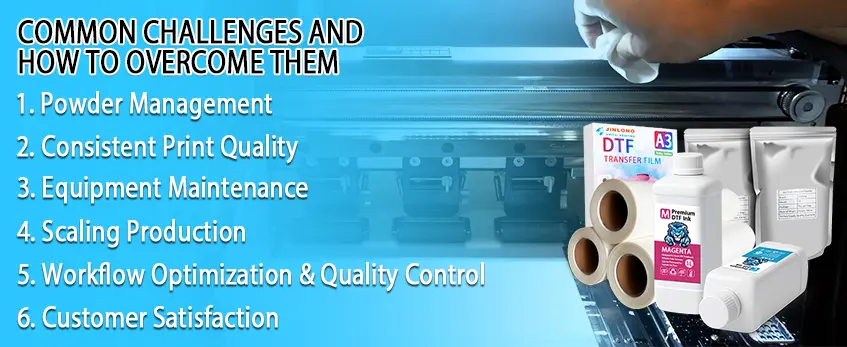
DTF printing on clothes comes with its share of challenges, but understanding them can make a big difference for your apparel business. Here are the main hurdles and practical ways to handle them:
Powder Management: Applying the right amount of adhesive powder is key. Too much can cause clumping, and too little affects durability. Using quality powder and a reliable shaker system helps keep things consistent. For best results, check out TPU powder properties on Jinlong’s site.
Konsistente Druckqualität: Achieving sharp details and vibrant colors requires routine calibration and maintenance of your DTF printer. Monitor ink levels and do regular test prints to avoid wasted materials or color shifts.
Equipment Maintenance: DTF printing gear needs regular cleaning and care to avoid clogging and breakdowns. Set up a maintenance schedule and keep spare parts handy to minimize downtime.
Scaling Production: When orders increase, maintaining quality and turnaround times can be tough. Streamline your workflow by organizing steps from printing to heat press and using production tracking tools.
Workflow Optimization & Quality Control: Efficient process design helps reduce mistakes and minimize wasted transfers. Establish quality checks at each stage—film printing, powder application, curing, and heat pressing—to keep customer satisfaction high.
Customer Satisfaction: Clear communication about turnaround times and product care leads to happy repeat buyers. Educate your customers on the durable nature of DTF prints and how to care for their garments.
A big boost for managing these pain points is choosing trusted partners like Jinlong DTF. Their reliable printers, premium inks, and powders make it easier to produce consistent, high-quality prints with fewer issues, helping your business run smoother and scale successfully. For example, their 1L CMYK pro series inks are designed for vibrant, durable results perfect for small businesses aiming for quality and efficiency (Jinlong DTF Ink Set).
Addressing these challenges head-on with the right tools and knowledge keeps your DTF apparel business competitive and profitable in today’s custom clothing market.
Maximizing Success with DTF: Tips for Profitable Operations
To make your DTF printing on clothes business really thrive, focusing on smart marketing and streamlined production is key. Here’s how to maximize your profits and build a sustainable operation:
Marketing and Sales Strategies
- Target niche markets where custom apparel is in demand, like event merch, local sports teams, and small fashion brands.
- Use social media ads to showcase vibrant, full-color prints that DTF excels at, especially on dark fabrics and blends.
- Offer quick turnaround and low minimum orders to attract small businesses and custom orders that bigger printers avoid.
Efficient Production Techniques and Software
- Invest in reliable DTF printers and compatible software for smooth workflows—check out some of the best free DTF RIP software options um Ihre Ausdrucke zu optimieren.
- Keep your workspace organized with a good system for powder application and curing to avoid waste and maintain quality.
- Batch similar orders when possible to save time on setup and heat pressing.
Building a Sustainable Business
- Diversify your offerings by printing on various fabrics and items like hoodies, bags, and hats—DTF’s versatility makes this easier than other methods.
- Establish strong partnerships with suppliers such as Jinlong DTF to ensure steady access to high-quality films, inks, and powders.
- Continually review your processes and tech upgrades to stay competitive, adapting to changing customer preferences.
Future Outlook: Custom Apparel Trends and DTF Positioning
- The custom apparel market is shifting towards smaller runs, personalized designs, and eco-friendly materials—DTF printing fits perfectly with these trends.
- As demand grows for soft-hand feel and durable prints on mixed fabrics, DTF will increasingly become the go-to method for startups and small businesses.
- Stay informed about new equipment and consumable innovations to keep your business on the cutting edge and profitable in 2026 and beyond.
By combining smart marketing with efficient production and a focus on quality and variety, your DTF apparel business can stand out and grow steadily in the competitive custom printing landscape.


 English
  Español
  Deutsch
  Français