
Es befinden sich keine Produkte im Warenkorb.


Jinlong
Hot Melt Glue Powder vs Liquid Adhesives Key Differences and Uses
Was ist Schmelzklebstoff-Pulver?
Schmelzklebstoffpulver ist ein thermoplastischer Klebstoff that requires heat to melt and activate its bonding properties. Once heated, this powder transforms into a molten state, allowing it to firmly bond materials when cooled. One of the most popular base materials for hot melt powders is TPU (thermoplastic polyurethane), prized for its flexibility and excellent Waschbeständigkeit—making it especially suitable for textile applications like DTF (direct-to-film) transfers.
Unlike liquid adhesives, hot melt glue powder comes in tiny particles, offering precise control during application. This powder form allows for uniform spreading and reduces waste since you can target exact areas without overflow. Key benefits of using hot melt glue powder include:
- Fast set time: Bonds in seconds once cooled, speeding up production lines
- Solvent-free formula: No harmful VOC emissions, safer for operators and the environment
- Long shelf life: Stable in powder form without special storage needs
- Starke Adhäsion: Durable bond on diverse substrates, particularly fabrics and plastics
In the U.S. market, these properties make hot melt glue powder a practical choice for industries requiring quick, clean, and reliable bonding with minimal downtime.
What Are Liquid Adhesives?
Liquid adhesives come in several types, mainly water-based, solvent-based, and emulsions. Each type uses a different bonding mechanism — usually evaporation of the liquid carrier, absorption into the substrate, or chemical cross-linking that forms a strong bond over time. Typical polymers in these adhesives include acrylics, polyvinyl acetate, and urethanes, allowing manufacturers to adjust the open time (the working time before the glue sets) to fit specific production needs.
In terms of application, liquid adhesives vary widely in viscosity. Some are thin and runny for easy spreading or spraying, while others are thicker for gap-filling or vertical surfaces. This flexibility makes them ideal for jobs where repositioning parts or longer curing times are needed. However, the curing process typically takes longer than hot melt glue powder, impacting production speed. For more tips on textile adhesives, you might find insights in how DTF transfer adhesives compare to liquid glue useful.
Core Composition and How They Work: Side-by-Side Comparison
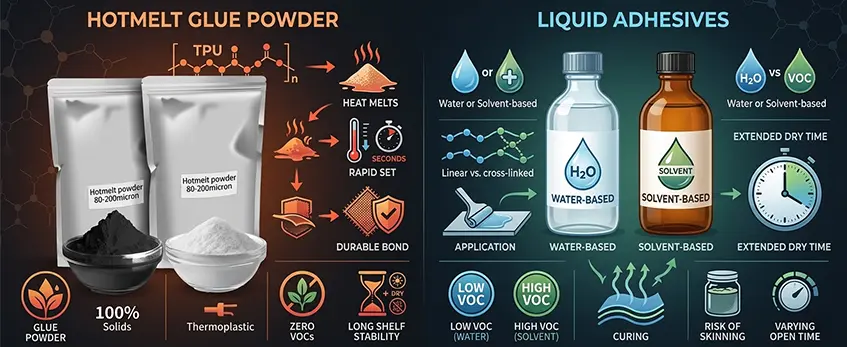
Beim Vergleich hot melt glue powder vs. liquid adhesives, the main difference lies in their chemical makeup and bonding methods.
Schmelzklebstoff-Pulver: This is a 100% solids, solvent-free, thermoplastic adhesive. It melts when heated, then solidifies quickly upon cooling, forming a strong, flexible bond without releasing volatile organic compounds (VOCs). Commonly made with materials like TPU, it offers fast set times and excellent durability.
Liquid Adhesives: These come as water-based, solvent-based, or emulsions. They bond through evaporation, absorption, or chemical cross-linking as the solvent or water dries. They vary greatly in open time and viscosity depending on formulation, and some release VOCs during curing.
| Merkmal | Schmelzklebstoff-Pulver | Liquid Adhesives |
|---|---|---|
| Composition | 100% solids, thermoplastic | Solvent or water-based polymers |
| Bonding Mechanism | Heat melting & cooling | Evaporation, absorption, or cross-linking |
| VOC Content | Zero to very low | Varies; water-based low, solvent-based high |
| Setting/Curing Time | Seconds on cooling | Minutes to hours drying or curing |
| Shelf Stability | Long (dry powder) | Moderate; risk of skinning or thickening |
Understanding these core differences helps choose the right adhesive type based on production needs and environmental factors. For example, for DTF-Überweisungen, hot melt TPU powders are popular because of their fast, flexible bonding and solvent-free nature. For detailed info on printing materials, you can check out the DTF-Tinte CMYK Pro Serie.
Key Differences Explained
Application Process and Equipment Needs
- Hot melt glue powder: Requires heat to melt and activate the adhesive. Application uses specialized powder shakers or automated spraying systems, making it ideal for high-speed, automated production lines. Precision is easier due to powder particle control.
- Liquid adhesives: Applied at room temperature via brushes, rollers, or sprays. Generally manual or semi-automated. Drying or curing time is needed, which adds complexity and ventilation requirements.
Bonding Speed and Production Efficiency
| Merkmal | Schmelzklebstoff-Pulver | Liquid Adhesives |
|---|---|---|
| Set Time | Seconds, very fast bonding | Longer open time for repositioning |
| Produktionsgeschwindigkeit | Excellent for fast manufacturing | Slower lines; curing needed |
Bond Strength, Durability, and Performance
- Heißschmelzpulver: Offers quick initial tack, flexible bonds with good wash and abrasion resistance, perfect for textiles and DTF applications.
- Liquid adhesives: Achieve higher ultimate bond strength but may vary in wet adhesion; often used where permanent, rigid bonds are needed.
Flexibility and Hand Feel (Textiles and DTF)
- Hot melt TPU powders: Create soft, stretchable bonds that maintain fabric feel without stiffening or cracking—ideal for apparel decoration and DTF (Direct to Film) printing. Check advantages of TPU hot melt powder for DTF to optimize results.
- Liquid adhesives: Bonds tend to be stiffer, can yellow over time, and may crack with material movement.
Environmental and Safety Factors
- Heißschmelzpulver: Typically solvent-free and 100% solids, leading to near-zero VOC emissions. No solvent disposal concerns and more energy-efficient due to localized heating.
- Liquid adhesives: Water-based options offer eco-benefits, but solvent-based types often emit VOCs and require ventilation and caution in handling.
Cost Considerations
- Heißschmelzpulver: Higher upfront equipment costs but lower waste due to powder reclamation and precise application, reducing material overuse and labor expenses.
- Liquid adhesives: Lower initial equipment cost but increased labor, drying time, and solvent disposal can add ongoing expenses.
For more insight into optimizing your process with hot melt powders, especially in DTF applications, this DTF printer A3 with powder shaker upgrade article is a useful resource.
Advantages and Disadvantages Table
Here’s a clear comparison of hot melt glue powder vs. liquid adhesives, highlighting key factors like speed, strength, ease of use, and more:
| Merkmal | Schmelzklebstoff-Pulver | Liquid Adhesives |
|---|---|---|
| Setting Speed | Sets in seconds; ideal for fast production lines | Longer curing time; allows repositioning |
| Bond Strength | Flexible, strong initial tack; great for wash resistance (especially TPU powders) | High ultimate strength; variable wet adhesion |
| Benutzerfreundlichkeit | Requires heat and precise temperature control; automation-friendly | Applies at room temp; often easier for small or manual jobs |
| Cleanup | Minimal waste, solvent-free, no drying mess | Possible solvent use; requires ventilation; skinning risk |
| Haltbarkeitsdauer | Long shelf life; stable powder form | Can skin or dry out if not stored properly |
| Kompatibilität der Substrate | Excellent for textiles, DTF transfers, flexible materials | Wide variety including wood, paper, and rigid substrates |
| Beschränkungen | Needs heating equipment; particle size affects quality | Slower production speed; VOC concerns |
This comparison gives a snapshot of how hot melt adhesive powder and liquid adhesives stack up, making it easier to decide based on your production needs and materials. For example, if you work with DTF transfers or need a fast-setting, solvent-free solution, hot melt powder shines. You can find tips to improve your DTF process with common heat press mistakes that affect adhesion.
Understanding these pros and cons helps you pick the right adhesive that fits your workflow, quality standards, and environmental goals.
Real-World Applications and Use Cases
Hot melt glue powder excels in industries where fast bonding, flexibility, and durability are critical. It\’s a top choice for DTF transfers, offering excellent wash resistance and soft hand feel — key for apparel decoration. You’ll also find it in shoe laminating, automotive interiors, and packaging, where its fast set time and solvent-free nature benefit production speed and product quality. For those interested, exploring specialized products like TPU hot melt adhesive powder for DTF can give a real boost to textile applications, as seen in options available from Jinlongprints TPU hot melt adhesive powder.
On the other hand, liquid adhesives are widely used in woodworking, paper crafting, labeling, and construction. These adhesives offer high rigidity and strong bonding, which suits projects where firm holds and long curing times are acceptable. Liquid adhesives often work well for detailed manual applications and surfaces requiring strong, structural bonds.
Scenario-Based Recommendations:
- Wählen Sie Schmelzklebstoffpulver if you need fast setting, flexible bonds with minimal waste and are working with textiles or packaging.
- Opt for liquid adhesives when dealing with heavy materials like wood or when a longer open time for repositioning is needed.
- For eco-conscious manufacturing, hot melt powders provide solvent-free bonding, while water-based liquid adhesives offer environmental benefits for less demanding uses.
This blend of options ensures you can match the right adhesive to your production needs, balancing speed, flexibility, and durability effectively.
How to Choose the Right Adhesive for Your Needs
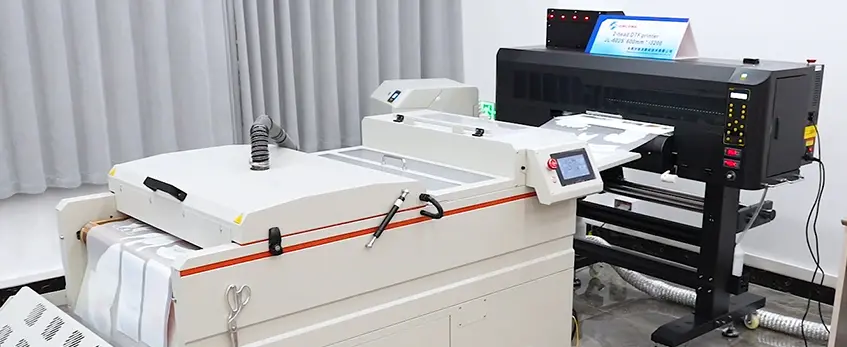
Picking the right adhesive—whether it’s hot melt glue powder or liquid adhesives—depends on your specific project needs. Here’s a quick checklist and flow to help decide:
| Decision Factor | Schmelzklebstoff-Pulver | Liquid Adhesives |
|---|---|---|
| Produktionsgeschwindigkeit | Fast set time, ideal for high-speed lines | Longer cure times, better for slower processes |
| Substrat-Typ | Great for textiles, apparel, DTF transfers | Works well on paper, wood, rigid plastics |
| Regulations & Safety | Solvent-free, low VOC, eco-friendly | Water-based options; watch for solvent VOCs |
| Haushalt | Higher upfront equipment cost, lower waste | Lower equipment cost, potential higher waste |
| End-Use Conditions | Flexible, durable bonds, washable | Strong bonds, some are rigid or brittle |
Quick Flowchart Guide:
Do you need fast bonding with flexibility (e.g., apparel or DTF printing)?
→ Choose hot melt glue powder, especially TPU powders for soft, stretchable results.
Are you working with porous materials like wood or paper?
→ Liquid adhesives usually offer stronger bonds there.
Is low VOC and eco-friendliness a priority?
→ Hot melt powders or water-based liquids are best picks.
What’s your production scale & speed?
→ For fast automated lines, hot melt powder saves time and labor. For manual or small batches, liquid adhesives can be simpler.
Do you want to reduce waste and improve consistency?
→ Hot melt powder systems with particle reclamation can be more cost-effective long term.
Choosing the right glue means balancing your substrate, speed, durability, and environmental needs. For clothing and DTF projects specifically, explore tips on achieving optimal adhesion with hot melt glue powder to get wrinkle-free, wash-resistant results like those explained in this guide on DTF transfer adhesion. This helps ensure you pick a product that meets both performance and budget goals.
Common Challenges and Best Practices
When working with hot melt glue powder, choosing the right Partikelgröße is crucial. Fine powders offer precise application but can clump if too small, while larger particles melt slower and may cause uneven bonding. Getting the heat and pressure settings right is equally important—too much heat can degrade the powder\’s properties, too little won’t create a strong bond. Consistent temperature control ensures fast setting and good adhesion, especially for TPU-Heißschmelzpulver used in textiles and DTF transfers.
For liquid adhesives, one common challenge is avoiding skinning—that dry layer that forms on the surface as solvents evaporate. Proper storage in airtight containers and stirring before use can help. Ventilation is key to managing fumes, especially with solvent-based formulas. Make sure your workspace has good airflow to keep operators safe.
In terms of storage and safety for both types, keep hot melt powders and liquid adhesives in cool, dry places away from direct sunlight. Follow manufacturer guidelines for shelf life to maintain performance. Wear protective gear like gloves and masks when handling adhesives to avoid skin irritation or inhalation of fumes.
These best practices help you get the most out of your adhesives while maintaining safety and product quality. For those working with DTF printing, using the right hot melt powder particle size and managing heat precisely pairs best with specialized printers, like the ones detailed in high-quality DTF digital printers für optimale Ergebnisse.
Future Trends in Adhesive Technology
The adhesive industry is moving fast toward more eco-friendly developments, especially as U.S. manufacturers and consumers push for greener, safer products. Hot melt glue powders are evolving with low-temperature formulations that cut energy use during heating—great news for businesses aiming to reduce their carbon footprint without sacrificing bond strength. These advances mean faster setting times and less heat stress on sensitive materials, like textiles and flexible plastics.
Another exciting trend is the rise of hybrid adhesive formulations that combine the best traits of hot melt and liquid adhesives. These blends offer improved flexibility, higher durability, and better wash resistance—which is essential for apparel decoration and DTF transfers. Manufacturers increasingly favor these innovative powders for their ability to deliver strong, flexible bonds with low VOC emissions, matching the demand for solvent-free adhesive powders.
Overall, staying ahead means adopting adhesives that bring cost savings, environmental benefits, and top performance in everything from shoe laminating to automotive interiors. To dive deeper, check out how DTF transfer adhesive vs liquid glue continues to shape the market for textile adhesives.
As these trends grow, expect the gap between hot melt powder particle size, energy efficiency, and curing tech to narrow—providing smarter, cleaner, and more adaptable bonding solutions across industries.


 English
  Español
  Deutsch
  Français