
Es befinden sich keine Produkte im Warenkorb.

Jinlong
Best DTF Heat Press Machines 2026 Key Features for Perfect Transfers
Understanding DTF Heat Press Requirements
If you’re diving into Direct to Film (DTF) printing, knowing the heat press’s role is key. The heat press is crucial for three main steps: film adhesion, powder curing, and transferring the print onto your garment. Without the right heat press, you risk poor transfer quality and wasted materials.
Why Heat Presses Matter in DTF
- Film Adhesion: The heat press activates the adhesive on the printed film, sticking it firmly before curing.
- Aushärtung mit Pulver: It melts the hot-melt adhesive powder evenly onto the film’s design.
- Final Transfer: The heat press applies the right temperature, pressure, and time to ensure the print bonds perfectly with the garment fibers.
Common DTF Transfer Issues Tied to Heat Press
| Problem | Ursache | Machine Feature Lacking |
|---|---|---|
| Peeling | Unzureichende Hitze oder Druck | Poor temperature or pressure control |
| Knacken | Uneven heat distribution | Inferior platen design |
| Verblasste Farben | Inaccurate temperature settings | Lack of digital temperature control |
These issues often stem from using standard heat presses not built for DTF. They may not maintain the precise temperature or apply consistent pressure needed for flawless transfers.
What Makes a Heat Press “DTF-Ready”?
Standard heat presses can struggle with DTF because they’re designed for simpler transfers (like vinyl or screen print). A DTF-ready heat press must:
- Angebot temperature accuracy within ±2-5°F for consistent results (typically 250-350°F).
- Ensure gleichmäßige Wärmeverteilung to avoid hot/cold spots.
- Bereitstellung von adjustable, uniform pressure to secure strong adhesion without damaging prints.
- Include digital controls for precise timing and temperature settings.
Without these features, you risk frequent failures like peeling, cracking, or faded prints — all costly in time and materials.
In short, a DTF heat press isn’t just any heat press. It’s a specialized tool designed to meet the unique demands of the DTF process. Choosing the right one sets the foundation for durable, vibrant, and professional-quality prints every time.
Core Features That Matter Most in a DTF Heat Press
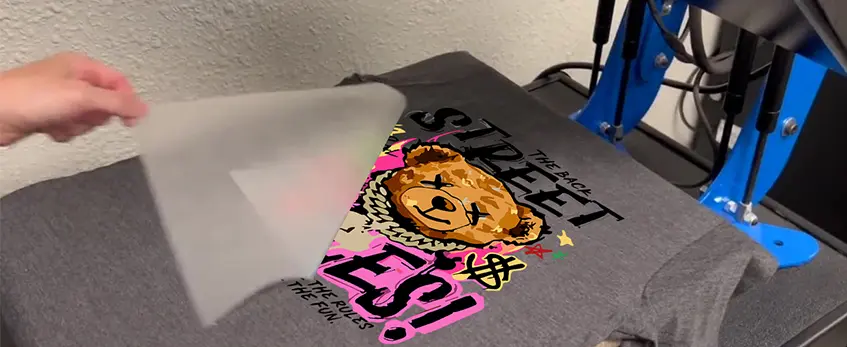
Choosing the best DTF heat press means knowing which features truly impact your prints. Here’s what matters most:
| Merkmal | Was zu beachten ist | Warum es wichtig ist |
|---|---|---|
| Temperature Accuracy | Digital controls, stable range 250-350°F, ±2-5°F variance | Prevents color fading and ensures proper powder curing |
| Even Heat Distribution | Consistent heat across platen, no hot or cold spots | Avoids peeling and cracking of transfers |
| Druckkontrolle | Adjustable pressure (manual, pneumatic, or digital PSI readout), 40-60 PSI recommended | Ensures uniform adhesion; prevents ghosting |
| Platen Size & Design | Common sizes 15×15\” & 16×20\”; swing-away, clam, or auto-open | Fits different garment sizes; safety and workflow optimization |
| Timer & Automation | Digital countdown, audio alerts, auto-release/hover features | Prevents over-pressing and frees hands during use |
| Build Quality & Durability | Heavy-duty steel or aluminum frame, reliable heating elements | Supports daily production without breakdowns |
| Safety & User-Friendliness | Overheat protection, clear displays, ergonomic design, fast heat-up/recovery | Keeps users safe and workflows smooth |
| DTF-Specific Extras | Fabric compatibility, easy maintenance, energy-saving modes, printer/film integration | Boosts efficiency and print quality over time |
Why These Features Matter in Real Use
Temperature accuracy and even heat are crucial because DTF printing depends on perfect film adhesion and powder curing at precise heat levels. A ±2-5°F variance avoids under or overheating, which can cause peeling or faded colors.
Pressure control directly influences the quality of your transfer. Around 40-60 PSI—a medium-firm pressure—is ideal for consistent bonding without ghost marks. Adjustable and even pressure prevents incomplete transfers.
Wenn es darum geht platen size, most pros go for 15×15” or 16×20” because they fit popular garment sizes without waste. Plus, the choice between swing-away, clam, or auto-open affects safety and ease. For example, swing-away presses keep heat off the operator’s hands, reducing burn risks.
Timers with automation like auto-release or hover functions save headaches by controlling the pressing time perfectly and freeing your hands for multitasking.
Dauerhaftigkeit matters when you’re pressing daily. Look for machines built with solid frames and high-quality heating elements—these go the distance.
Safety features like overheat protection and easy-to-read displays make operation smoother and protect your investment.
Lastly, perks like fabric compatibility and integration with DTF printers or films (like the ones available at Jinlong Prints) ensure your heat press works seamlessly in your entire DTF setup. Check out options like their basic series DTF inks to pair up with your press perfectly.
Understanding these critical features will help you select a reliable and efficient heat press that brings out the best in your DTF prints every time.
How to Choose the Best DTF Heat Press for Your Needs
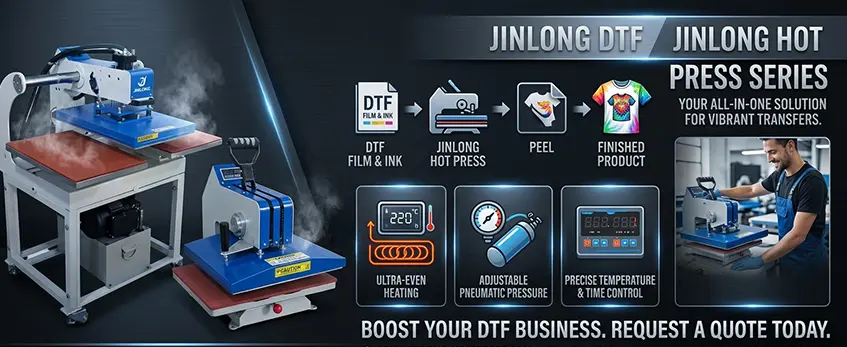
Picking the right DTF heat press depends a lot on your production volume, budget, and workspace. Here’s a quick guide to help you decide:
Produktionsvolumen
- Hobbyist: Occasional use, low volume. Smaller, entry-level machines with basic digital controls will do.
- Small Business: Moderate daily runs. Look for mid-range heat presses with better temperature accuracy and consistent pressure.
- Commercial: High-volume, daily use. Heavy-duty, premium machines designed for reliability, fast recovery time, and extra features.
Budget Tiers
| Ebene | Eigenschaften | Am besten für | Preisspanne |
|---|---|---|---|
| Einstiegslevel | Basic digital controls, manual pressure | Anfänger, Hobbyisten | $200 – $500 |
| Mid-Range | Precise temperature & pressure control, larger platen sizes | Kleine und mittlere Unternehmen | $500 – $1,200 |
| Prämie | Auto-open, pneumatic pressure, heavy-duty build, rapid heat recovery | Commercial, high-volume work | $1,200 and up |
Raum & Arbeitsablauf
- Shop Size: Compact swing-away or clam-style presses save room. Larger 16×20” platens fit bigger designs but need more space.
- Operator Experience: Auto-open features help beginners avoid over-pressing, while experienced users may prefer manual control for flexibility.
Key Questions Before Buying
- Warranty length and what\’s covered
- Customer support accessibility
- Availability and cost of replacement parts
- Compatibility with your DTF printers and films (read on about optimized usage in best heat press for DTF hoodies, t-shirts, and heavy fabrics)
Quick Comparison Framework
| Merkmal | Einstiegslevel | Mid-Range | Prämie |
|---|---|---|---|
| Temperature Accuracy | ±5°F | ±3°F | ±2°F or better |
| Druckkontrolle | Manual, fixed | Adjustable manual/digital | Pneumatic/digital readout |
| Walzengröße | 15×15\” | 15×15\”, 16×20\” | Multiple sizes + Custom options |
| Automation | Timer only | Timer + audio alert | Timer, auto-release, auto-open |
| Dauerhaftigkeit | Light-duty | Medium-duty | Heavy-duty steel/aluminum frame |
Choosing a press that matches your volume and budget means better prints, less hassle, and longer machine life. For deeper insights into selecting DTF supplies and ensuring smooth workflow, check resources like the right DTF rolls for high-volume printing.
Top DTF Heat Press Recommendations for 2026
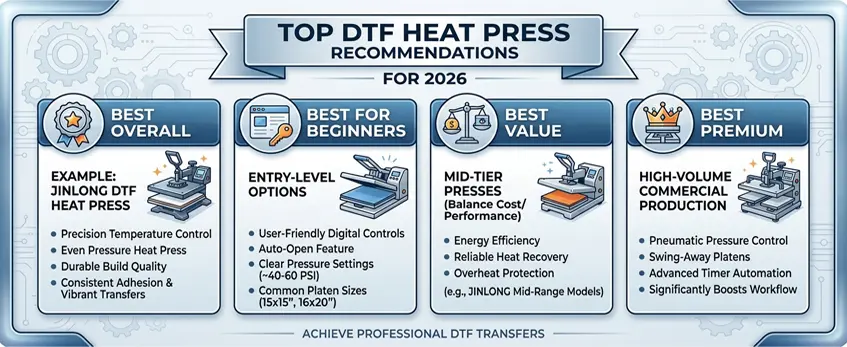
When choosing the best DTF heat press in 2026, it\’s key to look at models that show consistent performance and offer features tailored for DTF printing. Here’s a quick guide to top picks across different needs:
- Best Overall: Machines like the Jinlong DTF heat press shine for their precision temperature control, even pressure heat press capabilities, and durable build quality. These presses manage consistent adhesion and vibrant transfers, essential for professional results.
- Best for Beginners: Entry-level options with user-friendly digital controls and auto-open features help newcomers avoid common pitfalls. Look for models with clear pressure settings (~40-60 PSI) and good platen size, like 15×15” or 16×20”, to cover most t-shirt sizes comfortably.
- Best Value: Mid-tier presses that balance cost and performance are great for small businesses. Key perks include energy efficiency, reliable heat recovery times, and safety features like overheat protection. Jinlong\’s mid-range models also stand out here.
- Best Premium: For high-volume commercial production, premium presses with pneumatic pressure control, swing-away platens, and advanced timer automation can significantly boost workflow speed and output quality.
What sets the best DTF heat press machines apart daily is consistent heat distribution with minimal variance (±2-5°F), adjustable and even pressure, and durable construction that withstands frequent use. Integration with DTF printers and compatibility with various films are additional pluses to watch for. Jinlong DTF presses consistently rate highly for these areas, making them a solid choice whether you’re scaling up or just starting out.
For more detailed guidance on using Jinlong DTF equipment and optimizing your transfer process, check out this DTF printing best practices guide. It covers core tips that directly relate to making the most of your heat press setup.
DTF Heat Press Settings and Best Practices
Ihr DTF-Heizpressen-Temperatureinstellungen right is key to strong, lasting transfers. Typically, you’ll want to aim for 250-350°F depending on the fabric and film type. Time usually ranges from 10 bis 20 Sekunden, with a pressure setting around 40-60 PSI. Adjust these based on your specific material — heavier fabrics might need a bit more heat and pressure, while delicate ones require a gentler touch.
Step-by-Step Pressing Process
- Pre-press garments for 3-5 seconds to remove moisture and wrinkles.
- Place the DTF transfer film on the garment.
- Verwenden Sie eine protective sheet (like parchment paper or a silicone mat) to shield your platen.
- Press for the recommended time and temperature to cure the adhesive powder and transfer the design.
- Die Folie abziehen heiß oder kalt depending on your film’s instructions — hot peel for quicker turnaround, cold peel to avoid smudging on detailed designs.
Fehlersuche bei allgemeinen Problemen
- Abblättern oder Rissbildung: Usually from uneven heat or pressure. Check your press’s heat distribution and pressure settings.
- Verblasste Farben: Can happen if the temperature is too low or pressing time is short.
- Ghosting (blurry prints): Often caused by insufficient or uneven pressure.
Tipps zur Wartung
- Clean your platen regularly to avoid residue build-up.
- Check the heating element for consistent heat output.
- Calibrate your digital controls periodically to maintain temperature accuracy.
- Lubricate moving parts on swing-away or clam models to ensure smooth operation.
These practices and settings help keep your DTF heat press running reliably so your prints come out vibrant and durable. For more detailed guidance, consider resources like the DTF printing on clothes beginner’s guide which dives deeper into optimizing your full DTF workflow.


 English
  Español
  Deutsch
  Français