
No products in the cart.

Jinlong
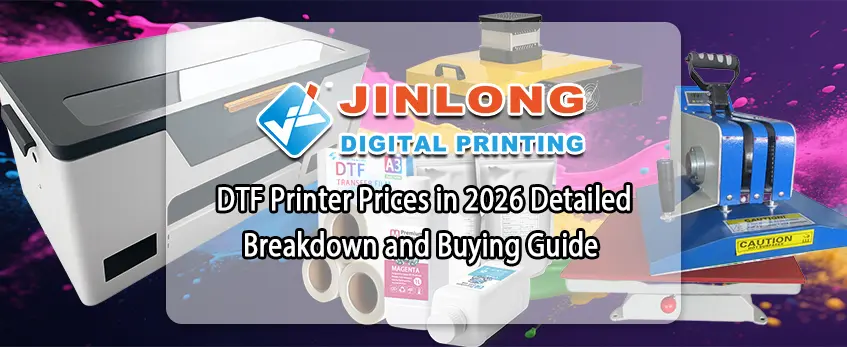
DTF Printer Prices in 2026 Detailed Breakdown and Buying Guide
If you’re serious about launching or scaling a DTF printing business in 2026, understanding how much DTF printers cost isn’t just about the sticker price. With rapid advances in printhead technology, automation, and industrial-grade stability, the value lies in speed, reliability, and ongoing expenses like consumables and maintenance. This isn’t a hobbyist purchase — it’s a strategic investment where every dollar affects your ROI and growth potential. In this guide, we break down the price ranges from desktop models to heavy-duty commercial machines, reveal what drives these costs, and show you how to future-proof your operation with the best choices on the market today. Let’s cut through the noise and get straight to the numbers that matter.
Tiered Price Breakdown: Entry-Level / Desktop Setup (The Hobbyist/Startup)
Price Range
Entry-level DTF printers in 2026 typically range from $1,500 to $4,000. These desktop setups are designed for hobbyists, startups, and small-scale custom apparel businesses looking to enter the textile printing market with a modest investment.
Typical Specs
- Print size: Usually up to A3 (11.7\” x 16.5\”) or slightly larger for desktop models
- Printhead: Basic XP600 or equivalent, single-head setup
- Ink system: Manual white ink circulation, limited automation
- Build quality: Lightweight chassis, compact footprint for small workspaces
- Software: Entry-level RIP software, sometimes free or bundled
Pros/Cons
Pros:
- Affordable entry point for startups
- Compact and easy to operate
- Lower initial investment with decent print quality
- Suitable for on-demand small runs
Cons:
- Slower print speeds compared to higher-tier models
- Limited automation (manual powder application and curing)
- Smaller print area restricts large-format design capability
- Printhead lifespan and maintenance can be less robust
Verdict
For new entrepreneurs and hobbyists, entry-level DTF printers offer a cost-effective way to break into the custom apparel printing business. While these units may require more manual work and have smaller print formats, they provide a solid foundation for learning the production workflow and establishing your brand with minimal upfront cost. If you’re focused on small batches and affordability, this setup is ideal—but scaling beyond requires a mid-range or industrial model.
Mid-Range / Prosumer (The Small Shop)
Price Range:
Mid-range DTF printers in 2026 typically cost between $7,000 and $15,000. This price bracket is where small shops and serious hobbyists step up from entry-level gear to more reliable, faster machines that can handle moderate production volumes without breaking the bank.
Typical Specs:
Dual or single Epson XP600 or i3200 printheads for better print quality and speed
Print width usually between 30 cm (A3) and 60 cm, convenient for popular apparel sizes
Automated or semi-automated powder shaker systems to improve efficiency
Decent chassis and vibration reduction for sharper prints
Compatible with a variety of RIP software options tailored to DTF printing
Key Upgrade:
The biggest upgrade here is the printhead and automation combo. Moving from entry-level heads to Epson i3200 printheads offers faster printing with higher resolution and longer lifespan. Also, automated powder shaker units reduce manual labor and improve coating consistency, which means less waste and better quality transfers. For a detailed comparison on powder shaker options, check out this DTF printer with powder shaker vs integrated DTF machines.
Target Audience:
This tier is perfect for small apparel shops, startups that have moved beyond hobby status, and businesses looking to scale up production without committing to industrial-level investment. These users demand reliability, better throughput, and improved print quality to stay competitive in evolving markets, especially within the US textile printing business where deadlines and quality consistently matter.
If you’re targeting moderate volume with consistent quality and a balanced operational cost, mid-range prosumer DTF printers are the sweet spot in 2026.
Tiered Price Breakdown: Industrial / Commercial Grade (The Volume Leader)

Price Range
Industrial-grade DTF printers in 2026 typically range from $10,000 to $25,000 or more, depending on features and capacity. These machines are built for heavy-duty production and long-term reliability.
Typical Specs
- Printheads: Often equipped with high-end Epson i3200 printheads or dual-head setups for faster output
- Print Size: Wide-format options, commonly up to 60 cm or larger
- Speed: High-speed printing with better ink circulation systems to handle continuous runs
- Build: Solid steel chassis designed to reduce vibration and ensure print sharpness
- Electronics: Advanced proprietary mainboards for stable long-run performance
- Software: Includes professional RIP software optimized for color accuracy and ink savings
Jinlong DTF Positioning
Jinlong’s industrial DTF printers stand out by delivering industrial durability at a competitive price, emphasizing cutting-edge white ink circulation technology and precision tension systems. This focus helps reduce downtime and enhances print consistency—key for volume-centric businesses.
Target Audience
This tier targets medium to large custom textile printing shops, apparel manufacturers, and commercial businesses looking to scale production without compromising on quality. If you’re planning a high-volume setting that demands stable, efficient machines that can handle bulk jobs day after day, this is your ideal category.
For those interested in the commercial garment printing space, checking out Jinlong’s industrial garment printer options explains how this technology fits into a growing market.
This breakdown gives a clear picture of what to expect when investing in an industrial DTF setup in 2026 and the value proposition behind Jinlong’s offerings.
Key Factors Influencing the Price Tag: The Heart of the Machine – Printheads
When considering how much DTF printers cost in 2026, the printhead is a major factor that directly impacts price and performance. Two of the most popular choices are the Epson XP600 and the Epson i3200 printheads, each catering to different needs and budgets.
XP600 Printheads
- Cost: More budget-friendly, making them ideal for entry-level and some mid-range DTF printers.
- Lifespan: Generally shorter, requiring replacement every 6 to 12 months depending on usage and maintenance.
- Performance: Great for startups or hobbyists; they have good color output but may lack the fine precision needed for high-volume or commercial-grade jobs.
i3200 Printheads
- Cost: Higher initial investment due to advanced technology and industrial-grade construction.
- Lifespan: Longer lifespan, often lasting 12 to 24 months with proper care, reducing downtime and replacement expenses over time.
- Performance: Delivers higher resolution and better consistency, perfect for prosumers and commercial printers looking to maximize output quality and reliability.
The difference in printhead technology not only affects the upfront price of a DTF printer but also long-term operating costs. A more expensive printhead like the i3200 might raise the initial investment but can save money by avoiding frequent replacements. Conversely, the more affordable XP600 suits small shops or startups just getting into the textile printing business, balancing cost and quality.
For those comparing industrial DTF printer costs, factoring in printhead choice is crucial for finding a balance between price and durability in your workspace. For more on printer components and setup advice, you can check out this comprehensive DTF beginners guide.
Key Factors Influencing the Price Tag: Build Quality & Chassis
The build quality and chassis of a DTF printer play a crucial role in its overall price. Heavier and sturdier frames help reduce vibration during printing, which directly improves the sharpness and precision of your transfers. A lightweight or flimsy chassis may cause slight movements, leading to blurry or inconsistent prints especially on detailed designs.
Industrial-grade DTF printers often feature robust steel frames and reinforced construction to maintain stability through long print runs. This added durability comes with a higher upfront cost but pays off by reducing downtime and maintenance. On the other hand, entry-level or desktop setups use lighter materials to keep costs down but may sacrifice some print quality and longevity.
If you’re investing in a commercial DTF printer for high-volume or professional textile printing, prioritizing solid build quality is key. For more on how build quality impacts overall printer performance, check out our detailed insights on selecting the best printer for your needs at the Jinlong Prints blog.
Key Factors Influencing the Price Tag: Mainboard & Electronics
The mainboard and electronics inside a DTF printer play a crucial role in determining its price and performance. Some machines use proprietary boards designed specifically for their models, while others rely on more generic, off-the-shelf electronics. Proprietary boards tend to cost more upfront due to custom engineering but often provide better integration and features tailored for direct-to-film printing.
One of the biggest benefits of higher-quality electronics is stability during long print runs. Commercial and industrial DTF printers, especially those used in busy shops, need reliable electronics that minimize crashes, glitches, or color inconsistencies. Less expensive models with generic boards can be more prone to errors during extended use, which can increase downtime and waste consumables like ink and PET films.
When budgeting for a DTF printer in 2026, it’s worth weighing the initial cost against the printer’s ability to handle your workflow smoothly. A stable mainboard boosts productivity and can save money in the long run by reducing maintenance and preventing print failures.
For a detailed breakdown of DTF printer components and setup essentials, check out this DTF transfer printer setup guide from printing to heat press.
Key Factors Influencing the Price Tag: Software (RIP)
When it comes to DTF printers, the software—specifically the RIP (Raster Image Processor)—plays a crucial role in what you’re actually paying for. Professional RIP software is often bundled with higher-end DTF printers or sold separately, and it’s a major reason why some setups cost more.
Professional vs. Free Tools:
Free RIP options can work for basic jobs, but they usually lack advanced color management and print optimization features. Professional RIP software helps control ink usage more precisely, resulting in less waste and better color accuracy. This means you get sharper prints with vibrant colors and can reduce your overall ink cost—both key for running a profitable business.
Impact on Ink Consumption and Color Accuracy:
An optimized RIP controls ink flow to prevent oversaturation, which saves on expensive DTF ink. Plus, it fine-tunes color profiles, ensuring prints match your design’s colors closely—critical for customer satisfaction. This software advantage is especially important if you’re using expensive Epson i3200 printheads or other high-precision technology in your printer.
In short, investing in quality RIP software protects your prints’ look and your bottom line. It may add to the upfront cost, but it pays off by improving efficiency and print quality. For a deeper dive on boosting print results, check out best practices for DTF heat press settings and equipment.
Beyond the Printer: The \”Hidden\” Costs of Ownership – Auxiliary Equipment
When budgeting for a DTF printer in 2026, remember that the printer itself is just part of the investment. Auxiliary equipment plays a big role in ensuring smooth, high-quality production and safety.
Automated Powder Shaker & Oven
These machines help evenly apply and cure DTF powder, boosting print consistency and reducing manual labor. An automated powder shaker saves time and mess, while a dedicated oven ensures solid bonding of the powder to your transfers.
Air Purification & Fume Extractors
DTF printing releases fumes and fine particles. Investing in good air purification or fume extractors is essential to maintain a safe, compliant workspace, especially in small shops or industrial settings.
Industrial Heat Press Types
Reliable heat presses designed for DTF transfers are crucial. Choosing the right size and type — from manual to fully automatic presses — affects transfer quality and throughput. Industrial presses offer better temperature stability and larger press areas, fitting various production scales.
These extra pieces add up but are necessary for efficient, quality DTF production. Planning for these costs upfront can save headaches down the road and help your textile printing business startup cost make more sense. For tips on maintaining your entire setup, check out our detailed DTF machines maintenance guide.
Beyond the Printer: The \”Hidden\” Costs of Ownership..Consumables (The Recurring Cost)
When budgeting for a DTF printer, it\’s easy to focus on the upfront cost, but the real ongoing expense lies in consumables. These include DTF ink, PET film, and TPU powder—each playing a crucial role in print quality and cost per print.
DTF Ink Pricing and Yield:
High-quality DTF ink typically ranges from $80 to $120 per liter, with yield depending on the printer and design complexity. On average, 1 liter can cover about 40-50 A3 prints. Choosing premium ink can improve color accuracy and durability but may impact your ink consumption rate. For reliable options, check out the professional DTF ink series designed for consistent printing results.
PET Film Types and Cost:
PET film is the clear transfer medium your designs print on, and prices vary with film thickness and quality. Standard PET films cost around $0.15 to $0.30 per sheet (A3 size), while specialty or pre-coated films that improve adhesion and wash resistance will cost more. Always factor in film type to keep long-term costs manageable.
TPU Powder Types and Price Differences:
TPU powder is the adhesive that melts onto fabric during heat pressing. Powder prices range from $10 to $25 per kilogram depending on quality and particle size. Premium powders ensure better wash fastness and flexibility but come at a higher price. Consider your production volume and customer needs to choose the right balance of cost and performance.
Understanding these recurring consumable costs ensures you calculate a realistic cost per print, keeping your DTF printing business profitable in 2026 and beyond.
Beyond the Printer: The \”Hidden\” Costs of Ownership..Maintenance & Parts
Owning a DTF printer means more than just the upfront cost; ongoing maintenance and parts replacement play a big role in your budget. Printheads, in particular, are a key item on the maintenance list. Depending on usage, a printhead might need replacing every 12 to 24 months, especially if you’re running high-volume jobs. For example, Epson i3200 printhead price and availability can impact your running costs significantly.
Other regular maintenance parts include dampers, capping stations, and wiper blades. These components keep your printer running smoothly and prevent issues like ink clogging or smudging. Over time, these parts wear out and need replacement to maintain print quality and avoid costly downtime.
Staying proactive with maintenance not only extends the life of your DTF printer but also ensures consistent results, which is crucial for any serious textile printing business startup cost planning. Factoring these “hidden” costs into your budget can make a big difference in your overall profitability and return on investment.
ROI Analysis: When Does the Machine Pay for Itself?..Cost Per Print Calculation

Calculating the cost per print is essential to understanding when your DTF printer will pay for itself. For an average A3-sized design, the main consumables you’ll factor in are ink, PET film, and TPU powder.
Ink cost: Depending on the printer model and ink quality, expect to use roughly 5-8 ml of DTF ink per A3 print. With most high-quality DTF inks priced competitively (such as those in the Jinlong DTF ink range), this usually totals around $0.50 to $0.75 per print.
PET film: PET transfer film is a recurring expense and varies based on size and quality. The commonly used 40cm or 60cm films generally cost between $0.20 and $0.40 per sheet. For a better understanding, check out the detailed specs on DTF transfer films.
TPU powder: Powder prices vary depending on quality and processing speed, but typically add about $0.15 to $0.30 per print. Investing in an automated powder shaker system can optimize powder usage and consistency, ultimately impacting costs.
In total, the average cost per A3 print ranges between $0.85 and $1.45, depending on your consumables and machine efficiency. Keeping these costs low while maintaining quality is key to improving your direct-to-film printing ROI and overall profitability.
ROI Analysis: When Does the Machine Pay for Itself?..Profit Margins
When looking at profit margins for your DTF printing business, the key is understanding the gap between your selling price and your production cost. For most small to mid-size shops in the U.S., direct to film printing ROI depends heavily on keeping material costs low while maintaining quality.
Typically, an A3-sized DTF print might cost you between $3 to $6 in consumables—ink, PET film, and TPU powder. If you sell a custom printed shirt for around $20 to $25, your gross margin per unit can easily fall between 60% and 80%. The wider this margin, the faster your initial investment in a commercial DTF printer pays off.
Remember, higher-end printers often reduce ink and powder waste thanks to better RIP software and print precision, which further improves profitability. But even entry-level setups can produce respectable margins if you optimize your workflow and supply costs.
For detailed insights on how consumables impact your bottom line, check out this DTF ink and consumables pricing guide, which can help you forecast your production costs more accurately.
In :
- Selling price per print: Typically $20-$25 for custom shirts
- Production cost: Usually $3-$6 per A3 design (materials only)
- Gross profit margin: Around 60%-80% depending on efficiency
- Key to maximizing margin: Use effective RIP software and high-quality consumables
Understanding this balance is critical before committing to any printer, whether you\’re starting a textile printing business or upgrading your existing setup.
ROI Analysis: When Does the Machine Pay for Itself? Break-Even Point
Understanding the break-even point is crucial when investing in a DTF printer. For example, a Jinlong DTF setup priced around $12,000 will start paying for itself once the revenue from sold shirts covers the initial costs, including the printer, ink, film, powder, and other consumables.
To break it down:
- Cost per shirt (A3 print) typically ranges from $3 to $5, depending on ink and material choices.
- If you sell custom printed shirts at $15 each, your profit margin could be around $10 per shirt.
- To cover a $12,000 investment, you’d need to sell roughly 1,200 shirts.
This calculation excludes overheads like labor and utilities but highlights the practical path to profitability for a small shop or startup.
Remember, improving print efficiency, using quality consumables like the ones available from Jinlong DTF ink CMYK Basic Series, and maintaining your printer will shorten this break-even period.
By understanding your costs and sales price clearly, you can gauge when your direct-to-film printing business becomes a reliable income source.
Buying Guide: Manufacturer vs. Reseller
When choosing a DTF printer supplier in 2026, deciding between a manufacturer and a reseller can impact your buying experience and support.
| Factor | Manufacturer | Reseller |
|---|---|---|
| Pricing | Often better pricing, fewer middlemen | May have higher prices due to markup |
| Product Range | Full access to latest models and parts | Limited to stocked models |
| Technical Support | Direct help, faster issue resolution | Support depends on reseller expertise |
| Warranty & Service | Manufacturer-backed warranties | Warranty handled by reseller |
| Training & Updates | More frequent updates and training | Varies, sometimes delayed |
| Distributor Benefits | Bulk deals, customized packages | May offer promotions or local perks |
Buying directly from a manufacturer like Jinlong DTF ensures authentic parts, reliable warranty coverage, and access to exclusive resources. Manufacturers usually provide better distributor support such as software updates, guidance on maintenance, and parts availability — essential for avoiding downtime in your textile printing business startup.
On the other hand, resellers can be useful for local hands-on support, but their knowledge and inventory might be limited versus a direct source.
For smooth long-term success, prioritize suppliers offering full backing, whether through direct manufacturer access or strong distributor partnerships.
This choice plays a key role in keeping your DTF printer running smoothly with less hassle. If you want reliable advice on consumables and lifecycle support, consider direct links to manufacturer product resources or their recommended tools for lowering costs, like this guide on how to reduce your DTF printing cost without sacrificing quality.
Buying Guide: How to Choose the Right Supplier in 2026..Warranty & Technical Support

Choosing a supplier with solid warranty and technical support is a must when investing in a DTF printer. Here’s what to look for:
| Support Aspect | What to Expect | Why It Matters |
|---|---|---|
| Warranty Coverage | At least 1-2 years on printheads & electronics | Protects against costly repairs |
| Technical Support | Responsive team via phone, chat, or video | Quick fixes keep your business running |
| Local Technicians | On-site help or fast service calls | Minimizes downtime |
| Parts Availability | Easily sourced original or compatible parts | Speeds up repairs and maintenance |
| Video Tutorials | Step-by-step guides and troubleshooting | Reduces learning curve |
A reliable support network saves you time and money over the life of your printer. Prioritize suppliers like Jinlong DTF who back their machines with comprehensive warranty plans and accessible, knowledgeable technical teams.
For more on setting up your business efficiently, check out the best heat press options for DTF printing that match your printer’s capability and budget.
Buying Guide: How to Choose the Right Supplier in 2026 – The \”Future-Proof\” Check
When picking a DTF printer supplier in 2026, future-proofing your buy is key. You want gear that keeps up as tech evolves without forcing costly upgrades.
What to Look For:
| Feature | Why It Matters |
|---|---|
| Compatibility with New Inks | Ensures your printer works with the latest DTF ink formulations, helping maintain vibrant colors and durability. |
| Ink Circulation Systems | Prevents white ink from settling or clogging, reducing downtime and maintenance costs. |
| Firmware & Software Updates | Frequent updates mean your machine stays efficient and compatible with emerging tools or materials. |
| Modular Components | Allows easy upgrades without replacing the whole printer. |
| Supplier’s Roadmap | Ask if they plan to support new inks, printheads, or consumables—this keeps your setup modern longer. |
Choosing a supplier that focuses on these future-ready features saves you headaches and money down the line. For a deeper dive, check out our full insights on how to choose the right top DTF printer for your custom apparel business, where we explore ink systems and supplier qualities in detail.
Keeping future-proof features in mind lets you invest confidently in your DTF printing business, ensuring smooth scale-up as your needs grow.
Why Choose Jinlong DTF?..Value Proposition
Jinlong DTF stands out by offering industrial durability without the typical high price tag. This means you get a sturdy, long-lasting machine built to handle volume printing—perfect for growing print shops or commercial operations—while keeping initial and ongoing costs competitive.
| Feature | Jinlong DTF Advantage |
|---|---|
| Build Quality | Heavy-duty chassis reduces vibration for sharper prints |
| Price Point | Competitive pricing vs. other industrial DTF printers |
| Printhead Compatibility | Supports premium printheads like Epson i3200 |
| Ink System | Efficient white ink circulation boosts reliability |
| Support & Warranty | Strong after-sales service with local U.S. technicians |
Jinlong machines balance cost and performance, helping businesses reduce downtime and lower total cost of ownership. For those looking to scale in 2026, this value proposition makes Jinlong a smart choice in the commercial DTF printer market without compromising on quality or output.
Explore related consumables like TPU powders and films to complement your investment and maximize print results.
Why Choose Jinlong DTF?..Technology
Jinlong DTF printers stand out thanks to advanced white ink circulation that keeps the ink flowing smoothly. This system prevents clogging and reduces wasted ink, which means fewer interruptions and better print consistency—critical for quality white layer prints on dark fabrics.
Another tech highlight is the precision tension system, designed to keep the PET film perfectly taut during printing. This ensures sharp, vibrant images without smudges or misalignments, even on longer print runs.
| Feature | Benefit |
|---|---|
| White ink circulation | Reduces clogging, saves ink |
| Precision tension system | Sharp prints, consistent film feed |
These technology upgrades translate into reliable output and less downtime, making Jinlong DTF ideal for small shops scaling up or volume-focused operations. For a look at compatible consumables, check out Jinlong’s DTF ink options designed to work perfectly with this technology.
Why Choose Jinlong DTF? Customer Success
Jinlong DTF stands out because of its strong support infrastructure, which is key to your printing success. From setup to daily operation, you’re never left on your own.
| Support Feature | Benefit |
|---|---|
| Local Technicians | Quick on-site help when issues arise |
| Video Tutorials & Guides | Easy troubleshooting and learning |
| Spare Parts Availability | Fast replacement reduces downtime |
| Responsive Customer Service | Prompt answers via phone or email |
Customers appreciate how Jinlong focuses on helping users maximize uptime and maintain print quality over time. This support network ensures your investment keeps delivering great ROI, especially important for US-based small shops and startups stepping into the textile printing business.
Choosing Jinlong means you’re backed by reliable service tailored for the demands of the industrial garment printer maintenance world, helping you avoid costly delays.
For a smoother workflow, pairing your Jinlong printer with quality consumables like the DTF transfer film 45cm Double Basic Series and professional DTF ink CMYK 1L Pro Series further boosts print consistency and customer satisfaction.


 English
 Español
 Deutsch
 Français